
 Worksheets
Theory of Evolution
Total questions: 25
Worksheet time: 6hrs 1mins
Name
Class
Date
1.
Which gas was not present in early Earth atmosphere?
a)
Oxygen (O2)
b)
Methane (CH4)
c)
Carbon Dioxide (CO2)
d)
Water Vapor (H2O)
2.
Nature has a way of causing organisms that inherit advantageous traits to survive and reproduce more successfully than the ones that don't. This process is known as...
a)
natural selection
b)
genetic variation
c)
adaptation
d)
overproduction
3.

A beetle's ability to camouflage (blend in) with a nearby leaf allows it to escape a hungry frog's appetite.
This is an example of an:
This is an example of an:
a)
overproduction
b)
genetic variation
c)
selection
d)
adaptation
4.

In both the past and the present, humans have selected plants or animals for breeding based on desirable traits. This process is known as...
a)
artificial selection
b)
natural selection
c)
farming
d)
cropping
5.
the process in which populations change over time
a)
artificial selection
b)
natural selection
c)
evolution
d)
mutation
6.
Evolution is the fundamental concept underlying all of biology and is supported by multiple forms of scientific evidence. Which of the following types of evidence supports evolution?
a)
fossil records
b)
molecular biology
c)
comparative embryology
d)
all of these
7.
The human appendix is a __________ structure that suggests that humans evolved from plant-eating ancestors.
a)
homologous
b)
embryonic
c)
essential
d)
vestigial
8.
Through his observations made in the Galapagos Islands, __________ formulated a theory of how species change over time, called natural selection.
a)
Pierre Curie
b)
Charles Darwin
c)
Richard Dawkins
d)
Jean-Baptiste Lamarck
9.
The first organisms evolved on Earth around 4 billion years ago. The fossil record indicates that the first organisms were which of the following?
a)
prokaryotes
b)
mitochondria
c)
plastids
d)
eukaryotes
10.

What did Charles Darwin observe in finch populations of the Galapagos Islands off the coast of South America?
a)
different species on different islands
b)
all species on one of the islands
c)
Identical species on all the islands
d)
the same species as found in South America mainland
11.

Genetic variation can arise from a random change in the DNA of a gene. The change is called a(n)
a)
mutation
b)
gene flow
c)
gene pool
d)
allele
12.

Two organisms that are closely related would have
a)
very similar DNA sequence
b)
exactly the same DNA sequences
c)
no proteins in common
d)
completely different DNA sequence
13.

Which type of evidence is illustrated in this picture
a)
fossil evidence
b)
molecular
c)
anatomical
d)
embryological
14.

Which best defines homologous structures
a)
structures with same function different ancestors
b)
reduced form of a structure indicating shared ancestry
c)
adapting to surrounding
d)
similar structures inherited from a common ancestor
15.
What book did Darwin write?
a)
Principles of Geology
b)
Essays on the Principles of Populations
c)
On the Origin of Species
d)
Evolution on the Galapagos Islands
16.

According to the law of superposition, the oldest fossils are found
a)
At the top of the rock layers
b)
Near the bottom of the rock layers
c)
In the middle of the rock layers
d)
Somewhat near the surface
17.
This scientist stated that by using or not using a certain body part, organisms could change in their lifetime and that the trait gained would be passed down to their offspring.
a)
James Hutton
b)
Charles Lyell
c)
Jean-Baptiste Lamarck
d)
Thomas Malthus
18.
Charles Darwin called the ability of an organism to survive and reproduce in its specific environment
a)
diversity.
b)
evolution
c)
adaptation.
d)
fitness.
19.
Which of the following is NOT an example of a fossil?
a)
a petrified dinosaur bone
b)
a footprint captured in mud
c)
a seashell found on the beach
d)
an insect stuck in amber
20.
The endosymbiotic theory proposed that eukaryotic cells arose from
a)
Individual prokaryotic cells
b)
Muticellular prokaryotes
c)
Communities formed by prokaryotes
d)
Communities formed by eukaryotes
21.

Miller and Urey experiment attempted to demonstrate
a)
how Earth first formed
b)
Whether DNA or RNA evolved first
c)
Whether organic molecules could have formed before life was present
d)
How the deepest part of Earth formed
22.
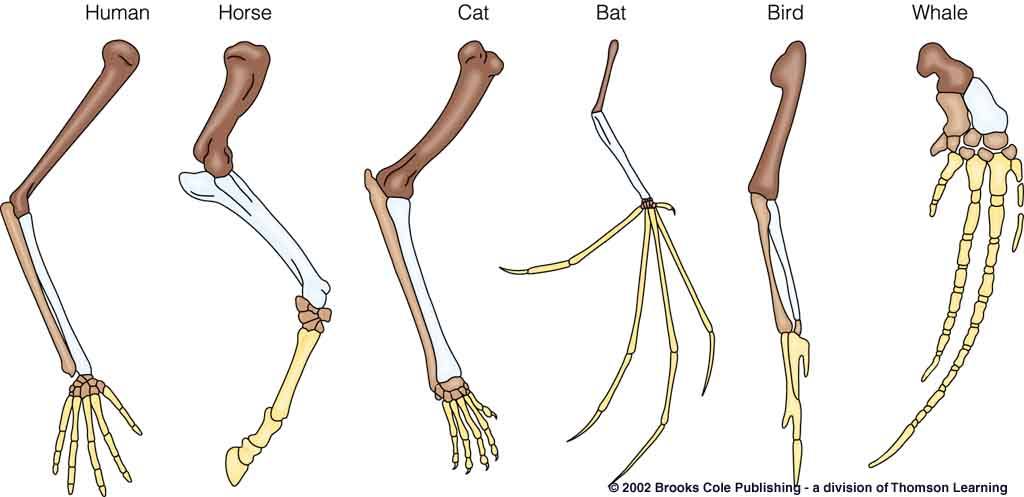
The structures shown are_________
a)
homologous
b)
heterologous
c)
analogous
d)
vestigial
23.
Scientists use radioactive decay to measure...
a)
relative time
b)
absolute time
c)
half-lives
d)
time of day
24.
What is survival of the fittest?
a)
It is where the fittest die out and therefore reproduce and pass on their genes
b)
It is where the fittest die out and therefore can't reproduce and pass on their genes
c)
It is where the fittest don't die out and therefore can't reproduce and pass on their genes
d)
It is where the fittest don't die out and therefore reproduce and pass on their genes
25.
being the "fittest" in evolutionary terms always means the biggest, strongest, fastest
a)
True
b)
False
100 %

