wayground logo

Free Printable Worksheets

NEW

Font size

S
M
L
XL
Worksheets

Weather Review

Total questions: 50

Worksheet time: 33mins

Name
Class
Date
1.
Why do clouds usually form at the leading edge of a cold air mass?
a)
Cold air contains more dust than warm air does
b)
Cold air flows over warm air, causing the warm air to descend & cool
c)
Cold air contains more water vapor than warm air does
d)
Cold air flows under warm air, causing the warm air to rise & cool
2.
The atmospheric pressure at the center of the low would most likely be
a)
994 mb
b)
988 mb
c)
990 mb
d)
997 mb
3.

Which statement best describe the relationship between relative humidity & air temperature?

(WATER CONTENT STAYS THE SAME)

a)
RH decreases as air temperature decreases
b)
RH remains the same as air temperature decreases
c)
RH increases as air temperature increases
d)
RH decreases as air temperature increases
4.
According to the ESRT, when the dry-bulb temperature reading is 10oC & the wet-bulb temperature is 2oC, the dewpoint temperature of the air is approximately
a)

10oC

b)
2oC
c)
-8oC
d)
-14oC
5.
When molecules of water evaporate into the air & replace the heavier molecules of oxygen and nitrogen, the density of the air generally
a)
Increases
b)
Decreases
c)
Remains the sam
6.
The rate of evaporation of water can be increased by
a)
Decreasing the circulation of the air
b)
Increasing the temperature of the air
c)
Decreasing the temperature of the water
d)
Increasing the amount of moisture in the air
7.
A temperature of 104oF is equal to a temperature of
a)
136oC
b)
40oC
c)
104oC
d)
72oC
8.
If low-pressure system follow the path of most weather systems in the United States, in which direction will they move?
a)
Southwest
b)
Northwest
c)
Northeast
d)
Southwest
9.
An air mass from the Gulf of Mexico, moving north into NYS, has a high relative humidity.  What other characteristics will it probably have?
a)
cool temperatures & high pressure
b)
warm temperatures & low pressure
c)
warm temperatures & high pressure
d)
cool temperatures & low pressure
10.
Identify the type of front that is shown in the image.
a)
Occluded Front
b)
Cold Front
c)
Stationary Front
d)
Warm Front
11.
Identify the type of front that is shown in the image.
a)
Occluded Front
b)
Cold Front
c)
Stationary Front
d)
Warm Front
12.
Located at the leading edge of a temperature drop off. Bring heavy thunderstorms, rain, and hail. Cool, fair weather is likely to follow.  
a)
Warm Front
b)
Cold Front
c)
Occluded Front
d)
Stationary Front 
13.
Located at the leading edge of a warm air mass. Brings gentle rain or light snow, followed by warmer, milder weather.  
a)
Warm Front
b)
Cold Front 
c)
Occluded Front 
d)
Stationary Front 
14.
Which weather tool measures air pressure?
a)
thermometer
b)
barometer
c)
anemometer
d)
psychrometer
15.
This weather tool measures wind speed and direction
a)
thermometer
b)
barometer
c)
anemometer
d)
psychrometer
16.
Condensation of water vapor in the atmosphere is most likely to occur when a condensation surface is available &
a)
a strong wind is blowing
b)
the air pressure is rising
c)
the air is saturated with water vapor
d)
the temperature of the air is below 0oC
17.
As the difference between the dewpoint temperature & the air temperature decreases, the probability of precipitation
a)
Increases
b)
Remains the same
c)
Decreases
18.
Which of the following air masses would be characterized as warm and dry?
a)
Maritime tropical
b)
Continental tropical
c)
Maritime polar
d)
Continental polar
19.
Continental tropical air masses form from the South and bring what type of air to southern plains?
a)
dry and cold
b)
dry and warm
c)
humid and cold
d)
humid and warm
20.
A severe storm which involves a funnel cloud forming over land is:
a)
hurricane
b)
tornado
c)
thunderstorm
d)
blizzard
21.
A severe storm that involves winds over 119mph and forms over water is:
a)
tornado
b)
thunderstorm
c)
hurricane
d)
blizzard
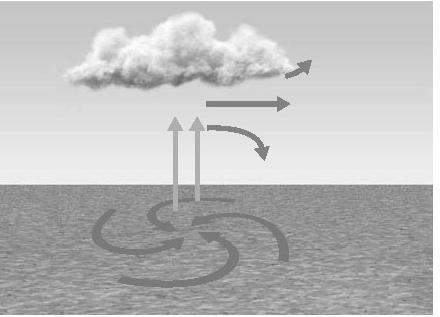
22.
Which type of pressure system is pictured?
a)
high
b)
low
c)
medium
d)
none
23.
What type of weather would you expect from the pressure system pictured?
a)
clear
b)
cloudy
c)
hot
d)
stormy
24.
When air contains as much moisture as possible at a specific temperature, it is:
a)
at its dew point
b)
saturated
c)
at its dew point AND saturated
d)
none of the rest
25.
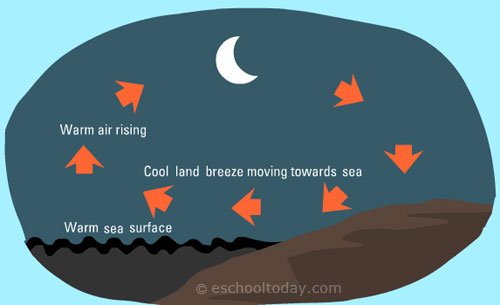
Is this a land or a sea breeze?
a)
land breeze
b)
sea breeze
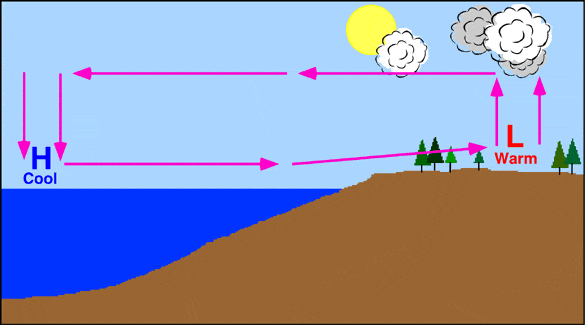
26.
Is this a land or a sea breeze?
a)
land breeze
b)
sea breeze
27.
The jet stream usually moves from 
a)
north to south
b)
west to east
c)
east to west
d)
south to north
28.
What is the Dew Point Temperature if the dry-bulb temperature on your sling psychrometer is 20ºC and the wet-bulb temperature is 15ºC?
a)
14ºC
b)
12ºC
c)
10ºC
d)
-18ºC
29.
If the air is only holding one-third as much moisture as it can possibly hold, what is the relative humidity?
a)
50%
b)
25%
c)
33%
d)
67%
30.
What will happen if the relative humidity is 100%, and the temperature begins falling?
a)
The air will be sticky and uncomfortable
b)
Dew will form
c)
The temperature will rise
d)
The atmospheric pressure will fall
31.
What is the Dew Point Temperature if the dry-bulb temperature on your sling psychrometer is 20ºC and the wet-bulb temperature is 15ºC?
a)
14ºC
b)
12ºC
c)
10ºC
d)
-18ºC
32.
 What is the dew point when the dry-bulb temperature is 24°C and the wet-bulb temperature is 21°C?
a)
 16°C
b)
18°C
c)
20°C
d)
 21°C
33.
The name of the global winds that move from west to east across the United States is called
a)
Trade Winds
b)
Prevailing Westerlies
c)
Polar Easterlies
d)
Doldrums
34.
Which atmospheric layer has the highest air pressure?
a)
Stratosphere 
b)
Troposphere
c)
Mesosphere
d)
Thermosphere
35.
UV radiation is absorbed in the stratosphere by which feature?
a)
Greenhouse
b)
Oxygen
c)
Ozone
d)
Cyanobacteria
36.
The movement of the air in a cyclone is...
a)
downwards and inwards
b)
downwards and outwards
c)
upwards and inwards
d)
upwards and outwards
37.
What causes ocean currents in the Northern Hemisphere to curve to the right?
a)
Earth's orbit around the Sun
b)
Earth's spinning on its axis
c)
Earth's magnetic field
d)
Earth's force of gravity
38.
The Gulf stream carries _____________ water from the east coast of The United States to the West coast of Europe.
a)
Cold
b)
Warm 
c)
Freezing
d)
Fresh
39.
In what direction is the warm front traveling?
a)
North West
b)
North East
c)
South West
d)
South East
40.

On the diagram conditions report a barometric tendency of ________ and visibility of ________

a)

1.7mb rising steady, 61 mi

b)

3.0mb falling steady, 3 mi

c)

19.8mb rising steady, 61 mi

d)

1.7mb falling steady, 198 mi

41.
As a result of the Coriolis effect in the northern hemisphere, winds are deflected:
a)
At a 45° angle from the original direction.
b)
At a 90° angle from the original direction.
c)
To the right of the original direction.
d)
To the left of the original direction.
42.

Westerlies blows from ______ to _____ latitude.

a)

0 Degree to 20 Degree (N/S)

b)

30 Degree to 40 Degree (N/S)

c)

40 Degree to 50 Degree (N/S)

d)

30 Degree to 60 Degree (N/S)

43.
Air pressure is greater _______.
a)
at the top of the mountain
b)
at the bottom of the mountain
c)
at the center of the mountain
44.

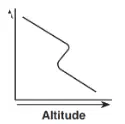
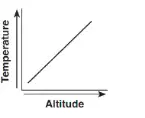
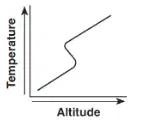
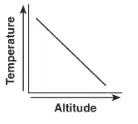
Which graph best shows the general relationship between altitude and temperature in the troposphere?
a)

b)

c)

d)

45.

Which type of air mass would most likely form over the Pacific Ocean north of the Aleutian Trench?

a)

cP

b)

cT

c)

mP

d)

mT

46.

At what time was the chance of precipitation the greatest?

a)

7am

b)

3 am

c)

5 am

d)

1 am

47.

A low pressure air mass brings what type of weather to this area?

a)

warm & dry

b)

warm & wet

c)

cold & dry

d)

cold & wet

48.

What direction would the storm continue traveling if it followed the normal storm path in the United States?

a)

SW

b)

SE

c)

NW

d)

NE

49.

Which set of terms constructs a correct explanation that describes the weather at the two weather fronts affecting Tornado Alley?

In the west, a _________(A)___ air mass is moving to interact with a ____(B)___ air mass. This produces ____(C)___. In the east, a ___(D) ___ air mass is moving to interact with a ___(E)___ air mass. This produces ____(F)_______.

a)

b)

c)

50.

How does the relationship between air temperature and density explain the movement of air at the Equator and poles?

a)

At higher temperatures, air is less dense and rises. Since the air at the Equator is warmer than the air at the poles, it will rise.

b)

At higher temperatures, air is more dense and sinks. Since the air at the Equator is warmer than the air at the poles, it will sink.

c)

At lower temperatures, air is less dense and sinks. Since the air at the poles is colder than the air at the Equator, it will sink.

d)

At lower temperatures, air is more dense and rises. Since the air at the poles is colder than the air at the Equator, it will rise.