
 Worksheets
Ecology
Total questions: 40
Worksheet time: 25mins
Name
Class
Date
1.
Humus is part of the soil within an ecosystem. Worms often act as decomposers within that ecosystem. Decomposition is part of the worm's ___ in the ecosystem.
a)
niche
b)
habitat
c)
biome
d)
ecosystem
2.

Kudzu takes over almost any area in which it germinates. Kudzu is considered to be a(n) __.
a)
invasive species
b)
predator
c)
native species
d)
prey
3.
Levels of ecological organization in order from largest to smallest would be _____.
a)
species, population, community, ecosystem, biome
b)
biome, ecosystem, community, population, species
c)
biome, ecosystem, population, community, species
d)
population, species, community, biome
4.

The picture below shows a ____.
a)
population
b)
community
c)
ecosystem
d)
biome
5.

Which statement about this energy pyramid is correct?
a)
Energy is not transferred from one level to the next level in the pyramid.
b)
All of the energy is only at the bottom of the pyramid.
c)
Energy is transferred, and the bottom level of the pyramid has the most energy.
d)
Most of the energy is at the top of the pyramid.
6.

What most likely caused the decrease in the lynx population around 1921?
a)
There had been an increase in the snowshoe hare population.
b)
There had been a decrease in the snowshoe hare population.
c)
The lynx only had an abundance of food that year.
d)
There is not enough information in the graph to determine an answer.
7.

Based on this graph, what might best explain the change in the deer population from 2000 to 2001?
a)
an increase in the emigration of deer
b)
an increase in the immigration of deer
c)
a decrease in the birth rate for deer
d)
an increase in the death rate of the deer
8.

In this energy pyramid 10,000 joules of the energy is produced by the producers. What would you predict would be the level of energy for the level 2 consumers?
a)
30,000 joules
b)
20,000 joules
c)
100 joules
d)
zero
9.

What type of symbiotic relationship exists between a bee and a flower?
a)
mutualism
b)
competition
c)
parasitism
d)
commensalism
10.

What type of symbiotic relationship exists between this sea turtle and the barnacles attached to his shell?
a)
competition
b)
commensalism
c)
parasitism
d)
mutualism
11.

In this picture two hartebeest are locking horns and fighting over their territory. What type of symbiotic relationship is this?
a)
mutualism
b)
parasitism
c)
commensalism
d)
competition
12.

This graph shows changes in two populations. What relationships do you observe between the two populations?
a)
When the prey population decreases it is followed by a decrease in the predator population.
b)
When the prey population increases, it is followed by a decrease in the predator population
c)
When the predator population increases it is followed by an increase in the prey population.
d)
When the predator population decreases it is followed by a decrease in the prey population.
13.

If their are 30 prairie dogs in a field that is 10 square meters, what is the population density?
a)
3 prairie dogs per square meter
b)
300 prairie dogs per square meter
c)
.03 prairie dogs per square meter
d)
30 prairie dogs per square meter
14.

Which of the following is not a documented invasive species in the United States?
a)
Zebra mussels which have impacted the aquatic marine ecosystems of the Great Lakes.
b)
Red fire ants of South America that have infiltrated the southeastern US.
c)
Kudzu which is a vine that when left uncontrolled will eventually grow over almost any fixed objects in its path.
d)
Arrowfeather threeawn grass which grows naturally throughout most states east of the Great Plains.
15.

The place where an organism lives and that provides the things the organism needs is called its ___.
a)
niche
b)
habitat
c)
community
d)
biome
16.
The largest population that an environment can support is called its ___.
a)
limiting factors
b)
immigration total
c)
carrying capacity
d)
birth rate
17.

An organism's specific role within an ecosystem is called its ___.
a)
ecosystem
b)
emigration
c)
niche
d)
carrying capacity
18.

When a jellyfish paralyzes a tiny fish with its poisonous tentacles, the jellyfish is the ___.
a)
predator
b)
prey
c)
host
d)
parasite
19.

The measurement of the approximate number of organisms that live in a given area is known as ____.
a)
population density
b)
limiting factor
c)
community
d)
none of these
20.

In 1976 what most likely happened to cause a change in this pheasant population?
a)
Quail migrated into this area and competed with these pheasants for food.
b)
More pheasants immigrated than usual.
c)
The pheasants were able to find more resources than usual.
d)
There was an unusual increase in the birth rate.
21.

Tropical rain forests have a very hot and humid climate with approximately 200 inches of rain per year. If we are referring to rain forests as a whole, what term would we use?
a)
community
b)
ecosystem
c)
population
d)
biome
22.

These penguins can reproduce with one another. This means they are part of the same ____.
a)
community
b)
ecosystem
c)
species
d)
biome
23.

What would be the correct flow of energy in a food chain or energy pyramid?
a)
producer > primary consumer>secondary consumer> tertiary consumer
b)
producer<primary consumer<secondary consumer<tertiary consumer
c)
tertiary consumer>secondary consumer>primary consumer>producer
d)
primary consumer>secondary consumer>tertiary consumer>producer
24.

Wild hogs were brought to the US by Europeans as early as the 1500s. The collective yearly cost of agricultural damage and control of these animals alone would conservatively be in the tens of millions of dollars. Wild hogs are considered to be ___.
a)
invasive species
b)
native species
c)
extinct
d)
endangered species
25.

Our planet is divided into large geographic areas based on differences in climate. These areas are called ____.
a)
biomes
b)
communities
c)
ecosystems
d)
habitats
26.

What is the independent variable for this graph?
a)
time
b)
number of predators
c)
number of prey
d)
there is no independent variable
27.

All food chains and food webs begin with ____.
a)
primary consumers
b)
producers
c)
secondary consumers
d)
decomposers
28.
Would a parasitic relationship most likely increase or decrease a population size?
a)
Increase
b)
Decrease
c)
Stay the same
d)
Never change
29.
Abiotic or Biotic?
Salt
Salt
a)
Abiotic
b)
Biotic
c)
Both
d)
Neither.
30.
Industries and power plants release heated waste water into lakes and rivers, killing fish. This is an example of a ________ factor influencing a biotic Factor.
a)
Biotic
b)
abiotic
c)
neither
d)
both
31.
In an ocean ecosystem, which biotic factors would effect a population of fish negatively?
a)
Too cold of temperatures
b)
Too many large predators
c)
Too much water
d)
Too many prey
32.
In a forest ecosystem, which would be an abiotic factor that could effect the population of trees?
a)
Too cold of temperatures
b)
Too many predators
c)
Too many organisms
d)
Too many living things
33.
Many factors place limits on the sizes of populations in an ecosystem. Which is an example of an abiotic factor that would limit a population size?
a)
Predators
b)
Prey
c)
Competition
d)
Sunlight
34.

In this diagram, removing which living factor will have the MOST impact on this food chain?
a)
sun
b)
grass
c)
grasshopper
d)
robin
35.
The prefix bio means
a)
life
b)
science
c)
story
d)
not
36.
A dolphin, whale, and sea horse would be an example of what ecological organization?
a)
Organism
b)
Population
c)
Community
d)
Ecosystem
37.
Which type of ecological organization has the most organisms?
a)
Organism
b)
Population
c)
Community
d)
Ecosystem
38.
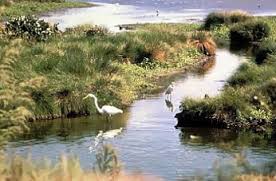
What are the abiotic factors in this image?
a)
water, sunlight, dirt, air
b)
birds and plants
c)
water, plants, and birds
39.
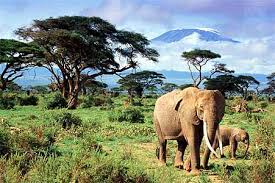
What are the biotic factors in this image?
a)
sunlight, elephants, and grasses
b)
sunlight, water, and air
c)
elephants, plants, trees
40.
An ecosystem is made up of all the ___________ and _____________ factors in an area.
a)
not/without
b)
Limiting Factor/ Carrying Capacity
c)
Living/ Nonliving
d)
life/ biotic factor
100 %

