
 Worksheets
AP DNA Structure and Replication
Total questions: 30
Worksheet time: 38mins
Name
Class
Date
1.
Enzyme that unwinds the DNA
a)
ligase
b)
DNA Polymerase
c)
primase
d)
helicase
2.
Seals the Okazaki fragments together
a)
DNA Polymerase
b)
ligase
c)
helicase
d)
primase
3.
Adds nucleotides to the newly synthesized strand of DNA
a)
DNA polymerase I
b)
DNA polymerase III
c)
Primase
d)
Ligase
4.
synthesizes a short fragment of RNA that allows DNA polymerase III to bind
a)
ligase
b)
DNA polymerase I
c)
primase
d)
helicase
5.
removes the RNA primer and adds DNA nucleotides to fill in the gap
a)
DNA polymerase III
b)
ligase
c)
primase
d)
DNA polymerase I
6.
repetitive sequences of DNA on the ends of chromosomes (TTAGGG)
a)
telomeres
b)
telomerase
c)
Okazaki fragments
d)
primer
7.
Experiment that radioactively labeled the proteins and DNA of bacteriophages to determine if DNA or protein was the transforming agent
a)
Avery
b)
Watson & Crick
c)
Messelson & Stahl
d)
Hershey & Chase
8.

The table shows the results of measuring the percentages of the four bases in the DNA of several different organisms. Some of the values are missing from the table. Based on Chargaff’s rule, the percentages of guanine bases in chicken DNA should be approximately what?
a)
28.8%
b)
19.9%
c)
21.5%
d)
13.4%
9.

Based on Chargaff’s rule, the percentage of cytosine in the DNA of the bacterium, S. lutea in the table, should be approximately what?
a)
26.6%.
b)
73.2%.
c)
36.6%.
d)
29.4%.
10.

Name this structure
a)
double helix
b)
nucelotide
c)
amino acid
d)
base pair
11.
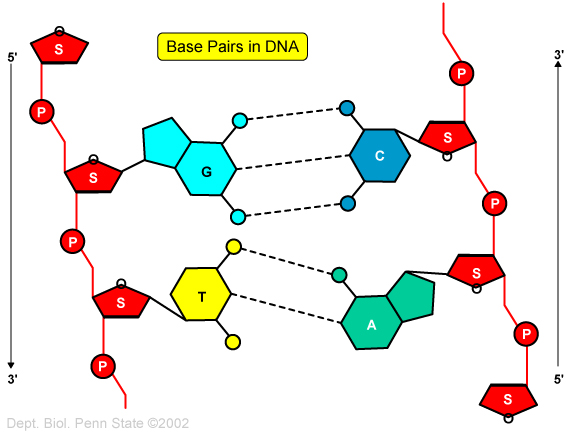
Nitrogenous bases are joined by which type of bond?
a)
polar bonds
b)
ionic bonds
c)
covalent bonds
d)
hydrogen bonds
12.
What are the three components of a nucleotide?
a)
carbonate, hydrogen, nitrogen base
b)
sugar, oxygen, nitrogen base
c)
sugar, phosphate, nitrogen base
d)
sugar, phosphate, amino acid
13.
If a DNA molecule is 18% Guanine which of the following is correct
a)
18% cytosine, 32% adenine, 32% thymine
b)
32% cytosine, 18% adenine, 32% thymine
c)
18% cytosine, 64% adenine, 64% thymine
d)
32% cytosine, 32% adenine, 18% thymine
14.
A biochemist isolates, purifies, and combines in a test tube a variety of molecules needed for DNA replication. When she adds some DNA to the mixture, replication occurs, but each DNA molecule consists of a normal strand paired with numerous segments of DNA a few hundred nucleotides long. What has she probably left out of the mixture?
a)
DNA ligase
b)
nucleotides
c)
DNA polymerase III
d)
Okazaki fragments
15.
What is meant by the description "antiparallel" regarding the strands that make up DNA?
a)
The twisting nature of DNA creates nonparallel strands.
b)
One strand is positively charged and the other is negatively charged.
c)
The 5' to 3' direction of one strand runs counter to the 5' to 3' direction of the other strand.
d)
Base pairings create unequal spacing between the two DNA strands
16.
What is the role of DNA ligase in the elongation of the lagging strand during DNA replication?
a)
It catalyzes the lengthening of telomeres.
b)
It synthesizes RNA nucleotides to make a primer.
c)
It unwinds the parental double helix.
d)
It joins Okazaki fragments together.
17.
What is meant that DNA replication follows a “semi-conservative” model?
a)
After DNA replication, each strand contains one side that is a parental strand and the other side is a daughter strand.
b)
After DNA replication, one completed strand contains only parental DNA while the other contains only daughter DNA.
c)
None of these identify the “semi-conservative” model.
d)
After DNA replication, one completed strand contains a mixture of both parental DNA and daughter DNA dispersed throughout the strand.
18.
Which scientist(s) mixed a heat-killed pathogenic strain of bacteria with a living nonpathogenic strain can convert some of the living cells into the pathogenic form?
a)
Griffith
b)
Watson & Crick
c)
Meselson & Stahl
d)
Chargaff
19.
Which scientist(s) said that adenine and guanine equals thymine and cytosine
a)
Franklin & Watkins
b)
Chargaff
c)
Griffith
d)
Hershey & Chase
20.
Which scientists determined that DNA was a double helix?
a)
Franklin & Watkins
b)
Hershey & Chase
c)
Meselson & Stahl
d)
Watson & Crick
21.
What is the function of telomeres on a DNA strand?
a)
They are used as a recognition site for DNA helicase to bond & begin "unzipping" the strand for replication.
b)
They bond the Okazaki fragments together forming a continuous replication of DNA on the lagging strand.
c)
When cell continually replicate, the DNA gets shorter so by adding telomeres to the ends of DNA, they extend the life of a cell.
d)
They help untangle the DNA strand prior to DNA helicase's arrival to unzip the DNA strand, readying it for replication.
22.
In E. coli, there is a mutation in a gene called dnaB that alters the DNA helicase that normally acts at the origin. Which of the following would you expect as a result of this mutation?
a)
Replication will occur via RNA polymerase alone.
b)
The DNA will supercoil.
c)
No replication fork will be formed.
d)
No proofreading will occur.
23.
Thymine makes up 42% of the nucleotides in a sample of DNA from an organism. Approximately what percentage of the nucleotides in this sample will be cytosine?
a)
42%
b)
31%
c)
16%
d)
8%
24.
What determines the nucleotide sequence of the newly synthesized strand during DNA replication?
a)
the particular DNA polymerase catalyzing the reaction
b)
the relative amounts of the four nucleoside triphosphates in the cell
c)
the nucleotide sequence of the template strand
d)
the primase used in the reaction e. the arrangement of histones in the sugar phosphate backbone
25.
In an analysis of the nucleotide composition of DNA, which of the following will be found?
a)
A = C
b)
A = G and C = T
c)
A + C = G + T
d)
G + C = T + A
26.
You briefly expose bacteria undergoing DNA replication to radioactively labeled nucleotides. When you centrifuge the DNA isolated from the bacteria, the DNA separates into two classes. One class of labeled DNA includes very large molecules (thousands or even millions of nucleotides long), and the other includes short stretches of DNA (several hundred to a few thousand nucleotides in length). These two classes of DNA probably represent
a)
leading strands and RNA primers.
b)
Okazaki fragments and RNA primers.
c)
lagging strands and Okazaki fragments.
d)
leading strands and Okazaki fragments.
27.
At a specific area of a chromosome, the sequence of nucleotides below is present on the DNA template where the chain opens to form a replication fork:
3' C C T A G G C T G C A A T C C 5'
An RNA primer is formed starting at the red T of the template. Which of the following represents the primer sequence?
3' C C T A G G C T G C A A T C C 5'
An RNA primer is formed starting at the red T of the template. Which of the following represents the primer sequence?
a)
5' G C C T A G G 3'
b)
5' A C G U U A G G 3'
c)
5' A C G T T A G G 3'
d)
3' G C C T A G G 5'
28.
Replication in prokaryotes differs from replication in eukaryotes for which of the following reasons?
a)
Prokaryotic chromosomes have a single origin of replication, whereas eukaryotic chromosomes have many.
b)
Prokaryotic chromosomes have histones, whereas eukaryotic chromosomes do not.
c)
The rate of elongation during DNA replication is slower in prokaryotes than in eukaryotes.
d)
Prokaryotes produce Okazaki fragments during DNA replication, but eukaryotes do not.
29.
Why does the DNA double helix have a uniform diameter?
a)
Purines pair with pyrimidines.
b)
C nucleotides pair with A nucleotides.
c)
Deoxyribose sugars bind with ribose sugars.
d)
Nucleotides bind with nucleoside triphosphates.
30.
Mistakes in the replication process are called _____
a)
helicase
b)
excision repair
c)
mutations
d)
RNA
100 %

