
 Worksheets
CH 8 Review DNA to Proteins
Total questions: 70
Worksheet time: 39mins
Name
Class
Date
1.
One strand of DNA has the nucleotide sequence CCGTACT.
Identify the nucleotide sequence of the other DNA strand.
Identify the nucleotide sequence of the other DNA strand.
a)
GGCUTGU
b)
AATGCAG
c)
GGCATGA
d)
TTACGTC
2.
The DNA double helix model used today is the product of research done by scientists
a)
Hershey and Chase.
b)
Watson and Crick.
c)
Pauling and Franklin.
d)
Chargaff and Griffith.
3.
Suppose you can read the sequence of bases on only one strand of the double helix. What would you use to figure out the sequence on the other strand?
a)
central dogma
b)
x-ray crystallography
c)
Chargaff's rules
d)
base pairing rules
4.
Which of the following is the site of DNA replication in eukaryotes?
a)
cytoplasm
b)
ribosome
c)
nucleus
d)
vacuole
5.
What does DNA polymerase do during replication?
a)
binds nucleotides together and corrects base pair errors
b)
transmits messages that are translated into proteins
c)
attracts amino acids to the ribosomes for assembly
d)
recognizes and points out new origins of replication
6.
A singe strand of DNA has the nucleotide sequence of TAGAGTC.
Identify the nucleotide sequence of the complementary RNA strand.
Identify the nucleotide sequence of the complementary RNA strand.
a)
ATUTUAG
b)
CAAGACT
c)
AUCUCAG
d)
ATCTCAG
7.
What "message" does mRNA carry?
a)
the genetic code that, when translated, forms proteins
b)
orders for making ribosomes, a cell's protein factories
c)
the order of base pairs in complementary RNA strands
d)
the number of codons in an individual reading frame
8.
When does replication occur?
a)
once in every cell cycle
b)
when nucleotides float in the nucleus
c)
during the cell's M phase
d)
when tRNA unzips DNA
9.
Identify the part of the cell where translation takes place.
a)
cytoplasm
b)
nucleus
10.
Which molecules join together by a peptide bond during translation in order to form a protein?
a)
fatty acids
b)
monosaccharides
c)
amino acids
d)
glycerols
11.
The main difference between the four nucleotides that make up DNA is that they have different
a)
sugars.
b)
uracil.
c)
bonds.
d)
bases.
12.
During transcription, what does messenger RNA do?
a)
It delivers DNA's instructions for making proteins.
b)
It constructs proteins out of random amino acids.
c)
It strings together two complementary DNA strands.
d)
It strings together two complementary RNA strands.
13.
The central dogma states that information flows from
a)
RNA to DNA to polysaccharides.
b)
DNA to RNA to proteins.
c)
RNA to DNA to proteins.
d)
DNA to polysaccharides to RNA.
14.
How many amino acids are coded for by the strand of mRNA shown below?
CGAUAC
CGAUAC
a)
1
b)
2
c)
3
d)
6
15.
Which type of RNA carries the amino acids to the ribosomes?
a)
mRNA
b)
rRNA
c)
tRNA
16.
What kind of mutation is caused when a new base is inserted, causing the entire reading frame to shift?
a)
point mutation
b)
frameshift mutation
c)
chromosomal mutation
17.
Cystic fibrosis is an example of a genetic disease caused by the deletion of a nucleotide. What is the term for this type of mutation?
a)
translocation
b)
chromosomal
c)
single gene
d)
frameshift
18.
Mutations that can affect the offspring of an organism occur in what cell type?
a)
body
b)
germ
c)
blood
d)
brain
19.
The main function of tRNA is to
a)
carry a message that, when translated, forms proteins.
b)
form a portion of ribosomes, a cell's protein factories.
c)
string together complementary RNA and DNA strands.
d)
bring amino acids from the cytoplasm to the ribosomes.
20.
A primary difference between transcription and replication is that transcription
a)
happens repeatedly throughout a single cell cycle.
b)
occurs within the nucleus of eukaryotic cells.
c)
is catalyzed by large and complex enzymes.
d)
proceeds according to careful cellular control.
21.
Which of the following DNA sequences is complementary to the base sequence ACCGTAT?
a)
GTTACGC
b)
UCCGTAT
c)
TGGCATA
d)
CAATGCG
22.
What holds base pairs together?
a)
hydrogen bonds
b)
sugar-phosphate backbones
c)
pairs of double-ringed nucleotides
d)
nitrogen-carbon bonds
23.
Which of the following is not true about protein synthesis?
a)
Translation produces a polypeptide from mRNA
b)
Transcription is the production of mRNA from DNA
c)
Translation occurs before transcription
d)
tRNAs read the mRNA and assemble the amino acids
24.
The purpose of nucleic acids is to store
a)
Water
b)
Minerals
c)
Genetic Information
d)
Energy
25.
"Essential" Amino Acids are amino acids that one must
a)
Produce with their own body
b)
Consume through food
c)
Manufacture in an Amino Acid Lab
d)
Use to make proteins
26.
The monomer of a protein is
a)
Monosaccharide
b)
Amino Acid
c)
Nucleotide
d)
Triglyceride (3 Fatty Acids and 1 Glycerol)
27.
What structure in a cell is the site for making proteins?
a)
ribosomes
b)
mitochondria
c)
lysosome
d)
Golgi body
28.
When amino acids are bonded together, what kind of molecule do they make?
a)
nucleic acid
b)
polysaccharide
c)
lipid
d)
polypeptide
29.
What type of bonds hold each amino acid together in a polypetide or protein?
a)
hydrogen bonds
b)
peptide bonds
c)
double bonds
d)
carbon bonds
30.
Which base is normally used in the synthesis of RNA but not in DNA?
a)
adenine
b)
uracil
c)
cytosine
d)
guanine
31.
What type of nucleic acid carries information from the nucleus of a cell to the cytoplasm?
a)
DNA
b)
mRNA
c)
rRNA
d)
tRNA
32.
Which cell activity must occur in order for mitosis and meiosis to take place?
a)
translocation
b)
nondisjunction
c)
DNA replication
d)
RNA transcription
33.
Which compound is not part of the DNA nucleotide?
a)
adenine
b)
ribose
c)
thymine
d)
deoxyribose
34.
A DNA molecule with the sequence AGCTCA was used as a template for making mRNA. What would be the sequence of that mRNA molecule?
a)
TCAGCA
b)
UCGAGU
c)
AGCUCA
d)
ATGACT
35.
As part of its structure, a known gene contains the base sequence AATCGA. An alteration of the sequence to AACCGA is known as
a)
deletion
b)
disjunction
c)
mutation
d)
segregation
36.
The correct order of molecules involved in protein synthesis is...
a)
mRNA, tRNA, DNA, polypeptide
b)
DNA, mRNA, polypeptide, tRNA
c)
tRNA, polypeptide, DNA, mRNA, DNA
d)
DNA, mRNA, tRNA, polypeptide
37.

Which amino acid would be synthesized given the DNA sequence GTA?
a)
Histidine
b)
Valine
c)
Threonine
d)
Methionine
38.

What part of protein synthesis does this diagram represent?
a)
mRNA
b)
tRNA
c)
rRNA
d)
RNA
39.

What is the structure labeled with an X?
a)
amino acid
b)
anticodon
c)
codon
d)
polypeptide
40.
One difference between DNA and RNA is that RNA....
a)
is double stranded
b)
contains the base Thymine
c)
contains the base Uracil
d)
contained the base Guanine
41.
What would be the tRNA anticodon for the mRNA codon CAG?
a)
GTC
b)
GUC
c)
CUG
d)
CAG
42.
If the percentage of DNA is made of 30% Thymine, what is the correct percentage of Guanine?
a)
30
b)
15
c)
20
d)
60
43.
The DNA nucleotide is composed of three parts. Which two components make up the nucleotide backbone?
a)
ribose sugar and base
b)
ribose sugar and phosphate group
c)
nitrogen base and deoxyribose sugar
d)
deoxyribose sugar and phosphate group
44.
Which organelle is DNA usually found in?
a)
cell membrane
b)
vacuole
c)
chloroplast
d)
nucleus
45.
When does replication occur?
a)
G0 phase
b)
G1 phase
c)
G2 phase
d)
S phase
46.
What mutation has occurred here?
T-G-A-C-C-A
T-G-A-G-C-A
T-G-A-C-C-A
T-G-A-G-C-A
a)
Substitution
b)
Deletion
c)
Insertion
d)
Frameshift
47.
If the percentage of DNA is made of 30% Thymine, what is the correct percentage of Adenine?
a)
30
b)
15
c)
20
d)
60
48.

Which process is used to make mRNA from the DNA in the nucleus?
a)
transcription
b)
translation
c)
replication
49.

Which RNA bases would pair with TACGAA in transcription?
a)
AUGCUU
b)
ATGCTT
c)
GCATCC
d)
GCAUCC
50.
One difference between DNA and RNA is that....
a)
Only RNA has the base URACIL
b)
only RNA contains the base THYMINE
c)
only RNA contains the base CYTOSINE
d)
only RNA contained the base GUANINE
51.
This cannot leave the nucleus
a)
DNA
b)
RNA
c)
Both
52.
What is the main function of ribosomes?
a)
Unwind DNA
b)
Create proteins
c)
Send messages in the nucleus
d)
Read RNA strands
53.

Replicate the following strand of DNA:
AATCATGGA
AATCATGGA
a)
AATCATGGA
b)
TTAGTACCT
c)
UUAGUACCU
d)
GGATAUCUA
54.
What is the correct complimentary strand for the following DNA? ATCGAG
a)
TACGAG
b)
ATCGAG
c)
TAGCTG
d)
TAGCTC
55.
In DNA, A pairs with T, but in RNA A pairs with
a)
U
b)
C
c)
T
d)
G
56.
Write the complementary DNA strand for:
CGA-TAT-AAC
CGA-TAT-AAC
a)
CGU-AUA-TTC
b)
GCU-UTU-TTG
c)
GCT-ATA-TTG
d)
GCU-AUA-UUG
57.
Write the mRNA for the following DNA:
AAA-GGG-TTT
AAA-GGG-TTT
a)
TTT-CCC-AAA
b)
UUU-CCC-AAA
c)
TTT-CCC-UUU
d)
UUU-GGG-AAA
58.

What part of DNA is this?
a)
phosphate
b)
ribose
c)
glucose
d)
deoxyribose
59.

What part of DNA is this?
a)
phosphate
b)
sugar
c)
base
d)
nitrogen
60.
AAA-TGC to
AAG-TGC
is a _______ mutation
AAG-TGC
is a _______ mutation
a)
point (base) substitution
b)
inversion
c)
frameshift
d)
base deletion
61.
ANYTHING that causes a mutation - X-rays, chemicals, UV rays, etc
a)
Mutagens
b)
Enzymes
c)
Growth regulators
d)
DNA helicase
62.
The process by which the DNA is copied in the S phase of mitosis is ...
a)
Transcription
b)
Translation
c)
Mitosis
d)
Replication
63.
Which pair of bases would be found in DNA?
a)
G-C
b)
A-U
c)
T-G
d)
T-U
64.

Translation begins with a(n):
a)
Start Codon
b)
Intron
c)
Promoter
d)
Origin
65.

When the Ribosome reaches ________________ the process of translation stops
a)
Stop Codon
b)
Okazaki Fragment
c)
Terminator
d)
taq Polymerase
66.
The process of copying a gene's DNA sequence into a sequence of RNA is called:
a)
Transcription
b)
Translation
c)
Splicing
d)
Protein Synthesis
67.

RNA contains which bases?
a)
adenine, guanine, uracil, cytosine
b)
thymine, guanine, cytosine, uracil
c)
thymine, uracil, cytosine, guanines
d)
adenine, uracil, guanine, thymine
68.
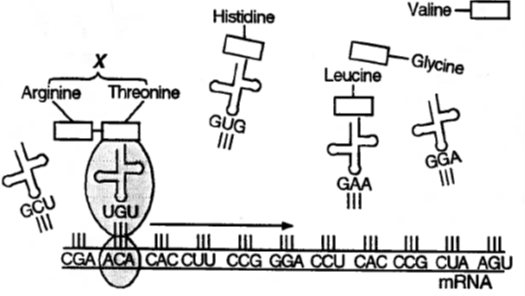
What process is going on in this photo?
a)
Transcription
b)
Translation
c)
Replication
d)
All the above
69.
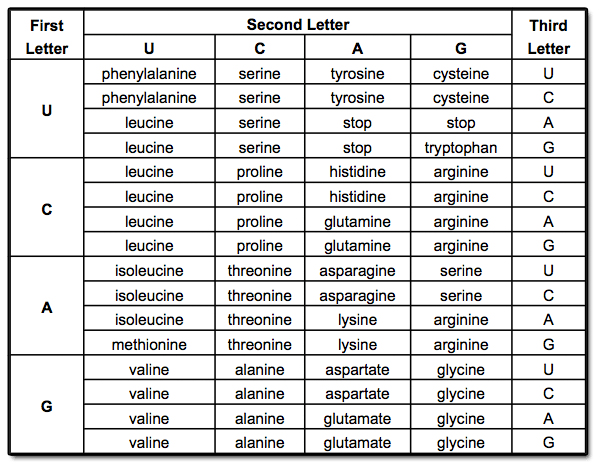
What amino acid is represented by the codon UUA?
a)
Phenylalanine
b)
Tyrosine
c)
Leucine
d)
Stop codon
70.
The process to go from mRNA to a protein is called ____
a)
transcription
b)
rRNA
c)
replication
d)
translation
100 %

