
 Worksheets
GENETICS EXAM REVIEW
Total questions: 70
Worksheet time: 40mins


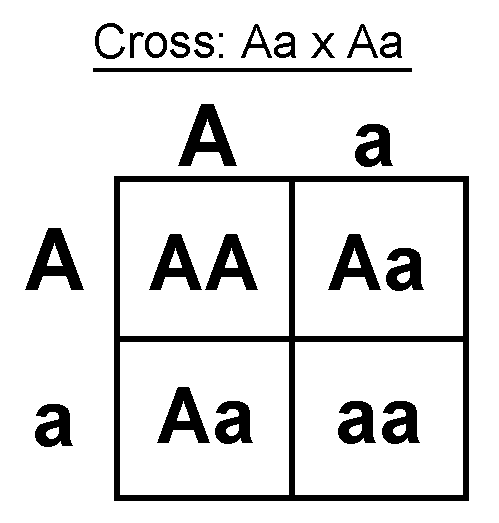
In the punnett square below, what belongs in the missing square
The genotype for a yellow plant is...




a characteristic that an organism can pass on to its offspring through genes
heredity
DNA
Trait
Chromosome
the passing of traits from parents to offspring
trait
heredity
chromosome
genes
the genetic material that carries information about an organism and is passed from parent to offspring
chromosome
allele
gene
DNA
a double rod of condensed chromatin in the nucleus that contains DNA
allele
chromosome
gene
DNA
the set of information that controls a trait; a segment of DNA on a chromosome that codes for a specific trait
allele
gene
dominant
recessive
The different forms of a gene
DNA
chromosome
phenotype
allele
an organisms genetic makeup or allele combinations (ex. BB, Bb, or bb)
dominant trait
genotype
recessive trait
phenotype
an organism's physical appearance or visible trait (ex. brown eyes, blue eyes)
dominant trait
genotype
recessive trait
phenotype
a trait that is always expressed in the phenotype of an organism
dominant trait
genotype
recessive trait
phenotype
a trait that is expressed only when two alleles are present
dominant trait
genotype
recessive trait
phenotype
A tool to predict the probability of certain traits in offspring
Calculator
Punnett Cube
Traits Indicator
Punnett Square
Mutation
Being bit a radioactive spider
Any change in a gene or chromosome
Having an accident in the science lab
None of these
A person who has one recessive allele for a trait, but does not have the trait
Bearer
Transporter
Carrier
Courier
A gene that is carried on the X or Y chromosome
X or Y gene
Sex-linked Gene
Z gene
Male or female gene
Any trait that is controlled by many alleles
Assorted alleles
Manifold alleles
Multiple alleles
Motley alleles
The offspring of two homozygous parents show an "in-between" phenotype
Incomplete dominance
Inadequate dominance
Insufficient dominance
Imperfect dominance
A chart or "family tree" that tracks which members of a family have a particular trait
Blueprint
Pedigree
Table
Graph
The process of selecting a few organisms with desired traits to serve as parents of the next generation
Hybridizaton
Cloning
Selective Breeding
Inbreeding
Involves crossing two individuals that have similar characteristics
Inbreeding
Cloning
Selective Breeding
Hybridization
Involves crossing two genetically different individuals
Inbreeding
Cloning
Selective Breeding
Hybridization
Producing an organism that has the exact traits as the organism from which it was produced
Hybridization
Genetic Engineering
Cloning
Gene Therapy
The transfer of a gene from the DNA of one organism into another organism in order to produce an organism with desired trait
Genetic Engineering
Cloning
Hybridization
Gene Therapy
The insertion of working copies of a gene into the cells of a person with a genetic disorder
Hybridization
Genetic Engineering
Cloning
Gene Therapy
All of the DNA in one cell of an organism
Gnome
Genome
Genre
Genie
Who is the "father" of genetics?
Bill Nye
Albert Einstein
Howie Mendel
Gregor Mendel
DNA consists of repeating series of a ____________.
Riptide
Nucleotide
Noontide
Springtide
Which of the following is not part of a nucleotide?
Sugar Group
Phosphate Group
Nitrogen Bases
Nuclear Group
Which of the following is not one of the nitrogen bases of a nucleotide
Cyanide
Adenine
Thymine
Guanine
A base pair is substituted for another pair
Addition mutation
Substitution mutation
Deletion mutation
A base pair is added into the strand
Addition mutation
Substitution mutation
Deletion mutation
A base pair is removed from the strand
Addition mutation
Substitution mutation
Deletion mutation
In order to see a recessive trait in an organism’s phenotype, what must be the organism’s genotype?
Homozygous Dominant
Homozygous Recessive
Heterozygous
A plant with a dominant homozygous trait is crossed with a plant with a recessive homozygous version of that trait. What is the probability that the offspring will display the dominant trait in its phenotype?
50%
100%
25%
0%
What is the genotype for females?
XX
XY
YY
Circles
What is the genotype for males?
XX
XY
ZZ
ZY
Sex chromosomes are located on which pair of chromosomes?
1st
47th
10th
23rd
Freckles=recessive. Cross a heterozygous parent with NO freckles with a parent with freckles. What is the probability that the offspring will NOT have freckles?
75%
100%
50%
0%
In dogs, long tails are dominant over short tails. Cross a heterozygous tailed dog with a homozygous recessive dog. What is the probability that the dog will have a short tail?
75%
50%
100%
25%
In a pedigree, what symbols represent females?
Squares
Circles
Hexagons
Triangles
In a pedigree, what symbols represent males?
Squares
Triangles
Circles
Octagons
In a pedigree, shaded in symbols mean what?
The person has a shady history.
The person is a carrier
The person is sensitive to sunlight
The person shows/has the particular trait
In a pedigree, symbols that are NOT shaded in mean what?
The person does not show the trait and is not a carrier
The person shows/has the trait
The person's history is a blank slate
The person is a carrier
In a pedigree, half shaded in symbols mean what?
The person does not show the trait, and they are not a carrier
The person has the trait
The person has two different colored eyes
The person does not show the trait, but they are a carrier

