
 Worksheets
Natural Selection PRACTICE
Total questions: 16
Worksheet time: 9mins
Name
Class
Date
1.
What was the name of the scientist who had the Theory of Evolution?
a)
Lamarck
b)
Einstein
c)
Washington
d)
Darwin
2.
The Theory of Evolution by Natural Selection means that what is changing over time?
a)
The inherited traits of a species
b)
Nothing
c)
Hair color and eye color
d)
Attractive features.
3.
When organisms with the best adaptations survive and reproduce (and therefore pass their traits along to offspring), this is called:
a)
Evolution
b)
Natural Selection
c)
Extinction
d)
Artifical Selection
4.
Finches on the Galapagos Islands all come from a common ancestor. Over millions of years, the beaks on the finches living on each island changed. Why did this happen?
a)
They wanted to look different to help them blend in
b)
They adapted to eat the food available on their island
c)
They wanted to protect themselves against predators
d)
Their beaks didn't actually change
5.
What is the difference between a theory and a hypothesis?
a)
A theory is not as strong as a hypothesis
b)
A theory requires a lot of data to support it, and a hypothesis is like a prediction
c)
A hypothesis is conclusive and a theory isn't
d)
They are the same thing
6.
Evolution is a
a)
law
b)
theory
c)
hypothesis
d)
conclusion
7.
A dog can be trained to alert a human if the telephone is ringing. This is an example of a:
a)
hypothesis
b)
theory
c)
law
d)
conclusion
8.
Natural selection is when ____________ decides who survives and who doesn't.
a)
nature
b)
humans
c)
animals
d)
years
9.
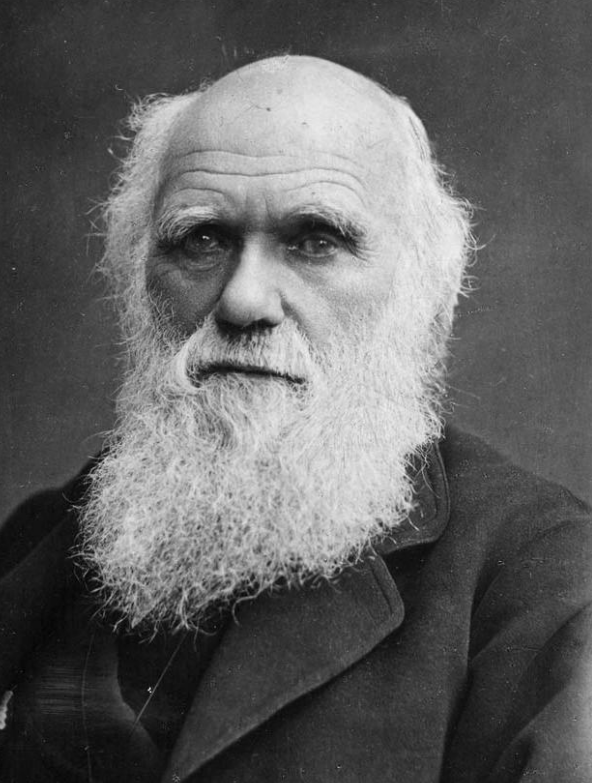
What did Charles Darwin think about natural selection?
a)
organisms change their traits to the trait that will help them
b)
breeding 2 similar animals get the best traits
c)
breeding 2 animals with different traits give the best results
d)
organisms with better traits for their environment will survive and reproduce
10.
What word describes a trait that helps an organism survive in its environment?
a)
natural selection
b)
mutation
c)
camouflage
d)
adaptation
11.
Why do frogs and other organism produce so many offspring?
a)
So that their babies can have friends to play with
b)
The more offspring the more likely the offspring will survive
c)
The more offspring the less likely offspring will survive
d)
The more offspring the less competition
12.
Which organisms are most likely to survive?
a)
the best adapted
b)
the fastest
c)
the strongest
d)
the most domesticated (tamed)
13.
Which of the following means "genetic change over a long time"?
a)
natural selection
b)
speciation
c)
evolution
d)
fitness
14.
Why are advantageous traits more likely to be passed onto offspring?
a)
Because they are more likely to survive and reproduce.
b)
Because they come from dominant alleles.
c)
Because they come from recessive alleles.
d)
Because the trait is an acquired phenotype.
15.
The differences among a species, like different bird beaks, are called
a)
genes
b)
variations
c)
traits
d)
theories
16.
Mutations are a change in what?
a)
DNA
b)
tRNA
c)
genotype
d)
phenotype
100 %
![[Practice Test] Skeletal & Muscular Systems](https://cf.quizizz.com/image/image-loader.svg)
