
NEW
Font size
S
M
L
XL
 Worksheets
Evolution & Natural Selection--Bio Acc
Total questions: 34
Worksheet time: 1hrs 25mins
Name
Class
Date
1.
Which of the following is a fossil?
a)
a plant that has recently died
b)
a group of organisms that can reproduce
c)
a structure or organ that no longer functions
d)
a trace of an organisms that existed in the past
2.

a bird that can easily outcompete other birds for food and that can produce many eggs has a high
a)
sexuality
b)
mutation rate
c)
fitness
d)
adaptability
3.
What is suggested by the similarity of early embryos of different species of vertebrates?
a)
no evolutionary relationships between the groups
b)
recent common ancestry
c)
similar environments in the past
d)
evolution from a distant common ancestor
4.

Some organisms that share a common ancestor have features that have different functions, but similar structures. These are known as
a)
vestigial structures
b)
analogous structures
c)
homologous structures
d)
fossil structures
5.

Two organisms that are closely related would have
a)
very similar DNA sequence
b)
exactly the same DNA sequences
c)
no proteins in common
d)
completely different DNA sequence
6.
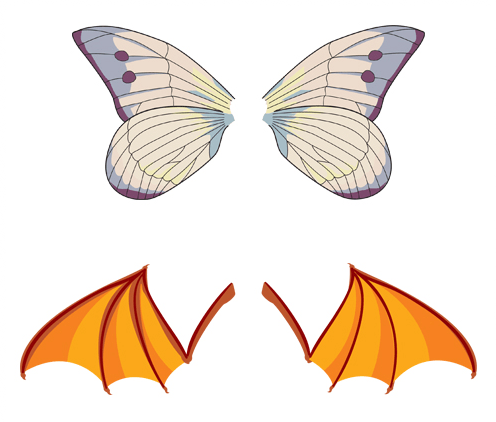
How would you describe this evolution?
a)
Homologous structure
b)
Analogous structure
c)
Structural adaption
d)
Functional adaption
7.

The forelimbs of vertebrates, like the ones pictured here, are similar in terms of number of bones and the orientation of bones. Which best describes how comparing homologous structures provides evidence of evolution?
a)
The genes for the body plan and forelimb layout were present in a common ancestral species vertebrates share, thus passed onto all vertebrates.
b)
Similar anatomical structures show how animals adapt to changing environments
c)
Homologous structures show that different species evolve at different rates
d)
Homologous structures don’t actually provide evidence for evolution
8.
How do fossils provide evidence that evolution has happened on Earth?
a)
Fossils show how the sizes of certain animals has changed drastically over millions of years
b)
Fossils show that some species have gone extinct
c)
Fossils show how life forms present today are different than those from the past
d)
Different sedimentary rock layers provide evidence for how the environment has changed over time
9.
A fossil of an extinct dinosaur is found and the anatomy of the fossil shows similarities to that of a bird. What could this mean?
a)
This is purely by chance and isn't significant
b)
The extinct dinosaur and modern bird share a common ancestor
c)
All dinosaurs evolved into birds and that's why there aren't any dinosaurs alive today
d)
Dinosaurs choose to fly, and evolved into birds to escape predation and capture food
10.

The diagram above shows an embryo of different vertebrates at different stages of development. Which field of study would support the similarities in development as evidence for evolution?
a)
comparative biochemistry
b)
paleontology
c)
comparative biogeography
d)
comparative embryology
11.

When scientists compare animals currently living on different continents, they often find those with similar characteristics, who are not actually close relatives, living in similar environmental conditions even though they are geographically very distant. One example is the Anteater/Armadillos of the Americas and the Pangolin of Africa. What can we deduce from this evidence?
a)
Living things can adapt similarly to similar environments over time.
b)
Living things do not change over time
c)
They must all have the same recent common ancestor
d)
I don’t know
12.
What do scientists generally find when comparing the relationship of living things in different geographic areas?
a)
Species living further apart geographically typically share a more recent common ancestral species than those living closer together
b)
Species living closer geographically typically share a more recent common ancestral species than those living further apart
c)
The location of where an organism lives gives no insight into their evolutionary relationships to other species
d)
Their protein sequences depend on the protein intake from the local watering hole.
13.
What type of evolution do homologous structures show?
a)
convergent
b)
divergent
c)
artificial selection
d)
disruptive selection
14.

If an organism has a vestigial structure, that structure likely once had a function in a(n)
a)
close relative
b)
early ancestor
c)
unrelated organism
d)
embryological stage
15.
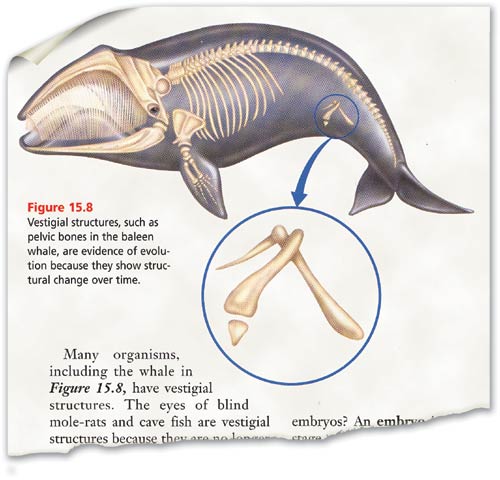
Which of the following is an example of a vestigial structure?
a)
the wings of a red-tailed hawk
b)
the hind limbs of a house cat
c)
the fins of sharks
d)
the tailbone of a human
16.

Which layer is the oldest
a)
B
b)
A
c)
E
d)
C
17.

The diagram shows fossils in different rock layers. Which of these statements about the age of these fossils is most likely correct?
a)
Fossil A and C are the same age
b)
Fossil B is older than fossil C
c)
Fossils A is older than fossil B
d)
Fossil D is older than fossil C
18.

Which best describes these fossils?
a)
The oldest fossils can be found on the lower layers
b)
The oldest fossils can be found at the top layers
c)
The youngest fossils are always found on the bottom layers
d)
You can not tell the age of any of these fossils
19.
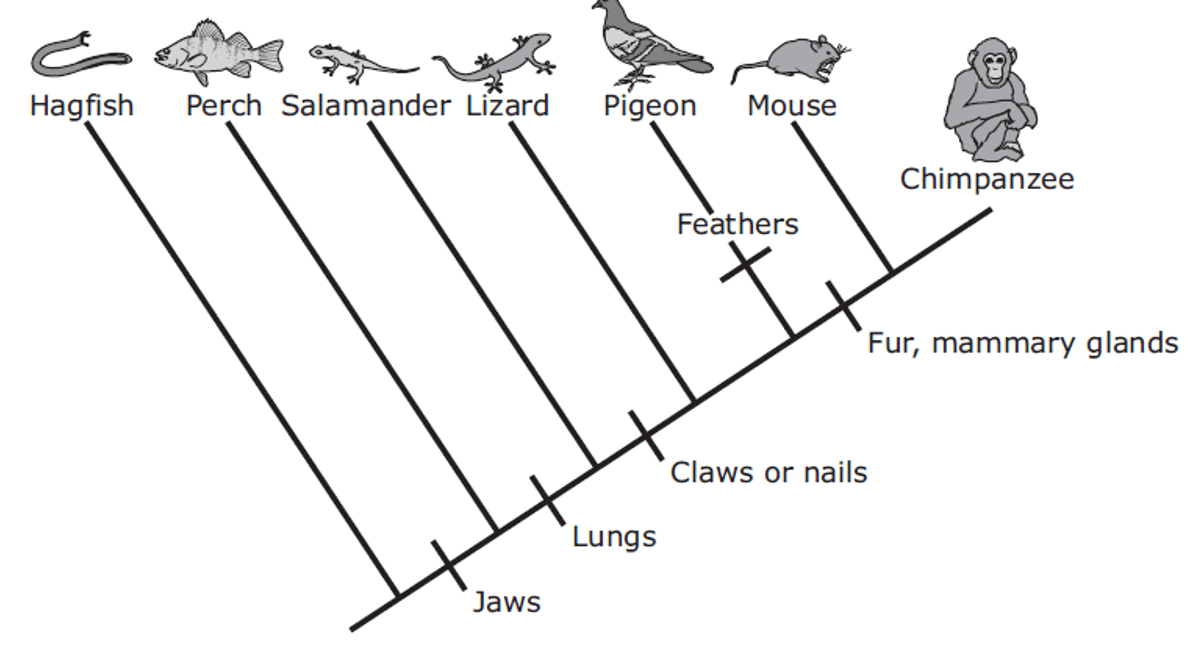
All the animals to the right of the hagfish would have the common characteristic of -
a)
Fur
b)
Claws or nails
c)
Lungs
d)
Jaws
20.

According to this cladogram, birds are LEAST related to -
a)
Amphibians
b)
Sharks
c)
Ray Finned Fish
d)
Crocodiles
21.

Individuals that are well adapted to their environment will survive and produce:
a)
Fewer mutations
b)
Stronger genes
c)
More offspring
d)
Better traits
22.

Which trait do only humans have, according to the cladogram?
a)
jaws
b)
mammary glands & hair
c)
terrestrial during all life stages
d)
opposable thumbs
23.

According to the cladogram, which organism is most distantly related to the human?
a)
crayfish
b)
rat
c)
perch
d)
frog
24.

According to the diagram, which organism is older: the ammonite or the coral?
a)
ammonite
b)
coral
25.

According to the diagram, which bird has the most similar DNA to a large tree finch?
a)
small tree finch
b)
medium tree finch
c)
large ground finch
d)
green warbler finch
26.

On this map there are many different geographical barriers, which could be mountains, rivers, or oceans. Animals that do not have a barrier between them have more similarities, which set shows that common ancestry existed?
a)
1 and 2
b)
3 and 4
c)
7 and 8
27.
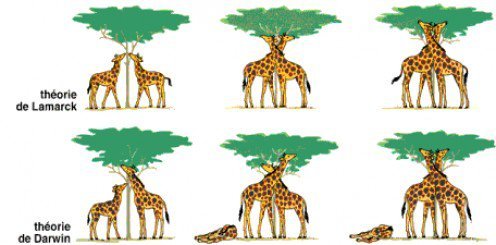
What would happen if the Giraffes never evolve?
a)
They would survive
b)
They would produce many offspring
c)
They would become extinct
d)
They would find another source of food
28.

Darwin wrote that organisms with traits that are best suited to the environment will ________________
a)
survive and produce offspring
b)
become extinct
c)
evolve into new species
29.

What is this an example of?
a)
diversity of species
b)
variation
c)
vestigial structures
d)
DNA studies
30.

Sea turtles usually lay 120-150 eggs, however, only a few of them hatch to produce young turtle hatchlings. Which principle of Darwin's Theory of Natural Selection is this example?
a)
variation
b)
overproduction
c)
descent with modification
d)
struggle for existence
31.

Male lions will display aggression and fight for reproductive dominance over female lionesses. Which principle of Darwin's Theory is this?
a)
variation
b)
overproduction
c)
struggle for existence/competition
d)
descent with modification
32.

Over a long period of time, horses have evolved to become larger, hoofed mammals. Which principle of Darwin's Theory of Natural Selection is this?
a)
variation
b)
struggle for existence/competition
c)
survival of the fittest
d)
descent with modification
33.

According to Darwin's Theory of Natural Selection, giraffes with long necks possessed variations that made them better adapted for survival in their environment. As a result, long neck giraffes survived and passed on their long neck trait to their offspring. This is an example of
a)
overproduction
b)
struggle for existence
c)
survival of the fittest
d)
descent with modification
34.
Giant tortoises on the Galapagos Islands possess variation in their neck length and carapace (shell) shape that make them well adapted for eating plants and vegetation. In which environment would this long necked tortoise with a saddle-shaped carapace have the greatest fitness?
a)
Island with low grasses
b)
Island with shrubs and higher vegetation
Reset

