
 Worksheets
Review for Evolution Test
Total questions: 33
Worksheet time: 29mins
Name
Class
Date
1.
What is the study of organisms at the early stages of development?
a)
DNA studies
b)
embryology
c)
extinction
d)
fossil record
2.
What is another name for natural selection?
a)
survival of the smartest
b)
survival of the fastest
c)
survival of the biggest
d)
survival of the fittest
3.
The cause of artificial selection is…
a)
The environment
b)
Humans
c)
Mutation
d)
Gene Flow
4.
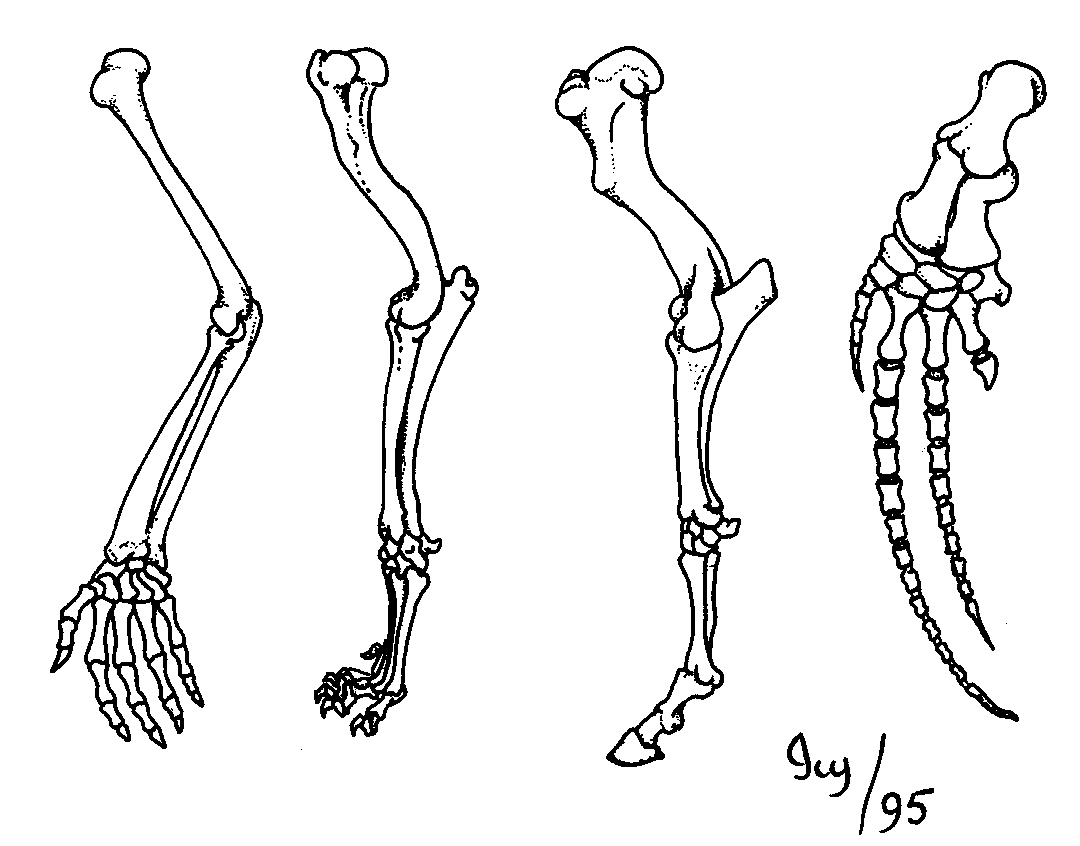
Structures with the same parts have different functions; suggests that organisms share a common ancestry
a)
vestigial structures
b)
homologous structures
c)
adaptive radiation
d)
fossil
5.
Where the better adapted organisms survive to pass traits along to offspring.
a)
Evolution
b)
Natural Selection
c)
Extinction
d)
Artifical Selection
6.

When an organism is completely wiped out of existence, we call it?
a)
extinction
b)
adaptation
c)
evolution
d)
inbreeding
7.
What are the evidences for Evolution?
a)
Fossil Records
b)
Embryology
c)
Similar body structure
d)
All the above
8.
Do organisms "decide" to evolve and change?
a)
Yes, they know they need to change to survive
b)
No, they change because of natural selection
9.
Which organisms are most likely to survive?
a)
the best adapted
b)
the fastest
c)
the strongest
d)
the most domesticated (tamed)
10.

Two organisms that are closely related would have
a)
very similar DNA sequence
b)
exactly the same DNA sequences
c)
no proteins in common
d)
completely different DNA sequence
11.

Genetic variation can arise from a random change in the DNA of a gene. The change is called a(n)
a)
mutation
b)
gene flow
c)
gene pool
d)
allele
12.
Natural selection results in change over time by acting on traits that are
a)
heritable
b)
new
c)
mutated
d)
better than the best
13.

characteristic or trait that helps an organism survive in its environment
a)
skills
b)
speciation
c)
natural instinct
d)
adaptation
14.
A scientist is examining a newly discovered species of bird to determine which type it is most closely related to. The best method to determine relatedness is
a)
comparative embryology
b)
the fossil record
c)
comparative anatomy
d)
DNA analysis
15.
A remnant or trace of an organism from the past is called a _______.
a)
Ancestor
b)
Skeleton
c)
Fossil
d)
Imprints
16.

The difference in the physical traits of an individual from those of other individuals in a group is called a(n)
a)
change
b)
adaption
c)
species
d)
variation
17.
Over time, adaptions can lead populations to experience
a)
environmental changes
b)
genetic changes
c)
geological changes
d)
extinction
18.
In natural selection, the selective agent is the
a)
humans
b)
mutations
c)
breeders
d)
environment
19.

All rabbits living in a particular area would be an example of a(n)
a)
population
b)
species
c)
fossil
d)
individual organism
20.

a bird that can easily outcompete other birds for food and that can produce many eggs has a high
a)
life expectancy
b)
mutation rate
c)
fitness
d)
adaptability
21.
Which of the following describes natural selection?
a)
it acts on genetic material directly
b)
it acts on existing physical traits
c)
it forms new traits
d)
it forms new genetic material
22.

which of the folllowing is an exammple of a vestigial structure?
a)
the wings of a red-tailed hawk
b)
the hind limbs of a house cat
c)
the fins of sharks
d)
the wings of an ostrich
23.
What is suggested by the similarity of early embryos of different species of vertebrates?
a)
no evolutionary relationships between the groups
b)
recent common ancestry
c)
similar environments in the past
d)
evolution from a distant common ancestor
24.
Mutations are important because they bring about
a)
death of the organism in which they develop
b)
genetic variation needed for a population to evolve
c)
benefits for the individual, not for the population
d)
Hardey-Weinberg equilibrium within a population
25.
What is the term for a feature that allows an organism to survive better in its environment?
a)
variation
b)
adaption
c)
homologous structure
d)
vestigial structure
26.
What is the process in which humans breed organisms for certain traits?
a)
natural selection
b)
inheritance
c)
artificial selection
d)
descent withOUT modification
27.

Which of the following is a term for a group of similar organisms that can reproduce fertile offspring?
a)
individual
b)
population
c)
species
d)
fossil
28.
A fossil that shows the traits of an ancestor and its descendants. It shows links between more than one species.
a)
Fossil
b)
Transitional Fossil
c)
Fossil Fuels
d)
There is no fossil
29.

The image shows an example of..
a)
vestigial structure
b)
analogous structure
c)
homologous structure
d)
embryology
30.

The diagram shows fossils in different rock layers. Which of these statements about the age of these fossils is most likely correct?
a)
Fossil A and C are the same age
b)
Fossil B is older than fossil C
c)
Fossils A is older than fossil B
d)
Fossil D is older than fossil C
31.
Mr. Jones, an archeologist, travels to study land animal fossils from millions of years ago. He has found fossils of the same land animals in eastern South America and western Africa. Which conclusion best supports Mr. Jones' findings?
a)
The 2 continents were once joined together as part of a larger continent.
b)
Land animals found from fossils collected from the west coast of Africa are similar to the ones found on the east coast of South America
c)
Early Europeans became Zombies as a Result of the Rock coming to save the world in the movie San Andreas
d)
The animals developed on the two continents at the exact same time
32.
This scientist stated that by using or not using a certain body part, organisms could change in their lifetime and that the trait gained would be passed down to their offspring.
a)
James Hutton
b)
Charles Lyell
c)
Jean-Baptiste Lamarck
d)
Thomas Malthus
33.
Lamarck’s ideas about evolution include the concept that differences among the traits of organisms arise as a result of
a)
continual increases in population size.
b)
the actions of organisms as they use or fail to use body structures.
c)
an unchanging local environment.
d)
the natural variations already present within the population of organisms.
100 %

