
 Worksheets
Magnetism Chapter 10 TTO PMC
Total questions: 67
Worksheet time: 45mins
Name
Class
Date
1.
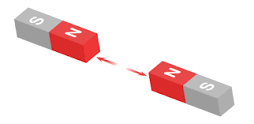
What will happen when these magnets are brought close together?
a)
They will attract each other.
b)
They will repel each other.
c)
Both magnets will turn to the left
d)
Both magnets will turn to the right
2.
What are the north and south ends of a magnet called?
a)
borders
b)
tips
c)
caps
d)
poles
3.
When two magnets have the same poles facing each other they will?
a)
attract
b)
repel
c)
attack one another
d)
spin
4.
What happens when two bar magnets repel each other?
a)
The poles of the magnets pull toward each other.
b)
The poles of the magnets push away from each other.
c)
The centers of the magnets pull toward each other.
d)
The centers o the magnets push away from each other.
5.
True or False: All metals stick to magnets.
a)
True
b)
False
6.
When two magnets repel, they ________________
a)
change color
b)
pull together
c)
push apart
d)
get colder
7.
Iron, Nickel and cobalt are all __________________ materials
a)
Shiny
b)
poles
c)
magnetic
d)
cold
8.
The needle of a compass always points to which direction?
a)
south
b)
east
c)
west
d)
north
9.
A device that uses a free-moving magnetic needle to show direction is a:
a)
lodestone
b)
magnet
c)
compass
d)
magnetic field
10.
Which object would a magnet attract?
a)
a glass bottle
b)
a piece of paper
c)
a metal paper clip
compass
compass
d)
a rubber eraser
magnetic field
magnetic field
11.
How is a permanent magnet DIFFERENT from a temporary magnet?
a)
A permanent magnet attracts materials made of iron.
b)
A permanent magnet has poles.
c)
A permanent magnet has a magnetic field.
d)
A permanent magnet keeps its magnetism for a long time.
12.
Which type of rock is naturally magnetic?
a)
granite
b)
lodestone
c)
limestone
d)
sandstone
13.
The space around a magnet where the force of the magnet can act is called the:
a)
north pole
b)
south pole
c)
magnetic poles
d)
attraction field
14.
Earth acts like a giant magnet because its center is made up MOSTLY of
a)
granite
b)
limestone
c)
iron
d)
nickel
15.
magnetic field lines
a)
do nothing
b)
go from South to North
c)
go from North to South
16.
what is a temporary magnet?
a)
paper clips
b)
paper clips attached to magnet
c)
bar magnet
17.
what is the source of magnetism
a)
spinning electrons
b)
aligned spinning electrons
c)
spinning protons
18.
what happens when a bar magnet is cut in half?
a)
magnet dies
b)
magnet is twice as strong
c)
2 new magnets are created
19.
Magnetic force can alter particle's
a)
speed
b)
direction
c)
nothing
20.
Perpendicular magnetic force can alter particle's
a)
speed
b)
direction
c)
nothing
21.
which of the following always points North?
a)
galvoneometer
b)
voltmeter
c)
ammeter
d)
compass
22.
every magnet has a
a)
east and west pole
b)
north and south pole
c)
east and south pole
d)
north and west pole
23.
magnets cannot be made from
a)
cobalt
b)
nickel
c)
iron and steel
d)
wood
24.
what is the difference between electricity and magnetism
a)
there is no difference
b)
electric charges can be isolated while magnetic charges cannot
c)
magnetic charges can be isolated while electric charges cannot
25.
Which of the following is a ferrous metal
a)
Copper
b)
Zinc
c)
Aluminium
d)
Iron
26.
Ferrous Oxide is otherwise known as?
a)
Rain
b)
Patina
c)
Rust
d)
Lead
27.

Which end of a compass is the north pole of its magnet?
a)
Red
b)
Plain
c)
Neither
28.
Breaking a bar magnet in half will produce
a)
A single north magnetic monopole
b)
A single south magnetic monopole
c)
One north and one south monopole
d)
Two bar magnets
29.
At the geographic North Pole, a compass will point south.
a)
True
b)
False
30.

The strongest part of a magnet is...
a)
the bars.
b)
the force field.
c)
the poles.
d)
the middle.
31.

Magnets that are arranged like this will _______.
a)
move away from each other (repel)
b)
move towards each other (attract)
32.

Magnets that are arranged like this will _______.
a)
move away from each other (repel)
b)
move toward each other (attract)
33.

True or False: The Earth is a giant magnet
a)
True
b)
False
34.
What is responsible for creating Earth's magnetic poles?
a)
Charged particles in Earth's atmosphere
b)
Magnetic rocks in Earth's crust
c)
Earth's iron core
d)
The flow of ocean currents around Earth
35.

Are the magnetic field lines in the picture correct?
a)
Yes, because they point from north to south.
b)
No, because they point from north to south (they're supposed to go the other way).
c)
Yes, because the North pole is on the left in all pictures.
d)
No, because the North pole is on the left in all pictures (it's supposed to be on the right).
36.
Why does each electron in an atom behave like a tiny magnet?
a)
The spinning of an electron produces a magnetic field.
b)
The spinning of an proton produces a magnetic field.
37.
Why do some atoms have strong magnetic properties?
a)
Some atoms contain electrons that are not paired.
b)
Some atoms contain protons that are not paired.
c)
Some atoms contain neutrons that are not paired.
38.
In a magnetized material, most of the domains are arranged in the same direction. In a material that is not magnetized, the domains point in _________ directions.
a)
same
b)
random
39.
A ferromagnetic material is a material that shows ________________ magnetic properties.
a)
weak
b)
cold
c)
strong
d)
fast
40.
This can be done by placing the unmagnetized material in a strong magnetic field or by rubbing it in one direction with one pole of a strong magnet.
a)
True
b)
False
41.
A magnet made of material that keeps its magnetism is called ________________ magnet.
a)
permanent
b)
temporary
c)
bar
d)
horseshoe
42.
Above a certain temperature a ferromagnetic material loses it magnetic properties.
a)
True
b)
False
43.
If you break a magnetic into four pieces, each piece _____________ its magnetic properties.
a)
retains
b)
loses
44.
Which one of these is a natural magnet that comes from the Earth?
a)
diamond
b)
bar magnet
c)
coal
d)
lodestone
45.
When magnet domains line up, the metal becomes what?
a)
magnetized
b)
unmagnitized
46.
which of these are magnetic materials
a)
plastic,iron,wood
b)
iron,cobalt,nickel
c)
scissor,plastic fork
d)
all rocks,aluminium,cap
47.
which one does not use an electromagnet
a)
maglev train
b)
scrapyard metal
c)
motors and generators
d)
light bulb
48.
Electromagnets can be made from
a)
wire wrapped around plastic
b)
wire wrapped around iron
c)
wire wrapped around magnet
49.

Which of the following is shown in the picture?
a)
Electromagnet
b)
Electric generator
c)
Electric motor
d)
Transformer
50.

This is a picture of a simple electromagnet. How can the electromagnet be made stronger?
a)
Add more coils of wire to the nail.
b)
Use a smaller battery.
c)
Reverse the poles of the magnet.
d)
Remove all the coils and the nail.
51.

What kind of magnet can be turned on and off?
a)
refridgerator magnet
b)
electromagnet
c)
magnetite
d)
iron
52.

Which of the following statements is true about Earth’s magnetic poles?
a)
They are the areas where Earth’s magnetic field is strongest.
b)
They are located at Earth’s geographic poles.
c)
They are the areas where Earth’s magnetic field is weakest.
d)
Earth has four magnetic poles.
53.
The lines that form a pattern showing the size and shape of a magnetic force field (shown with iron filings).
a)
lines of force
b)
magnetic field
c)
lodestone
d)
compass
54.
Why would a magnet attract to a paperclip, but not a penny?
a)
magnets only attract to silver objects
b)
magnets are not attracted to all kinds of metal objects
c)
magnets do not attract to round objects
d)
magnets do not attract to objects that are orange
55.
Magnets will pull harder on objects that are_____________.
a)
close
b)
large
c)
far away
d)
cold
56.

How might the magnet on the end of this crane be used?
a)
To pick up plastic toys
b)
To lift metal cars
c)
To move heavy stones
d)
To carry wooden crates
57.

Magnets that use electricity are called ________________.
a)
electromagnet
b)
poles
c)
machines
58.

What are the four metals a magnet can stick to?
a)
Iron, cobalt, nickel, steel
b)
Iron, silver, nickel, steel
c)
copper, silver, gold, iron
59.

A magnet is an item made up of ______________ that ______________ other iron objects.
a)
steel, hugs
b)
hardwood, leaves
c)
iron, attracts
60.

The area around a magnet that will attract magnetic objects is called the _______________ ___________.
a)
magnetic field
b)
force
c)
north pole
61.

If I was walking north and wanted to walk east, would I turn my compass or myself? ____________________
a)
Left
b)
Right
c)
Straight
d)
turn around
62.

Are all magnets the same strength?
a)
No
b)
Yes
63.
When a material is magnetized, most of its magnetic domains are not aligned.
a)
True
b)
False
64.
What does the strength of an electromagnet depend on?
a)
The current in the solenoid
b)
The number of loops in the coil
c)
The type of ferromagnetic core
d)
All of the above
65.
What are the tiny magnets inside a ferromagnetic material called?
a)
mini magnets
b)
domains
c)
grains
d)
cells
66.
What is the name for a temporary magnetism when a magnet picks up a piece of iron?
a)
induced
b)
momentary
c)
repulsion
d)
weak
67.
The most easily magnetised and demagnetised material is:
a)
steel
b)
copper
c)
aluminium
d)
iron
100 %

