wayground logo

Free Printable Worksheets

Font size

S
M
L
XL
Worksheets

Ecological Succession

Total questions: 43

Worksheet time: 1hrs 25mins

Name
Class
Date
1.

A change an ecosystem experiences over time is called

a)

symbiosis

b)

ecological succession

c)

competition

d)

cooperation

2.

Which ecosystem would survive better if they experienced environmental stress like climate issues?

a)

an ecosystem with little biodiversity

b)

biodiversity doesn't matter

c)

an ecosystem with a lot of biodiversity

d)

parasites

3.

Series of changes where other organisms have not previously lived

a)

primary succession

b)

secondary succession

c)

commensalism

d)

competition

4.

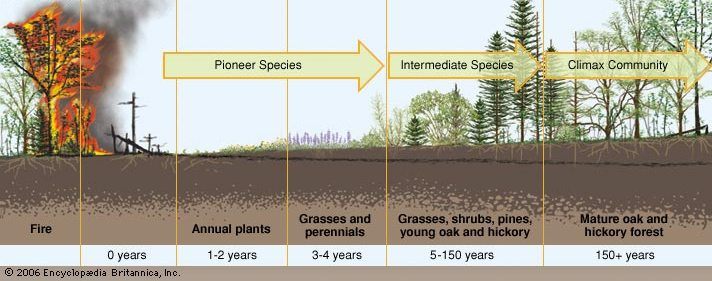
This picture depicts what succession type?

a)

primary succession

b)

secondary succession

c)

tertiary succession

d)

climax succession

5.

Different biotic and abiotic communities together in an area

a)

species

b)

ecosystem

c)

community

d)

population

6.
Stable, final stage of succession
a)
adaptation
b)
pioneer species
c)
niche
d)
climax community
7.

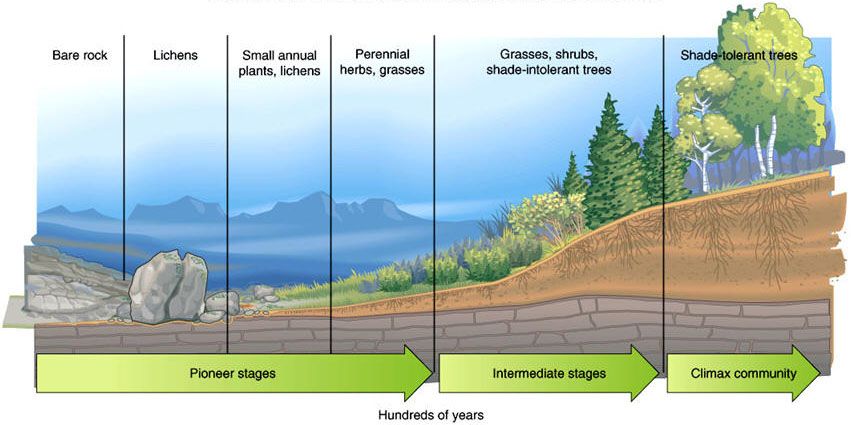
What type of Succession is this?

a)

primary succession

b)

secondary succession

c)

tertiary succession

d)

variable succession

8.

Plant life starting to grow on a volcano, what type of succession is occuring

a)

primary succession

b)

secondary succession

c)

tertiary succession

d)

variable succession

9.
How do lichens contribute to primary succession?
a)
Lichens decompose organic matter from animals and plants
b)
Lichens begin to break down rock to form soil
c)
Lichens are nitrogen fixing bacteria
d)
Lichens convert carbohydrates into fossil fuels.
10.
Dead or decomposing material is  called
a)
organic material
b)
decomposers
c)
estuary
d)
brackish water
11.
What is likely to begin right after the eruption?
a)
Secondary succession 
b)
Increased tree growth 
c)
Primary succession 
d)
A climax community
12.

What is the best evidence that this is NOT primary succession?

a)

Soil and plants are present at the first step.

b)

Changes occur in stages.

c)

The size and number of the plants change.

d)

Trees are present in one of the steps.

13.
Which would most likely be the first plants to grow in an abandoned farm field?
a)
Lichens
b)
Grasses
c)
Shrubs
d)
Trees
14.

A field consists of one species of plant. What can you infer about the sustainability ( being able to last) of the field ecosystem?

a)

It has low biodiversity and could be easily wiped out by disease.

b)

It has high biodiversity and could easily withstand drought and other limiting factors.

c)

There is not enough information to determine if the ecosystem is sustainable.

d)

Abiotic factors will not affect the sustainability of an ecosystem.

15.

The most sustainable = ecosystem would

a)

have low biodiversity.

b)

have high biodiversity.

c)

not experience change.

d)

have no predators.

16.

Which would most likely be the first plants to grow in an abandoned lava field?

a)

Lichens

b)

Grasses

c)

Shrubs

d)

Trees

17.
A volcanic eruption releases a large amount of lava that destroys all the plants and animals living in an area. In time, new populations of organisms begin returning to the area that was destroyed by the lava. These organisms are known as —
a)
a climax community
b)
herbivores
c)
pioneer organisms
d)
introduced species
18.

_________ Succession reaches a climax community quicker because soil is already present

a)

primary

b)

secondary

c)

both types of succession

19.
The picture shows what type of succession?
a)
primary
b)
secondary
c)
tertiary
d)
quadanary
20.
The picture shows what type of succession?
a)
primary
b)
secondary
c)
tertiary
d)
quadanary
21.
Succession that occurs in an area with NO SOIL
a)
ecological succession 
b)
primary succession 
c)
secondary succession
d)
pioneer speciles
22.
the process by which a new community forms where no community lived before 
a)
resource
b)
invasive (non- native) species
c)
primary succession
d)
competition
23.
Starts with BARE ROCK followed by lichen
a)
primary succession 
b)
secondary succession
c)
both types of succession
24.

To keep our ecosystem healthy, we must maintain our?

a)

limited organisms

b)

earth

c)

sun

d)

biodiversity

25.

Biodiversity can affect the ________ of ecosystems and the _________ of populations.

a)

climax , pioneer

b)

stability and sustainability

c)

life and existence

26.
After a volcanic eruption, lava covers the land. What is the order that plants grow to repopulate the area?
a)
Lichens → Shrubs → Grasses → Trees
b)
Lichens → tree → shrubs→Grasses
c)
Grasses → Lichens → Shrubs → Trees
d)
Lichens → Grasses → Shrubs → Trees
27.

In a pond, which of the following changes would most likely result in succession that results in a marsh or forest?

a)

An increase in water plants growing in the pond.

b)

A decrease in the number of decomposers in the pond.

c)

An increased rate of deposition of sediments into the pond.

d)

A decreased oxygen content kills large fish in the pond.
28.
The following natural events will cause primary succession to occur:
a)
floods and hurricanes
b)
wildfires and controlled burns
c)
tsunamis and tornadoes
d)
glacier movement and volcanoes
29.

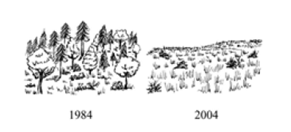
The figure shows the same ecosystem in Texas at two different times. Which of the following most likely caused the change of species shown in the figure?

a)

development of a parking lot

b)

passing through a glacier

c)

volcanic eruption

d)

occurrence of a forest fire

30.
A hurricane hits coastal prairie and destroys the habitat. Years later there is an appearance of small plants with rapidly spreading roots on newly formed coastal sand dunes. The vegetation describes-
a)
a microhabitat
b)
primary succession
c)
secondary succession
d)
biodiversity
31.

How is secondary succession different from primary succession?

a)

Secondary succession occurs after a disturbance in an area that was previously uninhabited (no life)

b)

Secondary succession occurs after a disturbance in an area in which the soil has remained intact.

32.
What is the order of succession shown in this figure?
a)
A, B, C, D
b)
B, A, D, C
c)
C, D, A, B
d)
D, A, B, C
33.

A stable ecological community that has reached equilibrium or stability is

a)

ecological succession

b)

climax community

c)

secondary succession

d)

pioneer speciles

34.
Which of the following is true in a climax community?
a)
the community will constantly evolve and change
b)
if one species dies, a new species will fulfill the same role
c)
They are stable for a long time, with the same species maintaining their population
d)
it goes through a major change called "climax" every few hundred years
35.
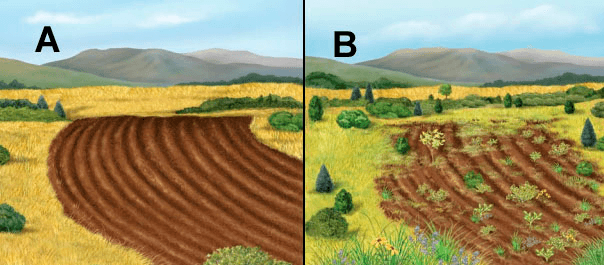
What type of succession is shown going from figure A to figure B?
a)
primary succession
b)
ecological succession
c)
secondary succession
d)
intermediate
36.

Which process occurs after humans cause deforestation?

a)

eutrophication

b)

photosynthesis

c)

primary succession

d)

secondary succession

37.
All the different populations that live together in an area
a)
population
b)
community
c)
ecosystem
d)
species
38.

What is Ecological Succession?

a)

Competition between plants in a society

b)

A natural disaster such as a flood or fire

c)

The gradual change an ecosystem experiences over time that leads to decreased biodiversity and sustainability

d)

The gradual change an ecosystem experiences over time that leads to increased biodiversity and sustainability

39.
All the members of one species in an area
a)
species
b)
biome
c)
population
d)
community
40.
succession that occurs in an area where soil is already present
a)
ecological succession 
b)
primary succession 
c)
secondary succession
d)
pioneer speciles
41.
As succession progresses, animal species diversity increases due to the fact that
a)
less soil is being created
b)
food choices increase
c)
precipitation rates stabilize
d)
temperatures moderate
42.

Which type of succession takes longer?

a)

primary

b)

secondary

c)

they both take the same amount of time

43.

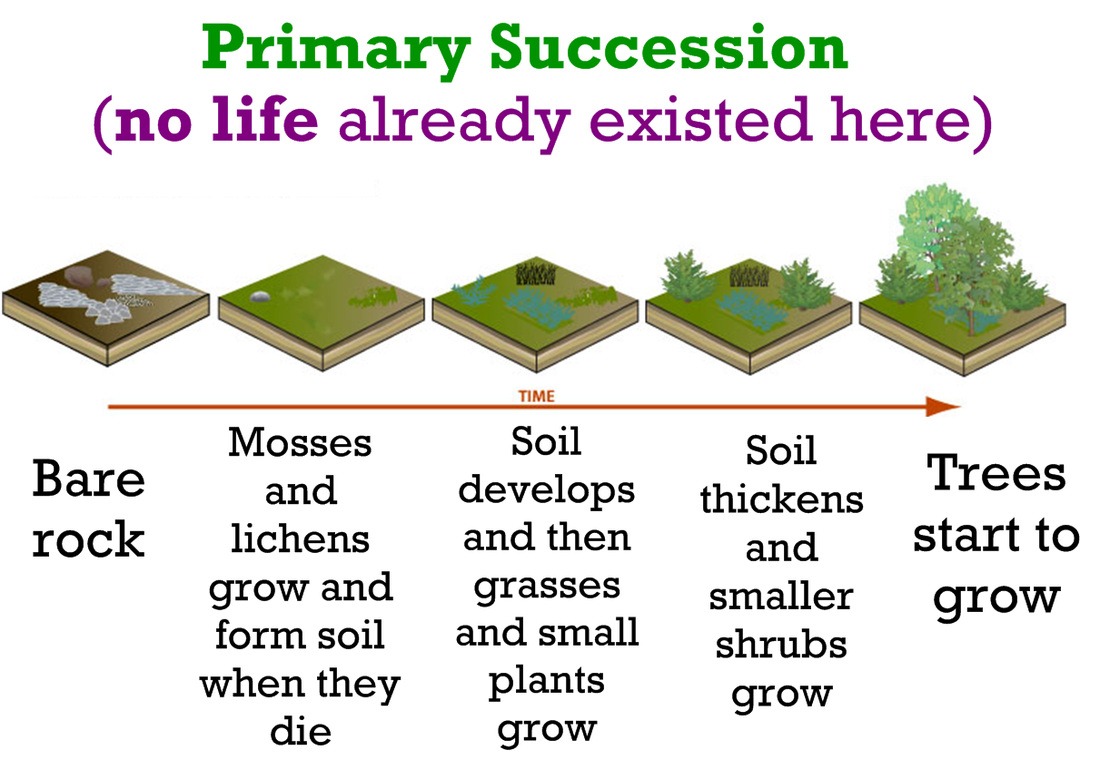
Which statement describes the pic

a)

The first area is the most stable

b)

the second area is replaced by trees

c)

the 3rd area came after the shrubs and made it better for them

d)

the 4th area modified the soil making it better for the last area