wayground logo

Free Printable Worksheets

NEW

Font size

S
M
L
XL
Worksheets

Plant Test Review

Total questions: 39

Worksheet time: 17mins

Name
Class
Date
1.

Which of the following is NOT true about protists?

a)

are eukaryotic

b)

lives in dry environments

c)

can be parasites

d)

lives in moist environments

2.
Roots have all of the following functions EXCEPT to ____.
a)
anchor the plant
b)
absorb water
c)
store food
d)
make food
3.
Stems have all of these functions EXCEPT ____.
a)
storing food and water
b)
absorbing soil nutrients
c)
supporting the plant
d)
moving materials between leaves and roots
4.

What life cycle stage begins when water is absorbed into the seed that in turn starts developing?

a)

fertilization

b)

germination

c)

dispersal

d)

pollination

5.
As much as 90 percent of the oxygen in our atmosphere is the result of ____.
a)
photosynthesis
b)
respiration
c)
thigmotropism
d)
transpiration
6.
Respiration is the process in which organisms break down food to release ____.
a)
energy
b)
nutrients
c)
sugar
d)
water
7.
The plants in terrarium A are healthy, but the plants in terrarium B are not. Which would most likely improve the health of the plants in terrarium B?
a)
decreasing the amount of soil
b)
decreasing the amount of water
c)
increasing the amount of light
d)
increasing the number of plants
8.
Which of the following is NOT example of a type of fungus?
a)
mushroom
b)
yeast
c)
moss
d)
bread mold
9.
Since plants cannot move to defend themselves, they have structures for defense. Structures that keep the plant from being eaten are __.
a)
flowers
b)
leaves
c)
thorns
d)
stems
10.

Which of the following is NOT true about fungi?

a)

Fungi have roots.

b)

Fungi have cell walls.

c)

Fungi use spores to reproduce.

d)

Fungi are heterotrophs.

11.
A plant absorbs water and minerals through _______.
a)
roots
b)
stems
c)
leaves
d)
stomata
12.
The main function of flowers is ____.
a)
defense
b)
food production
c)
reproduction
d)
respiration
13.
Which are nonvascular plants?
a)
pine trees
b)
grasses
c)
mosses
d)
tulips
14.
Plants with tendrils tend to move by thigmotropism.  Which is the best explanation of thigmotropism?
a)
plant growth in response to touching a solid object
b)
plant growth toward light
c)
root growth toward the center of gravity
d)
root growth toward water
15.
Which tropism does the picture show?
a)
gravitropism
b)
hydrotropism
c)
thigmotropism
d)
phototropism
16.
Bees, ants, bats, and wind primarily aid in what process of plant reproduction?
a)
asexual growth
b)
fertilization
c)
germination
d)
pollination
17.
Which of the following is NOT needed for photosynthesis?
a)
carbon dioxide
b)
oxygen
c)
sunlight energy
d)
water
18.
Transpiration helps keep a balance of what molecule within the plant?
a)
carbon dioxide
b)
oxygen
c)
sunlight energy
d)
water
19.
What tropism is depicted in the picture?
a)
gravitropism
b)
hydrotropism
c)
thigmotropism
d)
phototropism
20.
Which of the following does NOT describe plants?
a)
autotroph (performs photosynthesis)
b)
in Kingdom Plantae
c)
two categories of plants
d)
unicellular (one-celled)
21.

Which may be produced as a result of sexual reproduction in flowering plants?

a)

bulbs

b)

runners

c)

seeds

d)

tubers

22.

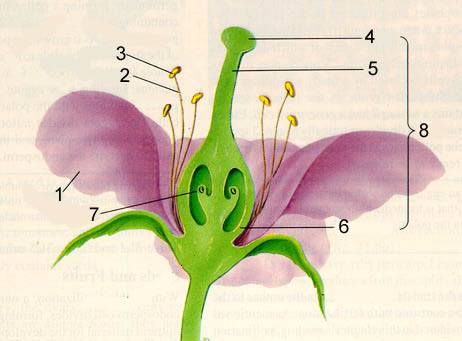
What do the anther and filament make up on the flower?

a)

stamen

b)

pistil

23.

What do the stigma and style make on the flower?

a)

stamen

b)

pistil

24.
Which part of the plant absorbs sunlight for photosynthesis?
a)
leaves
b)
stems
c)
roots
d)
flowers
25.
Where are stomata located?
a)
leaves
b)
stems
c)
roots
d)
flowers
26.

What transports water UP from the roots to the leaves?

a)

xylem

b)

phloem

27.

What transports food DOWN from the leaves to the roots?

a)

xylem

b)

phloem

28.
What is #6 pointing to?
a)
anther
b)
filament
c)
ovary
d)
style
29.
What is #8 pointing to?
a)
petal
b)
stamen
c)
pistil
d)
ovary
30.

What is #1 pointing to?

a)

anther

b)

filament

c)

petal

d)

style

31.

Ferns are classified as _______ plants.

a)

gymnosperm

b)

non-vascular

c)

seedless vascular

d)

seed-bearing vascular

32.

Which is necessary for sexual reproduction in flowering plants?

a)

cones

b)

pollen

c)

spores

d)

stems

33.

Which would be best adapted to a desert environment?

a)

spines for leaves (like a cactus)

b)

broad leaves (like a maple tree)

c)

leaves that float on water (like lily pads)

d)

leaves with sharp edges

34.

Which part of the flower makes pollen?

a)

anther

b)

ovary

c)

pistil

d)

stigma

35.

Where does photosynthesis take place in the cell?

a)

chloroplast

b)

mitochondria

c)

nucleus

d)

vacuoles

36.

As the days get shorter and the amount of sunlight is reduced, trees begin __.

a)

to die

b)

to make large amounts of food

c)

to rest and become dormant

d)

to store water

37.

This protist uses what to move in its environment?

a)

cilia

b)

flagella

c)

pseudopods

38.

Which of the following is the most necessary for a seed to begin the germination process?

a)

nutrients

b)

low temperature

c)

sunlight

d)

water

39.

Which type of flowering vascular plant has two seed leaves?

a)

dicots

b)

monocots