
 Worksheets
Layers, Plate Tectonics, and Human Impact
Total questions: 45
Worksheet time: 32mins
Name
Class
Date
1.
This layer of Earth is the thickest part
a)
crust
b)
outer core
c)
mantle
d)
inner core
2.
What is Pangaea?
a)
The name of a German Scientist
b)
the name of the supercontinent that existed millions of years ago
c)
another name for continental drift
d)
the name of an ancient fossil
3.
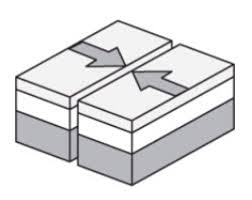
Name the boundary
a)
convergent boundary
b)
divergent boundary
c)
transform boundary
d)
sergent boundary
4.

Name the boundary
a)
convergent boundary
b)
divergent boundary
c)
transform boundary
d)
sergent boundary
5.
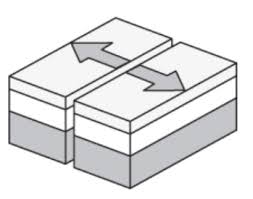
Name the boundary
a)
convergent boundary
b)
divergent boundary
c)
transform boundary
d)
sergent boundary
6.
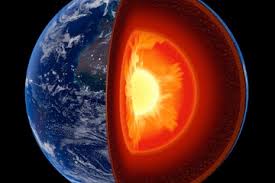
As you travel from the inner core to the crust, how would temperature, pressure and density of the material change?
a)
The would all increase
b)
The would all decrease.
c)
They would stay the same.
d)
Temperature would decrease, but pressure and density would increase.
7.
A subduction zone is formed...
a)
when one tectonic plate sinks below another
b)
at every type of convergent plate boundary
c)
at every type of divergent plate boundary
d)
at transform boundaries
8.
Plate movement is caused by ______________.
a)
the rotation of the Earth
b)
ocean tides
c)
convection currents in the mantle
d)
the moon's gravity
9.
What are mid-ocean ridges?
a)
A chain of underwater waterfalls
b)
A chain of underwater volcanos
c)
A chain of underwater mountains
d)
A chain of underwater rocks
10.

Who is the person credited with developing the theory of continental drift?
a)
Harry Hess
b)
Galileo
c)
Alfred Wegener
d)
Newton
11.
What does the theory of continental drift state?
a)
The continents were once joined in a super-continent and have moved over time
b)
Continents are stationary and do not move
c)
The Earth is broken into lithospheric plates that move due to convection currents
d)
none of the above
12.
Which type of plate boundary would cause mountains to form
a)
Transform
b)
Convergent
c)
Divergent
d)
Reform
13.
This layer of Earth is solid Iron and Nickel
a)
Outer Core
b)
Mantle
c)
Inner Core
d)
Crust
14.
The Great Rift Valley in Africa and the Mid-Ocean Ridge were all created by this boundary
a)
Divergent
b)
Convergent
c)
Reform
d)
Transform
15.
What are the two types of crust
a)
continental and oceanic
b)
ocean and upper
c)
lower and upper
d)
pizza and bread
16.
Which layer has convection currents?
a)
Inner Core
b)
Outer Core
c)
Mantle
d)
Crust
17.
Transform boundaries are most likely to produce what phenomenon?
a)
volcanoes
b)
deep sea trenches
c)
underwater mountain ranges
d)
earthquakes
18.
How have scientists been able to study Earth's mantle?
a)
In some places, Earth's crust thins enough to see mantle.
b)
Earth's surface heat warms the crust turning it into mantle.
c)
Cooling crust material becomes mantle over time.
d)
In some places, mantle rock pushes to Earth's surface.
19.
Which layer of the Earth is the most dense?
a)
crust
b)
mantle
c)
inner core
d)
outer core
20.
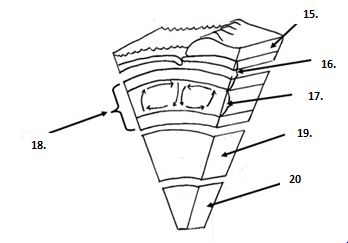
Identify each layer - #15.
a)
Lithosphere
b)
Mantle
c)
Crust
d)
Asthenosphere
21.
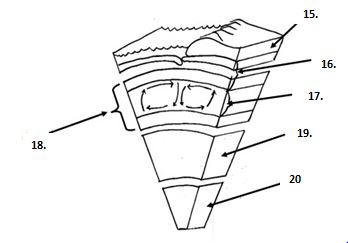
Identify each layer - #20.
a)
mantle
b)
asthenosphere
c)
inner core
d)
outer core
22.
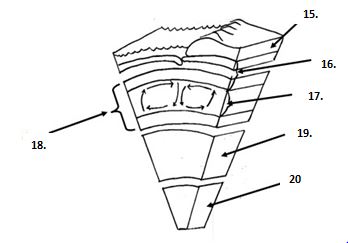
Identify each layer - #19.
a)
mantle
b)
lithosphere
c)
inner core
d)
outer core
23.

What is the thinnest layer of the earth’s composition?
a)
mantle
b)
inner core
c)
crust
d)
outer core
24.

The thickest layer of the earth is the
a)
crust
b)
mantle
c)
inner core
d)
outer core
25.
Killing organisms at a rate that is faster than what they can repopulate:
a)
invasive species
b)
carrying capacity
c)
limiting factors
d)
overharvesting
26.
Invasive species are:
a)
non-native
b)
harmful to an ecosystem
c)
organisms that can lack predators in the new environment
d)
all of the answers are correct
27.
No more of the species exists.
a)
extinct
b)
endangered
c)
threatened
28.
An office decided to help the environment by using less paper. How will this most likely benefit the environment?
a)
It will help increase the biodiversity
b)
It will help conserve forests and save energy
c)
It will help protect soil
d)
It will help reduce acid rain
29.
Increase in which gas is primarily responsible for increased global warming?
a)
Carbon dioxide
b)
Water vapor
c)
Methane
d)
Nitric oxides
30.
Wastes produced by agriculture, households, industry, mining, and other human activities can end up in ______________.
a)
groundwater
b)
streams and rivers
c)
oceans
d)
All of these choices
31.
The ozone layer protects us from
a)
UV rays
b)
CFCs
c)
Increased atmospheric heat
d)
Decreased atmospheric heat
32.
The ozone layer is damaged by
a)
CFCs
b)
Increase in greenhouse gases
c)
Increased global temperatures
d)
Sulfuric and nitric acids
33.
Global warming is due to
a)
Greenhouse gases
b)
Nitric and sulfuric acids
c)
CFCs
d)
Ozone depletion
34.

What is one way that humans can lessen their ecological footprint?
a)
Recycle
b)
Eat more meat
c)
Drive large vehicles
d)
Increase agricultural area
35.
Which of the following is a renewable resource?
a)
coal
b)
solar energy
c)
natural gas
d)
oil
36.
What are renewable resources?
a)
Resources that are used faster than they form
b)
a. Resources that can replenish themselves over time
c)
a. Resources that exist only in urban areas
d)
Resources that exist only in rural areas
37.
Why are the Rainforests being destroyed?
a)
diseases carried by insects
b)
Wildfires
c)
tropical storms
d)
human demand for wood and farmland
38.

Which of the following is a non-renewable energy resource?
a)
wind
b)
solar
c)
coal
d)
biomass
39.
What is Deforestation?
a)
A forest in which there are too many deers.
b)
A forest party where deers hang out
c)
The adding of trees in a forest.
d)
The clearing of trees; transforming of a forest into cleared land.
40.

Many different types of organisms.
a)
Pioneer species
b)
Community
c)
Biodiversity
d)
Population
41.

Natural Gas is a __________ energy resource.
a)
Renewable
b)
Nonrenewable
42.

Solar Power is a __________ energy resource.
a)
Renewable
b)
Nonrenewable
43.

Coal is a __________ energy resource.
a)
Renewable
b)
Nonrenewable
44.

__________ is an energy resource that WILL run out in the next several hundred years.
a)
Renewable Energy Resource
b)
Nonrenewable Energy Resource
c)
Fossil Fuels
d)
Forever Fuels
45.
What type of fossil fuel is mined from the ground?
a)
wind
b)
coal
c)
biomass
d)
air
100 %

