Wayground logo

Free Printable Worksheets

Font size

S
M
L
XL
Worksheets

Unit 10 review

Total questions: 30

Worksheet time: 38mins
Name
Class
Date
1.
What type of adaptation is migration?
a)
mutation
b)
behavioral
c)
physiological
d)
structural
2.
What did Charles darwin think about natural selection?
a)
organisms change their traits to the trait that will help them
b)
breeding 2 similar animals get the best traits
c)
breeding 2 animals with different traits give the best results
d)
organisms with better traits for their environment will survive and reproduce
3.
What process is when man chooses to alter a gene by adding or removing DNA?
a)
natural selection
b)
adaptation
c)
genetic engineering
d)
selective breeding
4.
Why are advantageous traits more likely to be passed onto offspring?
a)
Because they are more likely to survive and reproduce.
b)
Because they come from dominant alleles.
c)
Because they come from recessive alleles.
d)
Because the trait is an acquired phenotype.
5.
The purpose of selective breeding is to 
a)
Get bigger animals
b)
get smaller animals
c)
create animals with desirable traits
d)
create animals with bad traits
6.
Which finch would present the least competition for the Vegetarian Finch?
a)
Woodpecker Finch
b)
Medium Ground Finch
c)
Warbler Finch
d)
Small Tree Finch
7.
Which statement best describes the process of evolution?
a)
Populations can survive in different locations on earth
b)
Environmental conditions limit the number of species on Earth
c)
Populations grow when resources are abundant
d)
The traits of a species can change over time
8.
Which of these statements best describes what Charles Darwin observed on the Galapagos Islands?
a)
The finch population on each island was unique.
b)
the finches on the islands ate seeds and nuts but no insects.
c)
The finches on the islands were the same as the finches in Ecuador
d)
the finches could produce offspring only with finches from other islands.
9.

Which internal structure is an adaptation that performs gas exchange in an aquatic environment?

a)

Gills

b)

Lungs

c)

Hollow bones

d)

Chambered Heart

10.
An illustration and a dichotomous key are given. What is the correct classification for this organism?
a)
Class Insecta
b)
Order Amblygygi
c)
Order Araneae
d)
Order Scorpiones
11.
When using a dichotomous key to identify organisms, what do we look at?
a)
physical features
b)
weather patterns
c)
environment
d)
diet
12.
What is a dichotomous key used for in science?
a)
To organize biomes
b)
Classify organisms
c)
Identify bacteria only
d)
None of these
13.
What step do we always start with when using dichotomous keys?
a)
Step 1
b)
Step 2
c)
Step 3
d)
Step 4
14.
Tool used by a taxonomist to identify an unknown organism is a:
a)
dichotomous key
b)
binomial nomenclature
c)
scientific name
d)
binomial key
15.
The great barrier reef of Australia is the largest coral reef in the world and known to have brutal hot summers.  Some species of turtles stay well below the surface during the summer months. This behavior is most likely to help the turtle by
a)
avoiding sharks
b)
getting better oxygenated water
c)
keeping their body temp low
d)
be close to the plants they eat
16.

Most foxes of the desert have a reddish brown coat but the artic fox has a white coat. How has this adaptation allowed the arctic fox to survive over many years?

a)

it gives it warmth during the summer

b)

it makes the fox look meaner

c)

it keeps it warm

d)

its protects it from predators using camouflage

17.
The physical appearance of an organism is scientifically known its
a)
genotype
b)
phenotype
c)
genes
d)
generation
18.
 characteristic or trait that helps an organism survive in its environment
a)
skills
b)
speciation
c)
natural instinct
d)
adaptation
19.
a unit of heredity that is transferred from a parent to offspring and is held to determine some characteristic of the offspring which is found in the DNA. 
a)
enzyme
b)
mutation
c)
gene
d)
nucleus
20.
Charles Darwin noticed that birds of the Galapagos Islands were very similar in size and shape but their beaks were very different. What is the explanation for birds having different beaks? 
a)
gathering food
b)
building nest
c)
fighting
d)
scaring predators
21.
An environment has a type of bug where some are red and some are blue. The red bugs always have red offspring and the blue bugs always have blue offspring. The birds in the environment always eat the blue bugs first. Over a long period of time, there will be
a)
more blue bugs than red bugs
b)
only red bugs in the environment
c)
only blue bugs in the environment
d)
changes in the red bugs so the birds will want them
22.
Frogs have webbed feet that help them to swim in water. Webbed feet in frogs are an example of a
a)
niche
b)
variation
c)
adaptation
d)
learned behavior
23.
Which of the following means "genetic change over time"
a)
natural selection
b)
speciation
c)
evolution
d)
fitness
24.
Which best describes an adaptation?
a)
A trait that helps an organism to survive in its environment.
b)
A trait that the organism can change when he wants.
c)
A trait that does not help the organism to survive in its environment.
d)
The place where an organism lives.
25.
What does the term variation mean?
a)
The same traits in a population.
b)
The different ways that traits are expressed in a population.
c)
The same ways traits are expressed in a population.
d)
The place where an animal lives.
26.
What does the term species mean?
a)
All the different organisms in a population
b)
A community of organisms.
c)
Organisms of the same kind that can reproduce with one another.
d)
Organisms of different kinds that can reproduce with one another.
27.

Which of the following variations would help members of a rabbit population survive if the climate turned very hot?

a)

Bigger ears

b)

Ability to run faster

c)

Ability to jump higher

d)

Ability to eat more

28.

Which function is xylem specifically adapted to perform in plants?

a)

Help prevent water loss

b)

Exchange gases with the atmosphere

c)

Capture sunlight for photosynthesis

d)

Transport water from roots to leaves

29.
a well-tested concept that explains a wide range of observations
a)
hypothesis
b)
scientific theory
c)
evolution
d)
law
30.
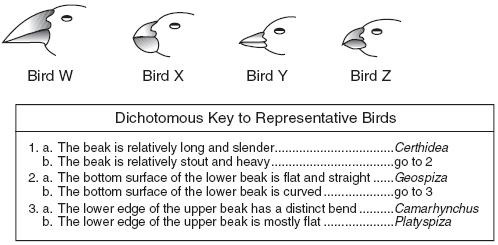
What is the name of bird W?
a)
Certhidea
b)
Geospiza
c)
Camarhynchus
d)
Platyspiza