
NEW
Font size
S
M
L
XL
 Worksheets
AV-W 8th Grade Science Skills
Total questions: 50
Worksheet time: 59mins
Name
Class
Date
1.
A proposed answer or educated guess
a)
observation
b)
hypothesis
c)
scientific theory
2.
Information that you obtain through your senses
a)
hypothesis
b)
observation
c)
experiment
3.
Instrument that measure temperature
a)
thermometer
b)
speedometer
c)
tape measure
4.

The volume of irregularly shaped objects can be measured using the ___________ method.
a)
guess and check
b)
water displacement
c)
meter stick
d)
mass and weight
5.

Which plant grew the most according to this line graph?
a)
Plant 1
b)
Plant 2
c)
Plant 4
d)
Plant 5
6.
The application of science and mathematics to solve problems that meet the needs of society and improve the quality of life is known as:
a)
technology
b)
engineering
c)
physics
d)
data
7.
Which of the following situations would NOT be an appropriate use of a meter stick?
a)
Measuring the length and width of a bathroom floor
b)
Measuring the distance down a school hallway
c)
Measuring the height of a ceiling
d)
Measuring the distance of a 5K race
8.
This scientific tool is used to find the mass of objects.
a)
graduated cylinder
b)
metric ruler
c)
beaker
d)
balance
9.
To calculate the volume of a rectangular solid like a tissue box, use this formula:
a)
mass divided by volume
b)
length times width times height
c)
y = mx + b
d)
force = mass times acceleration
10.
The final step to a scientific experiment is to:
a)
publish data in the scientific community
b)
form a hypothesis
c)
create a prototype
d)
analyze data
11.
What tool do we use to measure liquid volume?
a)
graduated cylinder
b)
beaker
c)
metric ruler
d)
balance
12.
What is the measurement system that scientist use?
a)
The Metric System
b)
The Customary System
13.
Should experiments be repeated over and over to see if the results are the same each time?
a)
yes
b)
no
14.

Put the liquids in order from most dense to least dense?
a)
4, 3, 2, 1
b)
1, 2, 3, 4
15.

What is the name of this piece of glassware?
a)
Beaker
b)
Graduated Cylinder
c)
Test Tube
d)
Flask
16.

What does this tool measure?
a)
Volume
b)
Mass
c)
Temperature
d)
Length
17.
Calculate the following density: Mass: 10 g Volume: 5 cm³
a)
10 g/cm 3
b)
2 g/cm 3
c)
50 g/cm 3
18.
In the equation, D=M/V, V stands for...
a)
Velociraptor
b)
Volume
c)
Viscosity
19.

I have two objects with the same volume but different masses. Which object will be more dense?
a)
The object with less weight.
b)
The object with more weight.
c)
The object with more mass.
d)
The object with less mass.
20.
What are the units for measuring density of a solid?
a)
grams
b)
m/s2
c)
g/cm3
d)
newtons
21.
The metric unit for length is:
a)
Inches
b)
Gram
c)
Meter
22.
I saw a black dog running in the park.
a)
Quantitative Observation
b)
Qualitative Observation
c)
Inference
d)
Prediction
23.

What is this tool called and what would it be used to measure?
a)
Meter stick and distance
b)
Meter stick and mass
c)
beaker and volume
d)
graduated cylinder and volume
24.

What is this tool called?
a)
Beaker
b)
Flask
c)
Graduated Cylinder
d)
Measuring Cup
25.
The base unit for mass is the
a)
meter
b)
gram
c)
kilogram
d)
liter
26.
The base unit for volume is the
a)
second
b)
gram
c)
meter
d)
liter
27.
What is an observation?
a)
A scientific statement based on ideas
b)
Using your senses to notice what is going on around you
c)
To be unaware of your surroundings
28.
What is a dependent variable?
a)
the variable that causes the change
b)
the variable that remains the same
c)
the variable that we expect to be changed
d)
the manipulated variable
29.
What is a control group in an experiment?
a)
a group in an experiment that remains unchanged for purpose of comparison (missing the IV)
b)
a group in an experiment that changes to compare the IV and DV variables
c)
the manipulated group
30.
The factor in an experiment that will be changed.
a)
dependent variable
b)
independent variable
c)
controlled variable
31.

Which of the following is a quantitative observation?
a)
The bird is very colorful.
b)
The bird has 4 different colors on him.
c)
The bird has many, many feathers.
d)
It is a bird.
32.

What is a qualitative observation about this image?
a)
There are 10 mini trees in the picture.
b)
There are two color bushes in the picture.
c)
There is one power line going across in the air.
d)
There is art created from trees in this photo.
33.
When scientists collect data that is measurable with numbers, we call it...
a)
qualitative data
b)
quantitative data
c)
hypothetical data
d)
graphing data
34.
Data that is descriptive and uses adjectives is called...
a)
quantitative
b)
qualitative
c)
non-scientific
d)
hypothesis
35.

How many variables can be tested in a controlled experiment?
a)
one
b)
two
c)
three
d)
as many as possible
36.
Why do we want to test one variable at a time?
a)
Because it is hard to setup a data table with more
b)
To know what is causing the changes
c)
It is what has always been done
d)
No one really knows
37.

A Microscope is a
a)
tool to help you see objects that are far away
b)
tool to make objects appear much larger
c)
tool to help you weigh an object
d)
tool to protect your eyes
38.

What is this science tool?
a)
sun glasses
b)
safety goggles
c)
hand lenses
d)
beaker
39.

Name the tool pictured
a)
Beaker
b)
Graduated cylinder
c)
Test tubes
d)
Flask
40.

Name the tool pictured
a)
Test tube
b)
Pipette
c)
Dissecting dish
d)
Petri Dish
41.

Primary Purpose:
a)
hold liquids
b)
weigh the mass of an object
c)
accurately measure the volume of liquids
d)
compare volumes of liquids
42.
What scale measures the acidity of a substance?
a)
pH Scale
b)
Periodic Table
43.
The pH scale ranges from
a)
0-14
b)
0-7
c)
H-Rn
d)
Base-Neutral
44.
If a liquid has high viscosity, it probably has:
a)
strong resistance to flow
b)
weak resistance to flow
45.

What is viscosity?
a)
A liquid's resistance to flow.
b)
a liquids flow.
c)
a liquid
d)
gas to solid.
46.

What is the term for a fluid's tendency to resist flow?
a)
Movement
b)
Silica
c)
Pressure
d)
Viscosity
47.
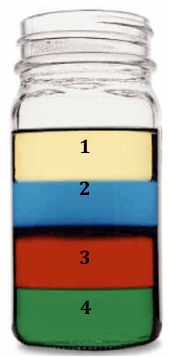
Put the liquids in order from most dense to least dense?
a)
4, 3, 2, 1
b)
1, 2, 3, 4
c)
3, 4, 2, 1,
d)
4, 3, 1, 2
48.

Which box has a higher density?
a)
Box A
b)
Box B
c)
cannot be determined
d)
they are the same
49.

Calculate the density of the cube.
a)
2 g/cm3
b)
4 g/cm3
c)
6 g/cm3
d)
8 g/cm3
50.

Calculate the density of the cube.
a)
2 g/cm3
b)
4 g/cm3
c)
6 g/cm3
d)
8 g/cm3
Reset

