
 Worksheets
Advanced Inheritance Patterns
Total questions: 30
Worksheet time: 1hrs 6mins


Hemophilia is a sex-linked, recessive trait. Which of the following describes the probability of hemophilia in the offspring of a man who does not have hemophilia and a woman whose father is a hemophiliac?
Each of their sons will have hemophilia.
None of their daughters will have hemophilia.
Their sons have a 25% chance of having hemophilia.
There is a 50% chance that their daughters will have hemophilia.

Alleles for the A and B blood cell antigens are codominant. The condition where no antigens are present on the blood cells (type O blood) is a recessive trait. Which set of parents can most likely produce a child with type O blood?
one parent with type AB blood, and the other parent with type A blood
one parent with type AB blood and the other parent with type O blood
one parent with heterozygous type A blood, and the other parent with type O blood
one parent with homozygous type A blood, and the other parent with homozygous type B blood

One of the parents of a child has phenylketonuria (PKU), which is caused by recessive alleles. The other parent does not have the PKU alleles. What is the chance that the couple will have a child with phenylketonuria?
0%
50%
75%
100%

Hitchhiker's thumb (H) is dominant to no hitchhiker's thumb (h). A woman who does not have hitchhiker's thumb marries a man who is heterozygous for hitchhiker's thumb. What is the probable genotypic ratio of their children?
0% Hh: 100% hh
50% Hh: 50% hh
75% Hh: 25% hh
100% Hh: 0% hh

What is the genotype of individual 6?
XHXH
XHXh
XHY
XhY

This diagram shows a diploid cell with two pairs of homologous chromosomes.
Due to independent assortment, what is the possible genetic make-up of gametes produced by this organism?
SsTt
Ss, Tt
S, s, T, t
ST, St, sT, st

The table lists the trials for fruit color where allele R exhibits incomplete dominance over allele R'.
Heterozygous fruit have orange phenotypes. What percent of offspring are expected to have an orange phenotype if the parent plants are orange (RR') and yellow (R'R')?
25%
50%
75%
100%

Mendel hypothesized that reproductive cells have only one factor for each inherited trait. This hypothesis is supported by which observation?
Haploid cells are produced by mitosis.
Diploid cells are produced by mitosis.
Haploid cells are produced by meiosis.
Diploid cells are produced by meiosis.

A human baby boy inherits a recessive allele from his mother. In which circumstance would he most likely show the trait coded for by the recessive allele?
The baby inherits the dominant allele from his father.
The allele is on an autosomal chromosome and the baby is a twin.
The allele is on the X chromosome.
The allele is on the Y chromosome.

In cattle the allele for cloven hooves (H) is dominant over the allele for mule-foot hooves (h). The phenotype for each trait is shown in this picture.
What is the probability of cloven hooves in the offspring of parents that are heterozygous for the trait?
25%
50%
75%
100%

The four butterflies in the illustrations represent the offspring in the F 1 generation. Which statement is best supported by the phenotypes of these offspring?
The F generation is composed only of males.
Two of the offspring in the F generation will not be able to reproduce.
The F generation is the result of a dihybrid cross.
Two of the offspring in the F 1 generation will experience a spontaneous mutation.

Chickens can have different types of feathers. Frizzled feathers curl toward a chicken’s head. Assume that feather type is determined by a single gene and that the allele for frizzled feathers is dominant over the allele for straight feathers. In a cross between two chickens with straight feathers, what percentage of the offspring can be expected to have frizzled feathers?
0%
25%
50%
100%


According to the Punnett square, what percentage of male offspring will have the disorder?


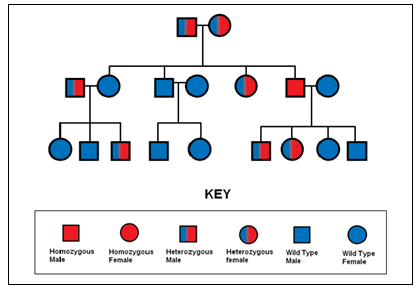

What is the genotype for individual IV-1?


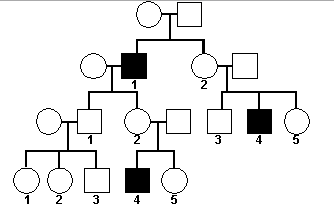
(hint: check your notes - "modes of inheritance")

