
 Worksheets
STPM Biology MCQ Ch 1 Biological Molecules (Nucleic Acids)
Total questions: 25
Worksheet time: 13mins


The repeating units in both DNA and RNA are called
hydrogen bonds
nucleic acids
nucleotides
amino acids
What nucleotide base does RNA contain that DNA does not?
adenine (A)
cytosine (C)
uracil (U)
thymine (T)

What is A?
Phosphate Group
Pentose Sugar
Nitrogenous Base
Adenosine Triphosphate


Which number represents a nucleotide?
1
2
3
4
Which is false regarding RNA?
There are three types of RNA which are mRNA, rRNA, tRNA
RNA is longer compared to DNA
Thymine in DNA is replaced by uracil in RNA
RNA is a single polynucleotide
What are purines and pyrimidines?
Purine is single ring; Pyrimidine is double ring
Names of different types of protein
Purine is A and G; Pyrimidine is C and T
Names of different types of DNA

1


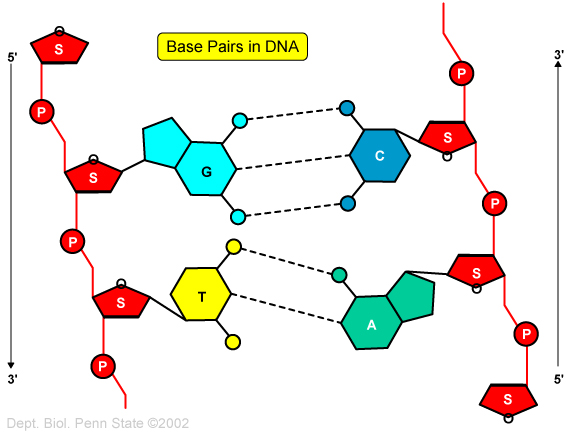

The bonds that join nucleotides together in DNA and RNA are called:
Peptide Bonds
Ester Bonds
Glycosidic Bonds
Phosphodiester Bonds

anti-parallel
deoxyribosic
helical
semi-conservative
If a strand of DNA contains 20% of Thymine, then how much Guanine would be present?
30%
20%
80%
10%

The picture below shows the steps of DNA replication beginning with step one and ending with step three.
Because you are reusing the old, or parent, DNA strand DNA replication is said to be
Semi- Conservative
Semi-discontinuous
Continuous
Fully-Conserveative

The function of the nucleic acid is --
to store and transmit genetic information inherited from your parents
to maintain our body temperature
to build up muscles bones and other body parts
to regulate sugar in your blood and give your cells energy
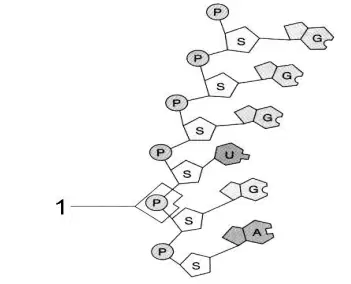
The molecular fragment represented in the accompanying figure is:
ATP.
RNA.
a nucleotide.
a polysaccharide.

