
 Worksheets
U5 Genetics Review
Total questions: 55
Worksheet time: 52mins
Name
Class
Date
1.

Which of the following best describes a DNA molecule?
a)
double helix
b)
contains ribose
c)
made of amino acids
d)
contains Uracil
2.
Which of the following units are repeatedly joined together to form a strand of DNA? (This is the MONOMER of DNA.)
a)
amino acids
b)
nucleotides
c)
fatty acids
d)
polysaccharides
3.

In DNA, the amount of Adenine present is always equal to the amount of
a)
cytosine
b)
guanine
c)
thymine
d)
uracil
4.
Adenine bonds with ______________.
a)
Guanine
b)
Thymine
c)
Cytosine
d)
Adenine
5.
Guanine bonds with ______________.
a)
Adenine
b)
Guanine
c)
Cytosine
d)
Thymine
6.

Why is DNA important?
a)
it is very small and very complicated
b)
it's in everything
c)
it serves as the blueprint for traits of all living things
d)
because we eat it every day for energy
7.
What are the 4 bases?
a)
adenine, thymine, cytoplasm, and guanine
b)
adenine, thymine cytosine, and guanine
c)
adenine, thymine, cytosine, and gylcerol
d)
adenine, thymine, cytosine, and glucose
8.

What determines the code, or information, of a DNA molecule?
a)
the shape (structure) of the nitrogen bases
b)
the order (sequence) of the nitrogen bases
c)
the color of the nitrogen bases
d)
the frequency (number) of nitrogen bases
9.
Which 2 molecules form the sides (backbone) of the DNA ladder?
a)
sugar and adenine
b)
sugar and a hydrogen bond
c)
sugar and the nucleus
d)
sugar and phosphate
10.
Which organelle is DNA usually found in?
a)
cell membrane
b)
vacuole
c)
chloroplast
d)
nucleus
11.
Any change in the sequence of DNA is...
a)
transgenic shift
b)
Single Genotype
c)
Monohybrid Trait
d)
Mutation
12.
DNA is often considered the "______________" of life.
a)
Blueprint
b)
Mistake
c)
Swimming Pool
d)
Smelly Cheese
13.
Which sequence of DNA bases would pair with this partiaal strand
ATG TGA CAG
ATG TGA CAG
a)
ATG TGA CAG
b)
TAC ACT GTC
c)
GTA AGT GAC
d)
CAT TCA CTG
14.
What does DNA stand for?
a)
Duplicate Nucleotide Acids
b)
Deoxyribonucleic Acid
c)
Deoxy Nucleus Acid
15.
What is the correct complimentary strand for:
ACCTGAT
ACCTGAT
a)
TGGCTA
b)
CTTACA
c)
GTTACTA
16.
What has DNA?
a)
animals
b)
plants
c)
bacteria
d)
all of the above
17.
The DNA nucleotide is composed of three parts. Which two components make up the nucleotide backbone?
a)
ribose sugar and base
b)
ribose sugar and phosphate group
c)
nitrogen base and deoxyribose sugar
d)
deoxyribose sugar and phosphate group
18.
A string of nucleotides that make a specific trait is called?
a)
gene
b)
ribosome
c)
RNA
d)
DNA
19.

The yellow part of this picture is DNA. What do you think the turquoise part around it is?
a)
chromosome
b)
gene
c)
DNA
d)
ACTG
20.

What is a gene?
a)
A bundle (like a hot dog bun) that the DNA is packed into
b)
something inside the nucleus
c)
a piece of DNA
d)
all of your DNA
21.

As a silly analogy, we talked about the bun of a hot dog as the ...
a)
genes of cells
b)
chromosomes
c)
DNA
d)
ingredients for life
22.

As a silly analogy, we talked about the meat of a hot dog as the ...
a)
genes of cells
b)
chromosomes
c)
DNA
d)
ingredients for life
23.

If you sliced a little piece of hot dog meat, what would that be like (keeping with our hot dog analogy)?
a)
a gene
b)
chromosome
c)
DNA
d)
ingredients for life
24.
The chemicals that make up DNA (A, C, T, & G) are like...
a)
the ingredients in a recipe.
b)
the steps in directions.
c)
a map to follow.
d)
really cool and whatever.
25.
A process in which DNA has the unique ability to make an exact copy of itself.
a)
Replication
b)
Translation
c)
Transcription
26.
Rosalind Franklin's "Photo 51" allowed Watson and Crick to determine the ___ of DNA.
a)
Shape
b)
Backbone
c)
Nitrogen bases
d)
Hydrogen bonds
27.

Who was responsible for the model shown?
a)
Oswald Avery, et. al.
b)
Watson and Crick
c)
Erwin Chargaff
d)
Linus Pauling
28.

Who was responsible for the experiment depicted by the image?
a)
Friedrich (Fritz) Miescher
b)
Watson and Crick
c)
Frederick Griffith
d)
Rosalind Franklin
29.

Nucleotides are made up of a sugar, phosphate, and..?
a)
nitrogenous base
b)
nucleic acid
c)
cholesterol
d)
fatty acid
30.
Identify the correct chart that matches the contribution to the scientist
a)
Mendel - studied peas plants to determine how traits are passed on.
Franklin - saw X-ray photograph of DNA
Watson & Crick - made a 3D model of DNA
Franklin - saw X-ray photograph of DNA
Watson & Crick - made a 3D model of DNA
b)
Mendel - make 3D model of DNA
Franklin - studied peas plants to determine how traits are passed on
Watson & Crick - saw X-ray photograph of DNA
Franklin - studied peas plants to determine how traits are passed on
Watson & Crick - saw X-ray photograph of DNA
c)
Mendel - saw X-ray photograph of DNA
Franklin - Made a 3D model of DNA
Watson & Crick - studied pea plants to determine how traits are passed on.
Franklin - Made a 3D model of DNA
Watson & Crick - studied pea plants to determine how traits are passed on.
d)
Mendel - made a 3D model of DNA
Franklin - Saw X-ray photograph of DNA
Watson and Crick - studied pea plants to determine how traits are passed on.
Franklin - Saw X-ray photograph of DNA
Watson and Crick - studied pea plants to determine how traits are passed on.
31.
What did Gregor Mendel use to discover the principles that rule heredity?
a)
Pea Plant
b)
Pigeons
c)
Pear trees
d)
Photosynthesis
32.
What did Mendel call the two kinds of traits exhibited by the pea plants (one coming from the father, one from the mother)?
a)
Genesis
b)
Elective traits
c)
Alleles
d)
Quadrants
33.
Gregor Mendel is known as the father of _________
a)
Modern Medicine
b)
Father of the Green Revolution
c)
Father of Genitics
d)
The Pea Plant Man
34.

Different forms a gene may have for a trait.
a)
chromosome
b)
gene
c)
mutation
d)
allele
35.
Speaking
a)
inherited
b)
acquired
36.
eye color
a)
inherited
b)
acquired
37.

Dog fetching
a)
inherited
b)
acquired
38.
Being talkative
a)
inherited
b)
acquired
39.
Living organisms inherit many traits from their parents. However, some traits are ____________ or learned from the environment,
a)
given
b)
acquired
c)
forced
40.
Which best describes an inherited trait?
a)
a characteristic one chooses to express
b)
a characteristic one receives from the food one eats
c)
a characteristic that is passed on from one's parents
d)
a characteristic that is influenced by one's surroundings
41.
Which is an example of a learned characteristic?
a)
color of a dog's fur
b)
color blindness of a person
c)
the ability of a mouse to run a maze
d)
a person's ability to roll their tongue
42.
Dominant or recessive?
tt
tt
a)
Dominant
b)
Recessive
43.
the passing of genetic traits from parent to offspring.
a)
heredity
b)
trait
c)
gene
d)
allele
44.
Which of the following alleles is homozygous recessive?
a)
Tt
b)
tt
c)
TT
d)
T
45.
Which of the following is a phenotype?
a)
Aa
b)
red hair
c)
heterozygous
d)
DNA
46.

What is Bb?
a)
Homozygous
b)
Heterozygous
c)
Recessive
d)
Alleles
47.
What are the two genotypes that show the DOMINANT Phenotype
a)
GG, gg
b)
GG, Gg
c)
Gg, gg
48.
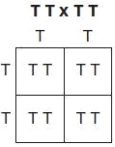
What ratio of the offspring from the cross shown will be homozygous recessive for the trait of tallness?
a)
0 in 4
b)
1 in 4
c)
2 in 4
d)
4 in 4
49.

In the punnett square shown, what is the genotypes of the two parents?
a)
RW and RR
b)
RW and WW
c)
RR and WW
d)
RW and RR
50.
Which of the following is homozygous dominant?
a)
Yy
b)
Y
c)
yy
d)
YY
51.
Which term refers to a farmer choosing the best corn from this year to plant next year?
a)
natural selection
b)
selective breeding
c)
genetic engineering
d)
genetic transformation
52.
Making changes in the DNA of an organism is
a)
selective breeding
b)
artificial selection
c)
genetic engineering
d)
genetic transformation
53.
Who was the first adult mammal successfully cloned?
a)
Dolly the Sheep
b)
Copy Cat the Cat
c)
Donald Trump the Donald
d)
Agouti Gout the Mouse
54.
True or False: Cloning humans is a federally accepted practice in the United States.
a)
True
b)
False
55.
The genetic make up of a trait:
a)
Genotype
b)
Phenotype
c)
Chromosome
d)
Hybrid
100 %

