
 Worksheets
Sponges, Cnidarians and Worms
Total questions: 23
Worksheet time: 14mins
Name
Class
Date
1.
butterflies have
a)
radial symmetry
b)
bilateral symmetry
c)
no symmetry
2.
humans have
a)
radial symmetry
b)
bilateral symmetry
c)
no symmetry
3.
sponges have
a)
radial symmetry
b)
bilateral symmetry
c)
no symmetry
4.
sea anemones have
a)
radial symmetry
b)
bilateral symmetry
c)
no symmetry
5.
A good title for a book of animals that feature only vertebrates would be
a)
Earth's Invertebrate Animals
b)
Earth's Animals
c)
The Animal Kingdom
d)
Animals with Backbones
6.
Polyps and Medusa are
a)
cnidarians
b)
sponges
c)
platyhelminthes
d)
roundworms
7.
What is one of the four key functions of animals?
a)
obtaining food and oxygen
b)
swimming
c)
making sound
d)
caring for young
8.
What is the correct order of relationships from basic to more complex?
a)
cells, tissues, organs, systems
b)
tissues, organs, systems, cells
c)
organs, systems, cells, tissues
d)
cells, organs, tissues, systems
9.
Some parasites of dogs include
a)
tapeworms
b)
planaria
c)
medusa
d)
earthworms
10.
Budding is a form of _________.
a)
sexual reproduction.
b)
asexual reproduction.
11.
A tissue is a group of _______ that work together to perform a job.
a)
organs
b)
system
c)
cells
d)
organisms
12.
An animal without a backbone is called a(n)
a)
vertebrate
b)
invertebrate
c)
larva
d)
parasite
13.
The highest level of organization in an animal is a(n)
a)
cell
b)
tissue
c)
organ
d)
system
14.
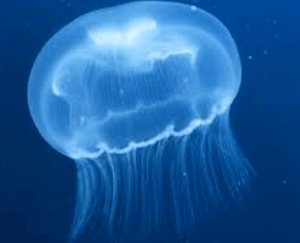
This form of cnidaria is known as a _______.
a)
polyp
b)
medusa
15.
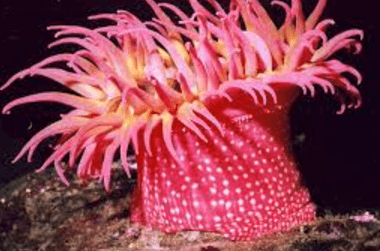
This form of cnidaria is known as a __________.
a)
medusa
b)
polyp
16.
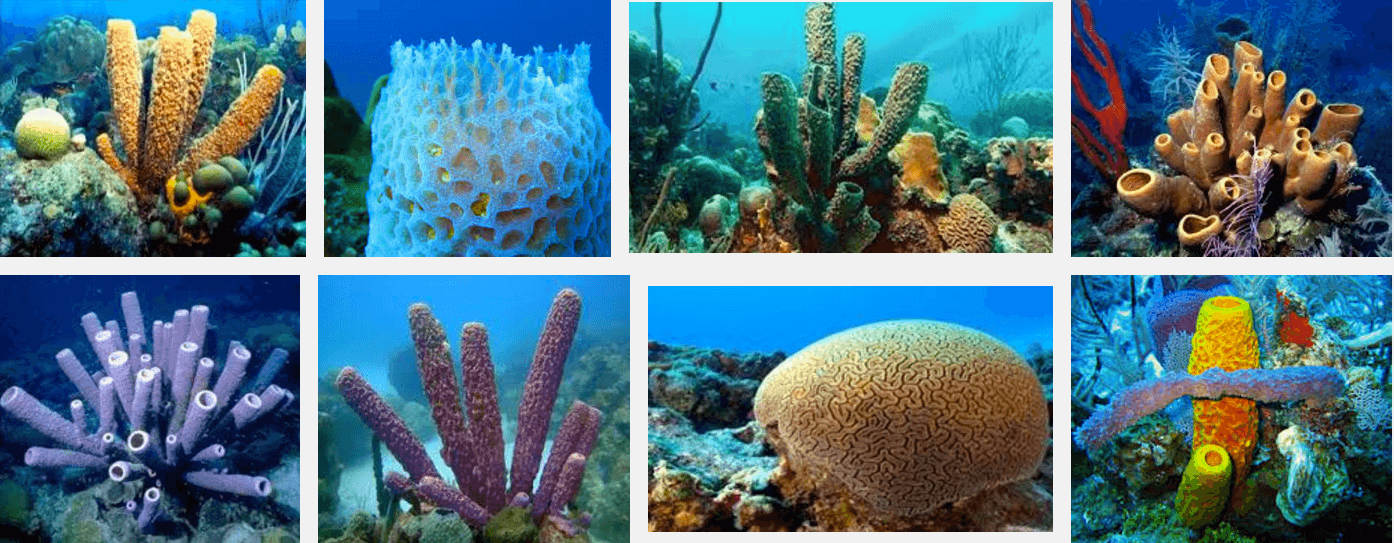
These belong to __________ phylum.
a)
porifera (sponges)
b)
cnidaria
c)
echinodermata
d)
mollusca
17.
Between 97% of all animals on earth can be classified as _____.
a)
invertebrates
b)
vertebrates
c)
reptiles
d)
mammals
18.
______________ are invertebrates that have two different body plans – polyp and medusa
a)
Cnidarians
b)
Worms
c)
Sponges
19.
One characteristic by which animals are classified is
a)
Their body structure
b)
Where they are found
c)
How they get their oxygen
20.
Which of the following is not a characteristic of a sponge
a)
Has collar cells
b)
Can reproduce sexually and asexually
c)
Has stinging cells
d)
Filters water
21.
Cnidarians capture food and defend themselves by
a)
stinging cells
b)
collar cells
c)
budding
d)
forming a hard skeleton
22.
The highest level of organization in an animal is
a)
cell
b)
tissue
c)
organ
d)
system
23.
Which of the following organisms has a closed circulatory system
a)
round worms
b)
flatworms
c)
segmented worms
d)
sponges
100 %

