
 Worksheets
Unit 9: Ecology
Total questions: 40
Worksheet time: 43mins
Name
Class
Date
1.
All of the following statements concerning characteristics of predator-prey relationship are correct EXCEPT:
a)
Camouflage is an adaptation that protects prey.
b)
A rise in the population of predators is followed by a decreased in the population of prey.
c)
A rise in the population of prey is often followed by a rise in the population of predators.
d)
The population of predators most often eliminates the population of prey
2.

Which kind of dispersion is #1?
a)
clumped
b)
random
c)
uniform
3.
The process used by some producers of capturing energy from nonliving sources such as gasses emitted in deep sea vents.
a)
Chemosynthesis
b)
Photosynthesis
c)
Percolation
d)
Respiration
4.
Invasive species are:
a)
non-native
b)
harmful to an ecosystem
c)
organisms that can lack predators in the new environment
d)
all of the answers are correct
5.

Which letter shows a mature, well-established population in favorable conditions?
a)
A
b)
B
c)
C
d)
D
6.

Which letter shows the the exponential growth of a population?
a)
A
b)
B
c)
C
d)
D
7.
Two animals live together in close association. One benefits, while the other is unaware of the first animal. The relationship is best described as
a)
Parasitism
b)
Mutualism
c)
Commensalism
d)
Predation
8.

Refer to the diagram of the survivorship curve.
Which curve best describes an organism that invests a lot of energy in parenting?
Which curve best describes an organism that invests a lot of energy in parenting?
a)
A
b)
B
c)
C
d)
this is not a survivorship curve
9.
Which of the following encompasses all the others?
a)
ecosystem
b)
community
c)
population
d)
individual
10.
Which of the following is NOT an abiotic factor?
a)
air
b)
water
c)
decomposers
d)
temperature
11.
The maximum population size for a species based on the environmental factors is called
a)
ecological footprint
b)
carrying capacity
c)
population growth
d)
environmental capacity
12.
A herd of zebras would be considered a
a)
community
b)
species
c)
ecosystem
d)
population
13.
Two organisms of different species exist in a relationship in which each individual benefits from the activity of the other:
a)
commensalism
b)
parasitism
c)
herbivory
d)
mutualism
14.

Which organism contains the most energy?
a)
Rabbit
b)
Grains
c)
Birds
d)
Mice
15.

Which of the following is an omnivore?
a)
Rabbit
b)
Carrots
c)
Owls
d)
Birds
16.
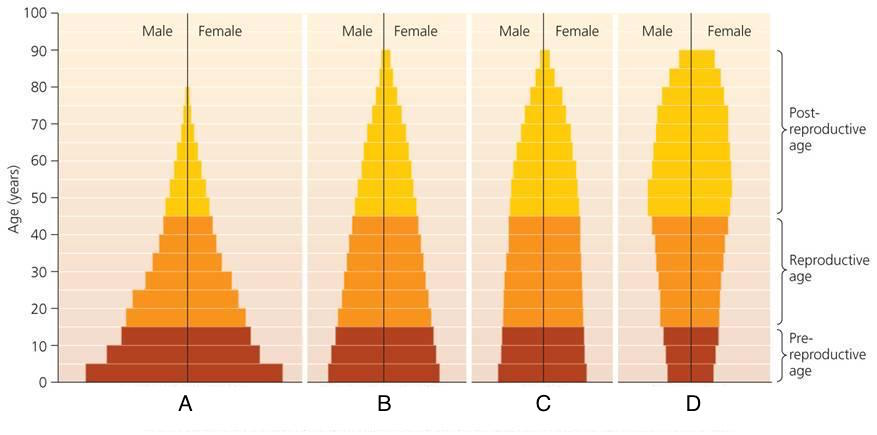
Which of these populations is experiencing the fastest growth?
a)
A
b)
B
c)
C
d)
D
17.
All of the following increases the concentration of CO2 in the atmosphere EXCEPT
a)
photosynthesis
b)
slash and burn clearing of tropical rainforests
c)
burning of fossil fuels
d)
burning of wood for cooking and heating
18.

In which trophic level would the biological magnification of the pesticide DDT be most evident?
a)
oak tree
b)
caterpillar
c)
bluetit
d)
sparrowhawk
19.

A toxic pollutant would be found in highest concentrations in which species?
a)
A
b)
B
c)
C
d)
D
20.

Which would have the greatest biomass?
a)
A
b)
B
c)
C
d)
D
21.
There are 200 bears in an area. 10 emigrate, 15 immigrate, 10 are born and 20 die. How many are left?
a)
195
b)
205
c)
200
d)
260
22.

What is the rate of change for the population grown without a parasite from day 200 to day 400?
a)
200 days
b)
a loss of approximately 15 beetles/200 days
c)
a loss of approximately 30 beetles/200 days
d)
30 beetles
23.
How do matter and energy flow differently?
a)
Energy flows in one direction, matter is recycled
b)
Matter flows in one direction, Energy is recycled
c)
Energy and Matter are both recycled
d)
Energy and Matter both flow in one direction
24.

A team of ecologists observed feeding patterns of several populations in the desert. The energy pyramid shown below depicts the feeding patterns the ecologists observed. Which of the following best explains the difference in the amount of available energy in the trophic levels of the desert ecosystem?
a)
There is less energy available in the producers because their tissues are less dense than those at higher trophic levels.
b)
There is more energy available in the second trophic level because less energy is needed for hunting compared to the higher trophic levels.
c)
There is less available energy in the fourth trophic level because of the loss of energy through metabolism in each of the lower trophic levels.
d)
There is more available energy in the birds of prey because they have greater muscle mass for storing energy than organisms in lower trophic levels have.
25.
________ grow slowly over time, cares for its young over a long period of time and is usually near the carrying capacity of its ecosystem.
a)
K-strategists
b)
R-strategists
c)
Uniform strategists
d)
environmentalists
26.
A species that exerts a large, positive impaction on its ecosystem is known as a:
a)
Keystone species
b)
Invasive species
c)
Indicator species
d)
Poached species
27.
Bacteria found in the soil and in the root nodules of plants are able to convert atmospheric nitrogen into nitrates and ammonia that are usable for plants. What is this process called?
a)
nitrogen fixation
b)
denitrification
c)
cellular respiration
d)
photosynthesis
28.

Which of the following statements is true regarding carrying capacity?
a)
The carrying capacity for P. aurelia was reached on Day 14 and is 275 cells. This is the highest number.
b)
The carrying capacity for P. aurelia was reached at Day 10 when grown alone and Day 15 when grown with P. caudatum.
c)
The carrying capacity for P. aurelia when grown alone was reached on Day 5 and is 175 cells.
d)
The carrying capacity for P. aurelia and P. caudatum is similar when grown alone and together.
29.
Which of the following represents the combination of all relevant environmental variables in which a species or population lives?
a)
clade
b)
hybrid zone
c)
phylogeny
d)
ecological niche
30.

When two species of cattails are grown together, they grow at different water depths and coexist. When grown alone, they grow at similar water depths. Which of the following is best demonstrated by the data?
a)
natural selection
b)
character displacement
c)
resource partitioning
d)
ecological succession
31.
A team of ecologists observed feeding patterns of several populations in the desert. The energy pyramid shown below depicts the feeding patterns the ecologists observed. Which of the following best explains the difference in the amount of available energy in the trophic levels of the desert ecosystem?
a)
There is less energy available in the producers because their tissues are less dense than those at higher trophic levels.
b)
There is more energy available in the second trophic level because less energy is needed for hunting compared to the higher trophic levels.
c)
There is less available energy in the fourth trophic level because of the loss of energy through metabolism in each of the lower trophic levels.
d)
There is more available energy in the birds of prey because they have greater muscle mass for storing energy than organisms in lower trophic levels have.
32.

What effect will an invasive species have on the carrying capacity of an ecosystem?
a)
The carrying capacity will increase
b)
The carrying capacity for everyone will decrease
c)
The carrying capacity will only decrease for those in competition for same resource
d)
The carrying capacity for all animals will stay the same
33.

What would happen in the case of a drought?
a)
iguanas would increase
b)
Eagles would increase
c)
grass would increase
d)
all organisms would decrease
34.

This population pyramid shows that
a)
the Ukraine population is in a rapid decline
b)
the Ukraine population is in a rapid increase
c)
the Ukraine population is in a stable and steady state
d)
men outlive women in the Ukraine
35.
Which of the following statements is true regarding carrying capacity?
a)
The carrying capacity for P. aurelia was reached on Day 14 and is 275 cells. This is the highest number.
b)
The carrying capacity for P. aurelia was reached at Day 10 when grown alone and Day 15 when grown with P. caudatum.
c)
The carrying capacity for P. aurelia when grown alone was reached on Day 5 and is 175 cells.
d)
The carrying capacity for P. aurelia and P. caudatum is similar when grown alone and together.
36.
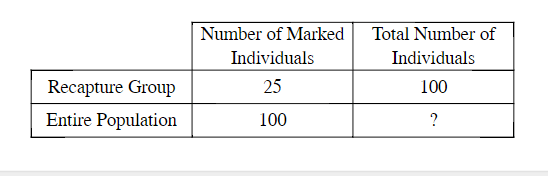
Researchers used the mark-recapture method to estimate the number of individuals in a population. Using the results presented in the table below, estimate the total number of individuals in the population. Give your answer to the nearest whole number.
a)
50
b)
250
c)
400
d)
450
37.
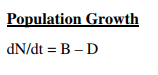
There are 300 falcons living in a certain forest at the beginning of 2013. Suppose that every year there are 50 falcons born and 30 falcons that die.
What is the population growth rate (include units)? Interpret the value.
a)
100
b)
50
c)
20
d)
10
38.
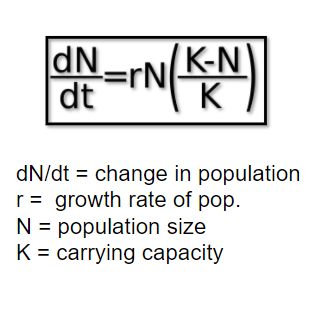
If a population has a carrying capacity (K) of 1000, and the growth rate (r) is 1.1, what is the population growth when the population (N) is 500?
a)
147
b)
275
c)
337
d)
1124
39.

What statement is TRUE about the graph?
a)
The prey is the green line because there needs to be more prey than predators.
b)
The prey is the red line because there needs to be more predators than prey.
c)
The green line is the producers
d)
The red line is the producers
40.
My favorite class of all time is...
a)
AP Biology
b)
not this one
c)
not this one
d)
not this one
100 %

