
 Worksheets
Chapter 12 Quiz
Total questions: 20
Worksheet time: 11mins
Name
Class
Date
1.
During replication, which sequence of nucleotides would bond with the DNA sequence TATGA?
a)
TATGA
b)
ATACT
c)
CACTA
d)
AGTAT
2.
The scientist(s) responsible for the discovery of bacterial transformation is (are)
a)
Watson and Crick
b)
Avery
c)
Griffith
d)
Franklin
3.
Which of the following does NOT describe the structure of DNA?
a)
double helix
b)
long chain of nucleotides
c)
contains adenine-guanine pairs
d)
sugar-phosphate
4.
What did Hershey and Chase's work show?
a)
Genes are probably made of DNA.
b)
Genes are probably made of protein.
c)
Viruses contain DNA but not protein.
d)
Bacteria contain DNA but not protein.
5.
The two "backbones" of the DNA molecule consist of
a)
adenines and sugars.
b)
phosphates and sugars.
c)
adenines and thymines.
d)
thymines and sugars.
6.
When prokaryotic cells copy their DNA, replication begins at
a)
one point on the DNA molecule.
b)
two points on opposite ends of the DNA molecule.
c)
dozens to hundreds of points along the molecule.
d)
opposite ends of the molecule.
7.
Compared to eukaryotic cells, prokaryotic cells contain
a)
much more DNA.
b)
much less DNA.
c)
twice as much DNA.
d)
the same amount of DNA.
8.
The process by which one strain of bacterium is apparently changed into another strain is called
a)
transcription.
b)
transformation.
c)
duplication.
d)
replication.
9.
Bacteriophages are
a)
a form of bacteria.
b)
enzymes.
c)
coils of DNA.
d)
viruses.
10.
Before DNA could be shown to be the genetic material in cells, scientists had to show that it could
a)
tolerate high temperatures.
b)
carry and make copies of information.
c)
be modified in response to environmental conditions.
d)
be broken down into small subunits.
11.
A nucleotide does NOT contain a
a)
5-carbon sugar.
b)
protein.
c)
nitrogen base.
d)
phosphate group.
12.
According to Chargaff's rule of base pairing, which of the following is true about DNA?
a)
A = T, and C = G
b)
A = C, and T = G
c)
A = G, and T = C
d)
A = T = C = G
13.
The bonds that hold the two strands of DNA together come from
a)
the attraction of phosphate groups for each other.
b)
strong bonds between nitrogenous bases and the sugar-phosphate backbone.
c)
hydrogen bonds between nitrogenous bases.
d)
carbon-to-carbon bonds in the sugar portion of the nucleotides.
14.

This picture shows the process of DNA
a)
replication.
b)
digestion.
c)
transformation.
d)
transpiration.
15.
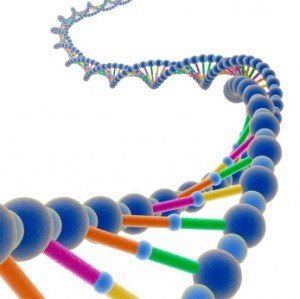
Which of the following best describes a DNA molecule?
a)
double helix
b)
contains ribose
c)
made of amino acids
d)
contains Uracil
16.
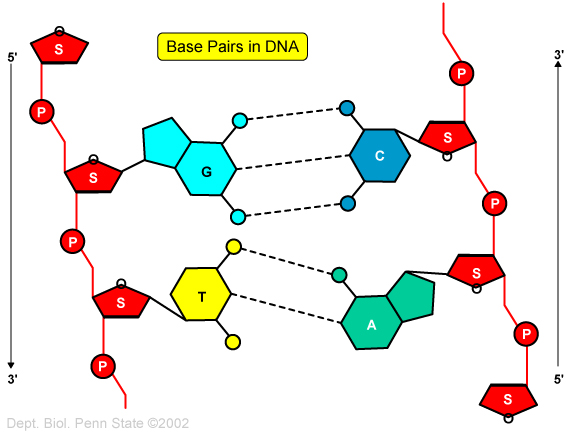
Nitrogenous bases are joined by which type of bond?
a)
polar bonds
b)
ionic bonds
c)
covalent bonds
d)
hydrogen bonds
17.
What are the three components of a nucleotide?
a)
sugar, hydrogen, nitrogen base
b)
sugar, oxygen, nitrogen base
c)
sugar, phosphate, nitrogen base
d)
sugar, phosphate, protein
18.
Which enzyme is responsible for adding nucleotides ("The Builder")?
a)
Topoisomerase
b)
DNA Polymerase
c)
Ligase
d)
Primase
19.
Which type of sugar is in DNA?
a)
Deoxyribose
b)
Ribose
c)
Table sugar
d)
There is no sugar in DNA.
20.
Which of the following units are repeatedly joined together to form a strand of DNA?
a)
amino acids
b)
nucleotides
c)
fatty acids
d)
polysaccharides
100 %

