
 Worksheets
Evolution
Total questions: 31
Worksheet time: 17mins
Name
Class
Date
1.

Evolution can best be described as:
a)
a quick process that involves individuals in a species
b)
a process that eliminates the chance of extinction
c)
a gradual process that is based on good adaptations in an entire species
d)
a process that relies on migration to provide genetic variety
2.

Which of the following is a term for a group of similar organisms that can reproduce fertile offspring?
a)
individual
b)
population
c)
species
d)
fossil
3.

Who is credited with developing the theory of evolution?
a)
Gregor Mendel
b)
Charles Darwin
c)
Alfred Wallace
d)
Rosalind Franklin
4.
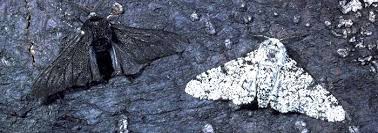
Predict which moth would increase in population.
a)
light
b)
dark
5.
The environment around Manchester, England, changed during the Industrial Revolution. How did this change affect peppered moths living in the area?
a)
Natural selection favored moths with dark wings because predators could not see them on the soot-colored trees.
b)
Natural selection favored moths with white wings that were easy for predators to see.
c)
Natural selection favored moths with white wings because predators could not see them on the soot-colored trees.
d)
Natural selection caused moths with white wings to become extinct.
6.

Which term refers to the process by which individuals that are better suited to the environment survive and reproduce therefore passing down their genes to their offspring?
a)
Evolution
b)
Variation
c)
Adaptation
d)
Natural Selection
7.

Darwin hypothesized that organisms with traits that are best suited to the environment will ________________
a)
increase in number
b)
become extinct
c)
have fewer offspring than organisms with unfavorable traits.
d)
have difficulty adapting.
8.

Which of the following is NOT an example of natural selection?
a)
People breeding hamsters for their fur color to get a desired result.
b)
Insect populations developing resistance to certain pesticides.
c)
Bacteria becoming resistant to antibiotics.
d)
Male birds of certain species developing colorful feathers to attract female mates.
9.

When an organism completely dies out, it is called.....
a)
adaption
b)
extinction
c)
fossilization
d)
mutation
10.

Which of the following is an example of natural selection?
a)
Bears moving into a new part of a forest over many generations.
b)
A tree growing toward sunlight.
c)
Shrubs growing longer thorns over many generations.
d)
A plant sprouting between rocks.
11.

Which of the following is an example of selective breeding?
a)
Populations of lizards that have a certain trait become more numerous after a change in climate.
b)
Farmers allow only sheep that produce the best wool to breed.
c)
A population of bacteria develops resistance to an antibiotic.
d)
A population of insects develops resistance to a pesticide after farmers repeatedly use the same pesticide to kill the insects
12.

What are the traces or remains of an organism that lived long ago?
a)
species
b)
fossil
c)
rock
d)
adaptation
13.

According to the diagram, which fossil is the oldest?
a)
Crinoid
b)
Trilobite
c)
Ammonite
d)
Fern
14.

According to the diagram, which organism is older: the ammonite or the coral?
a)
ammonite
b)
coral
15.

Many animals share homologous structures. Choose all of the statements considered true about these homologous structures and evolution.
a)
1, 3, 5
b)
2, 3, 6
c)
3, 4, 5
d)
6, 5, 3
16.
What is a vestigial structure?
a)
A body part or behavior that helps an organism to survive in its environment, like camouflaged brown fur
b)
A body part that is slightly different between members of the same species, like running speed
c)
A body part that an organism still posses but no longer has a function, like a whale's hip bones
d)
A body part, like a forelimb, that looks similar across many species of organisms
17.

Mutations are important because they bring about:
a)
death of the organism in which they develop.
b)
genetic variation needed for a population to evolve.
c)
benefits for the individual, not for the population.
d)
Hardy-Weinberg equilibrium within a population.
18.

In times of environmental change, the more genetic variation a population has the more likely it will:
a)
become extinct
b)
migrate to a new environment
c)
survive and evolve
d)
mutate
19.

If 10 people live on an island and no one can enter or exit, what is the only way new traits can be introduced into the population?
a)
Natural Selection
b)
Artificial Selection
c)
Selective Breeding
d)
Mutations
20.

Which of the following organisms in the kingdom Animalia are not closely related?
a)
mouse and hagfish
b)
mouse and lizard
c)
mouse and pigeon
d)
mouse and chimp
21.

Which species’ DNA is most similar to the DNA of the toothed whale?
a)
Hippopotamus
b)
Baleen Whale
c)
Grazing Mammals
d)
Camels
22.
What are the four points upon which Darwin's natural selection is based?
a)
genetic variation, overproduction of offspring, struggle for existence, and differential in survival and reproduction
b)
genetic drift, migration, mutation, and gene flow
c)
sexual reproduction, mutation, genetic variation, and survival of the fittest
23.

Female bullfrogs release thousands of eggs underwater that are then fertilized by the males. Once fertilized, the female will cover the egg mass with a jelly-like substance. The eggs hatch within a couple weeks. This illustrates which point of natural selection?
a)
genetic variation
b)
overproduction of offspring
c)
struggle for existence
d)
differential in survival and reproduction
24.

Which of the following explains the differential survival and reproduction that is shown in this image?
a)
The animals whose DNA codes for tall height are able to reach the food, eat, survive, reproduce, and pass on their tall genes. The shorter animals starve to death.
b)
Over time, the advantageous allele for tall height will build up in this population while the not helpful allele for short height will decrease in this population. If there is no further change in the environment, the population will eventually be mostly tall.
c)
There is a variety of heights in this population of animals.
d)
There was a drought this year and the vines of the fruits are not growing as long as they normally do. Consequently, the fruit is hanging much higher than usual.
25.

Which of the following explains the genetic variation in this image?
a)
The animals whose DNA codes for tall height are able to reach the food, eat, survive, reproduce, and pass on their tall genes. The shorter animals starve to death.
b)
Over time, the advantageous allele for tall height will build up in this population while the not helpful allele for short height will decrease in this population. If there is no further change in the environment, the population will eventually be mostly tall.
c)
There is a variety of heights in this population of animals.
d)
There was a drought this year and the vines of the fruits are not growing as long as they normally do. Consequently, the fruit is hanging much higher than usual.
26.

Which of the following explains the change over time that will occur as a result of what is seen in this image?
a)
The animals whose DNA codes for tall height are able to reach the food, eat, survive, reproduce, and pass on their tall genes. The shorter animals starve to death.
b)
Over time, the advantageous allele for tall height will build up in this population while the not helpful allele for short height will decrease in this population. If there is no further change in the environment, the population will eventually be mostly tall.
c)
There is a variety of heights in this population of animals.
d)
There was a drought this year and the vines of the fruits are not growing as long as they normally do. Consequently, the fruit is hanging much higher than usual.
27.

Bats are common in Texas, especially in rocky regions. Bats with longer hang claws are better able to survive because of their ability to cling to rock while resting. The longer hang claws are an example of:
a)
Adaptation
b)
Non-random mating
c)
Gene Flow
d)
Mutation
28.

A forest fire happened to destroy half of the rabbits in a northeastern forest. The result was the loss of their genes from the rabbit population. This is an example of:
a)
migration
b)
mutation
c)
gene flow
d)
genetic drift
29.

Due to a drought, a herd of buffalo traveled several miles to an area with available water. There the buffalo joined a larger herd and began mating which introduced new genes to the population. This is an example of:
a)
gene flow
b)
migration
c)
genetic drift
d)
mutation
30.

The similarities in early embryos lead scientists to believe that organisms:
a)
develop identically.
b)
all have the same internal structures.
c)
will produce the same fossils.
d)
have a common. ancestor
31.

Molecular similarities found in organisms indicate a common ancestor. These similarities include:
a)
the same DNA and cell membrane structure.
b)
same proteins produced.
c)
similar metabolism such as cellular respiration.
d)
all of these.
100 %

