
NEW
Font size
S
M
L
XL
 Worksheets
U3, #2: Fission & Fusion
Total questions: 10
Worksheet time: 10mins
Name
Class
Date
1.
The splitting of a nucleus into smaller nuclei is
a)
fusion
b)
fission
c)
half-life
d)
gamma radiation
2.
The product of nuclear fission includes
a)
neutrons and electrons
b)
several nuclei and neutrons
c)
several nuclei and electrons
d)
several nuclei and protons
3.
Two nuclei with low masses are combined to form one nucleus of larger mass is called what?
a)
Nuclear fission
b)
Nuclear fussion
c)
Nuclear half-life
d)
Half-life
4.
Which of the following is true about nuclear fusion?
a)
It is easy to implement.
b)
It produces less energy than nuclear fission.
c)
It produces more energy than nuclear fission.
d)
It has the ability to occur easily in everyday life.
5.
How do nuclear power-plants work?
a)
Fusion
b)
Half-life
c)
Fission
d)
Fusion or fission
6.
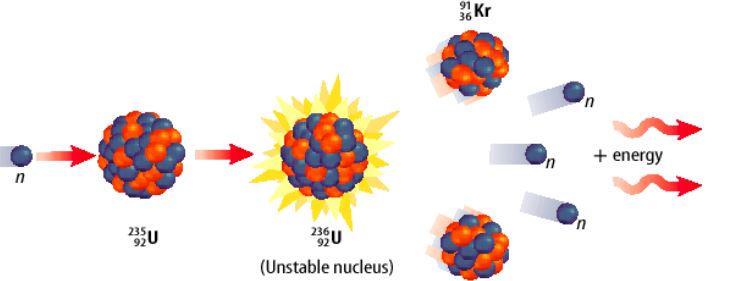
This is an example of...
a)
Fission reaction
b)
Fusion reaction
c)
Decomposition reaction
d)
Decay
7.
Where does fusion occur naturally?
a)
Underwater
b)
All around us
c)
In the radioactive waste
d)
On the sun
8.
Which atoms combine together during fusion reaction on the sun?
a)
Helium and Hydrogen atoms
b)
Hydrogen atoms
c)
Hydrogen and Lithium atoms
d)
Hydrogen and Carbon atoms
9.
Very high temperature and pressure is required for:
a)
Fission
b)
Fusion
c)
Radioactive Decay
10.
U-235 is the primary fuel
a)
Fission
b)
Fusion
c)
Radioactive Decay
Reset

