
 Worksheets
CH 10 Review
Total questions: 51
Worksheet time: 41mins
Name
Class
Date
1.

According to cell theory, where did this cell come from?
a)
another living cell
b)
energy from sun
c)
a multicellular organism
d)
the nonliving environment
2.
Which of the following is NOT a cell theory.
a)
All non-living things are made of cells
b)
All cells come from pre-existing cells
c)
Cells are the basic unit of structure and function of all living things
3.
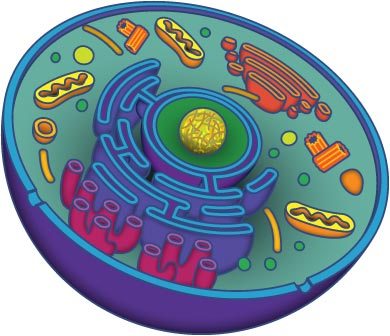
All living things are made up of...
a)
cells
b)
cell tissues
c)
organ
d)
organ systems
4.
All cells come from___________ cells.
a)
pregnant
b)
pre-existing
c)
paternal
d)
pin size
5.
Rocks are not living because
a)
they never move
b)
they aren't needed for humans
c)
they are not made of cells
d)
they don't break down
6.
An organism made of one cell is called
a)
unicellular
b)
multicellular
7.

Robert Hooke, Anton van Leeuwenhoek, Theodor Schwann, Rudolf Virchow, and Matthias Schliden were all responsible for what theory?
a)
The Theory of Gravity
b)
The Theory of Relativity
c)
The Cell Theory
d)
The Theory of Continental Drift
8.
Oldest type of cell
a)
Prokaryote
b)
Eukaryote
c)
both
9.
Smaller
a)
Prokaryote
b)
Eukaryote
c)
both
10.
Has nucleus
a)
Prokaryote
b)
Eukaryote
c)
both
11.
Bacteria
a)
Prokaryote
b)
Eukaryote
c)
both
12.
multicellular
a)
Prokaryote
b)
Eukaryote
c)
both
13.
Where is the DNA found in a prokaryotic cell?
a)
floating around in the cytoplasm
b)
in the nucleus
14.
Where is the DNA found in a eukaryotic cell?
a)
floating around in the cytoplasm
b)
in the nucleus
15.
What type of cell has a nucleus?
a)
eukaryotic
b)
prokaryotic
16.
What type of cell does not have a nucleus?
a)
eukaryotic
b)
prokaryotic
17.
Has membrane bound organelles
a)
Prokaryote
b)
Eukaryote
c)
both
18.
All of the following have a nucleus except...
a)
Bacteria
b)
Animalia
c)
Plantae
d)
Protista
19.

You would find mushrooms in which kingdom?
a)
Plantae
b)
Protists
c)
Fungi
d)
Animalia
20.

This domain is characterized by ancient bacteria that can live in extreme environments, such as hot springs.
a)
Archaea
b)
Bacteria
c)
Eukarya
d)
Prokarya
21.

Which kingdom would this organism belong to?
a)
Plantae
b)
Archaebacteria
c)
Protista
d)
Animalia
22.

Which kingdom do humans belong to?
a)
Plantae
b)
Fungi
c)
Animalia
d)
Protista
23.
What are the three domains?
a)
Archaea, Bacteria, and Eubacteria
b)
Archaea, Protista, and Eubacteria
c)
Archaea, Bacteria, and Eukarya
d)
Archaea, Fungi, Animalia
24.

What type of organism makes its own food internally?
a)
heterotroph
b)
autotroph
c)
carnivore
d)
omnivore
25.

Who is the closest relative to the birds?
a)
crocodiles
b)
sharks
c)
fish
d)
amphibians
26.
Who is the closest relative to the sharks?
a)
crocodiles
b)
sharks
c)
ray-finned fish
d)
amphibians
27.
Scientists classify living organisms by _
a)
giving each one several different kingdom names
b)
the type of brain the organism has
c)
placing them in groups with organisms that share similar characteristics.
d)
determining if the organism is harmful or helpful
28.
Which list correctly shows the levels of classification in the correct order?
a)
Kingdom, Phylum, Class, Order, Family, Genus, Species, Domain
b)
Domain, Kingdom, Phylum, Class, Order, Family, Genus, Species
c)
Kingdom, Domain, Phylum, Family, Class, Species, Genus
d)
Domain, Kingdom, Phlum, Order, Class, Species, Genus
29.
Which scientist developed the system of classification known as binomial nomenclature?
a)
Carolus Linnaeus
b)
Francesco Redi
c)
John Ray
d)
Anton van Leeuwenhoek
30.
The correctly written scientific name is -
a)
Felis domesticus
b)
mus domesticus
c)
quercus Alba
d)
Canis Lupus
31.

A dichotomous key for trees is provided. Hikers found a tree that has large brown cones and single sharp needles. What species of tree have the hikers found?
a)
Juniper
b)
Pine
c)
Spruce
d)
Fir
32.

An illustration and a dichotomous key are given. What is the correct NAME for this organism?
a)
Class Insecta
b)
Order Amblygygi
c)
Order Araneae
d)
Order Scorpiones
33.
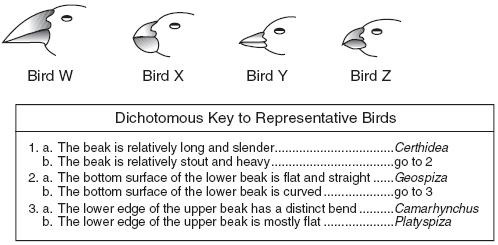
What is the name of bird W?
a)
Certhidea
b)
Geospiza
c)
Camarhynchus
d)
Platyspiza
34.

Using this dichotomous key, identify the name of the circled Fish, J.
a)
peacock flounder
b)
band-tail puffer
c)
trumpet fish
d)
spotted goat fish
35.
Where an organism lives
a)
habitat
b)
niche
c)
heterotrogh
d)
biosphere
36.
The nonliving aspects of an ecosystem.
a)
Abiotic factors
b)
Biotic factors
37.
The living portions of the ecosystem.
a)
Biotic factors
b)
Abiotic factors
38.
A collection of organisms that make up a community as well as all of the nonliving aspects of the environment.
a)
Population
b)
Community
c)
Habitat
d)
Ecosystem
39.
A symbiotic relationship that involves species having to fight for something they both need or want
a)
competition
b)
predation
c)
commensalism
d)
parasitism
40.
Which biome holds the greatest biodiversity?
a)
grassland
b)
tundra
c)
rainforest
d)
desert
41.
The trees in this biome shed their leaves and grow new ones each year:
a)
temperate deciduous forest
b)
grasslands
c)
deserts
d)
tundra
42.
The ability to conserve water is an important adaptation in which biome?
a)
Coniferous Forest
b)
Deciduous Forest
c)
Desert
d)
Tundra
43.
Which biome features permanently frozen soil called permafrost?
a)
Coniferous Forest
b)
Deciduous Forest
c)
Desert
d)
Tundra
44.
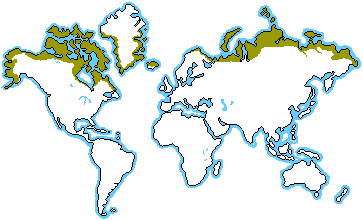
The area of the map shaded in green represents which of the following terrestrial biome
a)
Coniferous Forrest
b)
Deciduous Forrest
c)
Desert
d)
Tundra
45.
The term "terrestrial" means
a)
land.
b)
water.
46.
This biome is found around the equator and is home to a large amount of biodiversity.
a)
Deserts
b)
Tropical Rain Forests
c)
Savannas
d)
Chaparral
47.
the amount of an organism in an area
a)
species
b)
group
c)
population
d)
average
48.
an organism that hunts other organisms
a)
predator
b)
prey
49.
an organism that is hunted by others as food
a)
predator
b)
prey
50.
a symbiotic relationship in which both animals benefit from the relationship
a)
mututalism
b)
parasitism
c)
commensalism
d)
predation
51.
a symbiotic relationship in which one animal is harmed, but the other benefits
a)
mutualism
b)
parasitism
c)
commensalism
d)
predation
100 %

