
 Worksheets
Geology Review
Total questions: 33
Worksheet time: 2hrs 27mins


This rock was formed when magma cooled very slowly inside the Earth. What specific type of rock is it?
Igneous Rock
Sedimentary Rock
Metamorphic
What are the 3 major types of rocks?
Igneous, Metamorphic, Sedimentary
Erosion, Compaction, Cementation
Two ways to describe types of igneous rocks are _____
Extrusive and Intrusive
Isotopic and Uniformitarianism
Which of the words below describe mud, sand, and tiny bits of rocks that cement together to form a type of rock?
isotopes
sediments
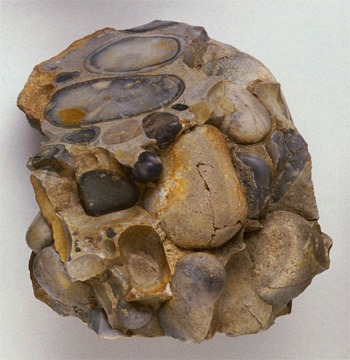
This rock was formed by smaller pieces of rock that settled at the bottom of a lake and compacted together, millions of years ago. What type of rock is this?
Sedimentary
Igneous
Metamorphic

When sediments are pressed together tightly, this is called ____________.
Compaction
Erosion

The process when rocks break into smaller pieces due to exposure to natural elements is called ___________.
erosion
weathering

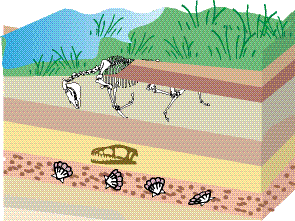
According to the law of superposition, the oldest fossils are found _________________.
In the upper part of the rock layers
In the bottom of the rock layers
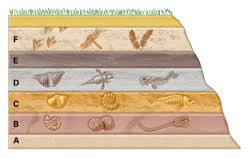

An archaeologist made the following diagram of a dig site. What can be said about the pottery as compared to the skull found in the site?
The rock layer with the pottery is more recent than the rock layer with the skull.
The rock layer with the skull is more recent than the rock layer with the pottery.
A break in Earth's crust is called
an extrusion
a fault
The age of a rock layer compared to the other rock layers around it is called
Absolute Age
Relative Age
When iron in rocks chemically reacts with oxygen in the air, __________ has occurred.
oxidation
acid rain
Which of the following is an example of chemical weathering?
acid rain
wind
How does freezing water cause the weathering of rocks? The freezing water ____________________.
keeps the rocks in place
expands in the cracks and breaks rocks

How do plants weather rocks?
during photosynthesis
when roots grow into cracks of rocks and expand the rock


Scientists who study fossils are called
Geologists
Paleontologists
Meteorologists
An organism that no longer exists on Earth is called
Decayed
Evolved
Extinct

What type of fossil is this?
Preserved remains
Petrified

What type of fossil is found in the most different layers?
dinosaur
ammonite
plant


Fossils are usually found in
igneous rock
sedimentary rock

Which layer is oldest?
A
W
______ is a solid copy of the shape of an organism.
Cast.
Trace fossil.
_____ is the change in living things over time.
Evolution.
Isotope.
The principle that states the geologic processes, like plate tectonics and weathering, that occur today, have also occurred in the past?
Extinction
Uniformitarianism

