wayground logo

Free Printable Worksheets

NEW

Font size

S
M
L
XL
Worksheets

periodic table

Total questions: 28

Worksheet time: 47mins

Name
Class
Date
1.
In the modern periodic table elements are arranged by:
a)
atomic mass
b)
atomic number
c)
valence electrons
d)
number of isotopes
2.
Why were there blank spaces left in Mendeleev's periodic table?                                              
a)
He didn't know what to put there.
b)
 Undiscovered elements not yet known.
c)
Multiple elements could have fit
d)
He forgot to add the elements in.
3.
Used the law of triads to make a list of elements
a)
Mendeleev
b)
Dobereiner
c)
Mosely
4.
Who arranged the periodic table by increasing atomic number?
a)
Mendeleev
b)
Rutherford
c)
Bohr
d)
Mosely
5.
_______________ developed the first periodic table and arranged the elements in order of increasing atomic mass.
a)
Stevie Wonder
b)
Sasha Vujacic
c)
Dmitri Mendeleev
d)
James Mosely
6.
Which property did Mendeleev use to order his periodic table?
a)
Shielding effect
b)
Eletronegitivity
c)
Atomic Weight
d)
Metallic Character
7.

what is the biggest group on the table

a)

metals

b)

nonmetals

c)

metaloids

d)

halogens

8.

how many rows are on the table

a)

4

b)

5

c)

6

d)

7

9.

how many groups/families are on the table

a)

15

b)

16

c)

17

d)

18

10.

what is the name of group number 1

a)

halogens

b)

noble gases

c)

alkali

d)

alkaline earth

11.
Pure forms of these elements are stored in oil so they won't react with oxygen and water in the air.
a)
Alkali Metals
b)
Alkaline-earth metals
c)
Halogens
d)
Noble Gases
12.
What group of elements don't have individual names?
a)
Alkaline-earth Metals
b)
Transition Metals
c)
Alkali Metals
d)
Halogens
13.
What element is used in light bulbs to help them last longer?
a)
Xenon
b)
Argon
c)
Helium
d)
Krypton
14.
Most of the elements on the periodic table are classified as _____.
a)
Metals
b)
Nonmetals
c)
Metalloids
d)
Periods
15.
This class of elements are sometimes called "semiconductors."
a)
Metals
b)
Nonmetals
c)
Metalloids
d)
Groups
16.

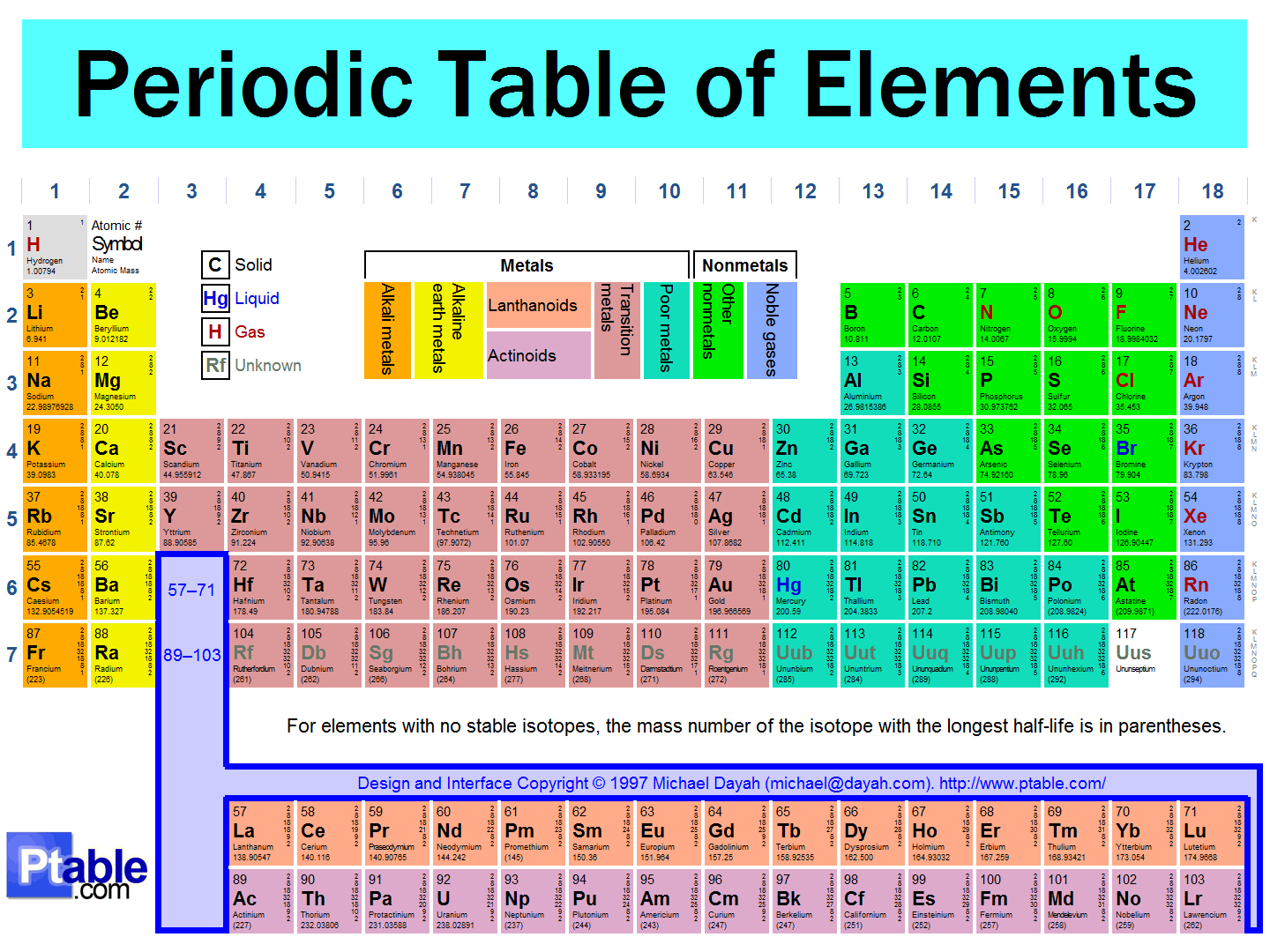
Which color on the image of the periodic table corresponds with the halogens.

a)

red

b)

black

c)

blue

d)

orange

17.

Which color on the image of the periodic table corresponds with the noble gases.

a)

red

b)

black

c)

blue

d)

orange

18.

What happens to the atomic numbers as you move from left to right on the periodic table?

a)

Increase

b)

Decrease

c)

Stay the same

d)

Nothing

19.

Which of the following elements is most likely to have similar properties to those of sodium (Na)?

a)

Magnesium (Mg)

b)

Sulfur (S)

c)

Francium (Fr)

d)

Titanium (Ti)

20.

Two elements that have similar physical and chemical properties are most likely in the same...

a)

period

b)

row

c)

group

21.

In which group would an element that is not reactive most likely be located?

a)

1

b)

2

c)

16

d)

18

22.
Atomic radius generally increases as we move __________.  
a)
down a group and from right to left across a period 
b)
up a group and from left to right across a period 
c)
down a group and from left to right across a period 
d)
up a group and from right to left across a period 
23.
As you move down the periodic table atoms get bigger.  This is because ____________.
a)
The atoms have more mass.
b)
The atoms have more protons.
c)
The atoms have more energy levels
d)
The atoms have more neutrons
24.

Rank the following in order of increasing reactivity: Ge, K, Br, Ca (lowest to highest reactivity)

a)

Ge, K, Br, Ca

b)

K, Br, Ge, Ca

c)

Br, Ge, Ca, K

d)

Br, Ca, Ge, K

25.

Name the group that contains inert (nonreactive) elements. These elements are stable because they have a filled valence shell (eight electrons).

a)

noble gases

b)

halogens

c)

alkali metals

d)

alkaline earth metals

26.

Which of the following is a metal?

a)

Calcium (Ca)

b)

Neon (Ne)

c)

Oxygen (O)

d)

Sulfur (S)

27.

Chlorine is what state of matter?

a)

solid

b)

liquid

c)

gas

28.
How many protons are in this element?
a)
79
b)
196
c)
117
d)
Cannot be determined