
 Worksheets
OAM Ch. 23: Seafloor Features
Total questions: 27
Worksheet time: 17mins
Name
Class
Date
1.
New seafloor is created here
a)
Deep ocean trench
b)
subduction zone
c)
mid-ocean ridge
d)
marine canyon
2.
Deepest spot in the ocean
a)
Monterey Canyon
b)
Mariana Trench
c)
Puerto Rico Trench
d)
Mid-Atlantic Ridge
3.
Large mountain ridges under the ocean that are formed when molten material from deep within the Earth flow up to the surface.
a)
Deep ocean trench
b)
abyssal plain
c)
guyot
d)
mid-ocean ridge
4.
Guyot
a)
flat topped seamount
b)
volcanic island
c)
submarine canyon
d)
deep trench
5.
seamount
a)
underwater atoll
b)
underwater volcano
c)
underwater island
d)
underwater hot spring
6.
Abyssal plain
a)
long mountain range
b)
deep cut in the ocean floor
c)
large flat area deep on the ocean floor
d)
eroded island
7.

What feature is marked by letter A?
a)
Continental slope
b)
Continental shelf
c)
Continental rise
d)
continent
8.

What seafloor feature is marked with the letter G?
a)
Mid-ocean ridge
b)
submarine canyon
c)
abyssal plain
d)
deep ocean trench
9.

What seafloor feature is marked with the letter D?
a)
Deep ocean trench
b)
Submarine Canyon
c)
Mid-ocean Ridge
d)
None of the above
10.
The water at some areas along the mid-ocean ridges are very hot because ...
a)
earth's magnetic field creates heat
b)
The areas are closer to the core
c)
There is more sunshine
d)
There are hydrothermal vents along the mid-ocean ridges
11.

What does this diagram show?
a)
Subduction
b)
Tsunami
c)
Volcanic island arc
d)
Seafloor spreading
12.
What are hydrothermal vents?
a)
Underwater volcanoes
b)
The deepest spot in the ocean
c)
Water below the seafloor is heated by magma and gushes out of openings in the seafloor
d)
Underwater landslides
13.
Continental shelf
a)
Leftover from Pangaea
b)
Part of the continent that is covered by shallow ocean.
c)
Giant landslides
d)
Huge underwater canyons
14.
Continental slope
a)
Mountains near the coast
b)
Underwater mountains
c)
A continent that is covered by an ocean
d)
Edge of a continental shelf that plunges steeply down to great depth
15.
In the 1950's research confirmed that there was an underwater seam or fracture that went around the world. This is called the
a)
mid-pacific ridge
b)
mid-atlantic ridge
c)
mid-ocean ridge
d)
mid-Hawaii ridge
16.
Plates are moving apart at
a)
divergent boundaries
b)
transform boundaries
c)
convergent boundaries
d)
strike-slip faults
17.
When a oceanic plate meets a continental plate
a)
the oceanic plate always subducts
b)
the continental plate always subducts
c)
mountains are formed
d)
rift valleys are formed
18.
Boundaries that are moving together are
a)
convergent
b)
divergent
c)
transform
d)
strike-slip faults
19.
The San Andreas fault is an example of
a)
a convergent boundary
b)
a divergent boundary
c)
a transform boundary
d)
strike-slip fault
20.
Volcanoes form at what two types of boundaries?
a)
convergent and divergent
b)
convergent and transform
c)
transform and divergent
d)
divergent and strike-slip
21.
The deepest part of the ocean is
a)
at trenches where plates are moving apart
b)
at trenches in subduction zones
c)
in the rift valleys of subduction zones
d)
at the mid-Atlantic ridges
22.
New earth crust is made
a)
in the deep ocean trenches
b)
far from the mid-ocean ridge
c)
where two continental plates make mountains
d)
from the magma that comes from the mid-ocean ridges
23.
What is the difference between a volcanic island & a seamount?
a)
A volcanic island rises above the water & a seamount does not
b)
A seamount rises above the water & a volcanic island does not
c)
Both the seamount & volcanic island are underwater
d)
Both the seamount & the volcanic island rise above the water
24.
Which best represents the order of seafloor features as you move from the shoreline to the deep ocean?
a)
Continental slope – continental shelf- continental rise – mid-ocean ridge
b)
Continental rise – continental shelf – mid-ocean ridge - continental slope
c)
Continental shelf – continental slope – continental rise – mid-ocean ridge
d)
Mid-ocean ridge – continental rise – continental shelf- continental slope
25.
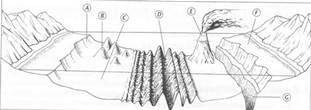
What is letter E?
a)
Volcanic Island
b)
Seamount
c)
Mid-Ocean Ridge
d)
Abyssal Plain
26.
The shallowest(least deep) part of the ocean is the ____________________
a)
trench
b)
abyssal plain
c)
continental shelf
d)
continental slope
27.
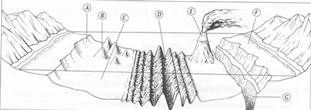
What is letter C?
a)
Mid-Ocean Ridge
b)
Cont. Shelf
c)
Cont. Slope
d)
Abyssal Plain
100 %

