
NEW
Font size
S
M
L
XL
 Worksheets
STAAR ReViEw :O
Total questions: 47
Worksheet time: 34mins
Name
Class
Date
1.

Which of the following would INCREASE the carrying capacity of an ecosystem?
a)
increase in predators
b)
disease
c)
increase in available food
d)
drought
2.
Food, water, sunlight, air, and soil are resources that are often __________.
a)
limiting factors
b)
sources of biodiversity
c)
not important
d)
found in rocks
3.
A snake is eaten by a hawk. The hawk is the _______.
a)
prey
b)
parasite
c)
predator
d)
all of these
4.
A frog eats a fly. The frog and fly are demonstrating ________.
a)
mutualism
b)
competition
c)
predator/prey
d)
parasitism
5.
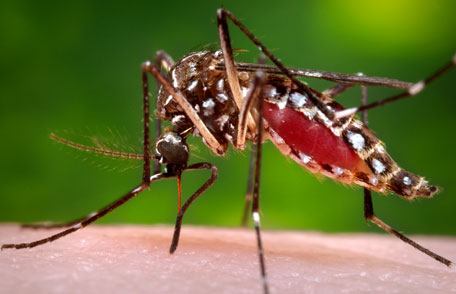
When a mosquito bites you, you are the __________ and the mosquito is the ____________.
a)
host, hostess
b)
parasite, host
c)
host, parasite
d)
prey, predator
6.
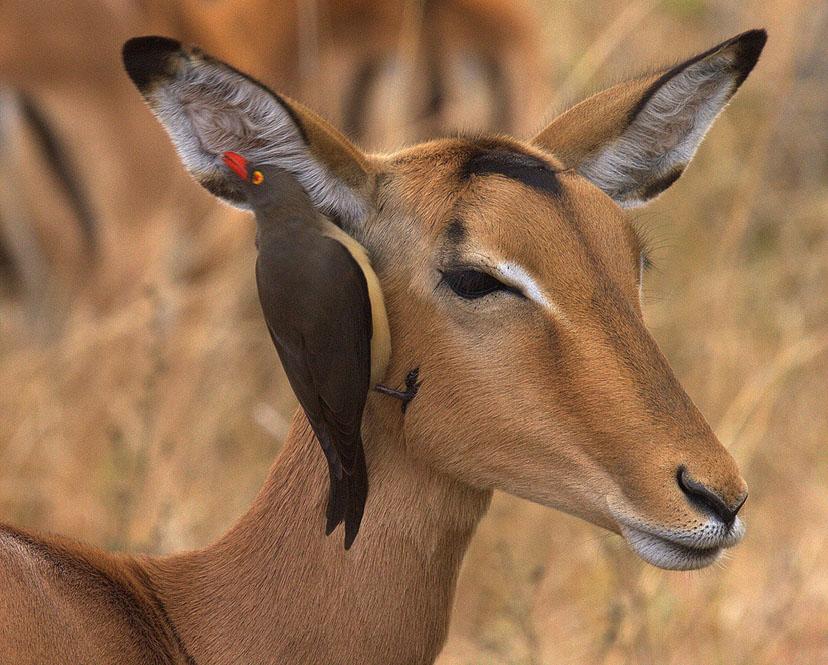
Red-billed oxpeckers are birds that often feed on parasites that infest impala. This is an example of _______.
a)
commensalism
b)
mutualism
c)
neutralism
d)
competition
7.
Which combination of symbols best describe mutualism?
a)
+ +
b)
+ -
c)
+ 0
d)
- 0
8.
Which is a biotic part of an ecosystem?
a)
Light
b)
Small fish
c)
Sand
d)
Water
9.
What is a group of organisms of the same species living in the same area at the same time called?
a)
Community
b)
Population
c)
A group
d)
Ecosystem
10.
A long-term relationship between two organisms in which at least one organisms benefits is known as
a)
mutualism
b)
commensalism
c)
parasitism
d)
a symbiotic relationship
11.
An individual living thing is known as a
a)
cell
b)
organism
c)
population
d)
abiotic factor
12.

Mistletoe extracts water and nutrients from the spruce tree to the detriment (ill effect) of the spruce.
This is an example of which type of symbiosis?
This is an example of which type of symbiosis?
a)
Commensalism
b)
Mutualism
c)
Parasitism
d)
IDK
13.
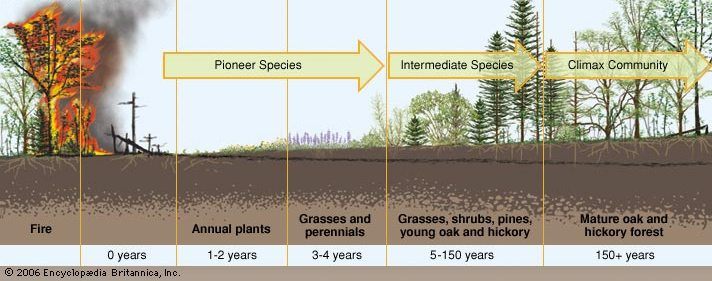
The picture shows what type of succession?
a)
primary
b)
secondary
c)
tertiary
d)
quadanary
14.

Orchids grow inside a bromeliad plant. The orchid obtains water and nutrients from the bromeliad, but does not help or harm it.
a)
parasitism
b)
commensalism
c)
mutualism
d)
predation
15.

Raccoons eat meat AND plants. They are ____.
a)
Carnivores
b)
Herbivores
c)
Omnivores
16.

Which of the following is a herbivore?
a)
cricket
b)
frog
c)
hawk
d)
shrew
17.

How many carnivores are shown in this food web?
a)
6
b)
4
c)
5
d)
3
18.

What part of the food chain is missing?
a)
Producer
b)
Consumer
c)
Decomposer
d)
Heterotroph
19.

Which of the following is NOT a consumer?
a)
grass
b)
dog
c)
shark
d)
fish
20.

The grass that the mice eat contains energy. What is the main source of energy for all life?
a)
Rainwater
b)
The Sun
c)
The soil
d)
Minerals
21.

What is the elevation of point B?
a)
800 ft
b)
850 ft
c)
900 ft
d)
1000 ft
22.
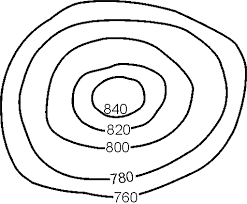
Determine the contour interval:
a)
5 m
b)
10 m
c)
15 m
d)
20 m
23.

What do close contour lines represent on a map?
a)
waterfall
b)
steep area
c)
gradual area
d)
river
24.

When there is a change in motion?
a)
When the forces are balanced.
b)
When the forces are unbalanced.
c)
Never.
d)
When the forces are equal.
25.

If there is a big mass, it would need a stronger force to accelerate it. Which law does this describe?
a)
Newton's 1st Law
b)
Newton's 2nd Law
c)
Newton's 3rd Law
d)
Newton's 4th Law
26.
What is one condition that is necessary for a hurricane to form?
a)
Warm ocean water
b)
A strong cold front
c)
Cold ocean water
d)
A strong warm front
27.
Newton's first law of motion is also called the law of...
a)
Acceleration
b)
Lies
c)
Inertia
d)
Force
28.

What type of galaxy is pictured here?
a)
Spiral
b)
Barred Spiral
c)
Elliptical
d)
Irregular
29.

What does this picture depict?
a)
H-R diagram
b)
Life of a low mass star
c)
Life of a massive star
30.

Newton's ____ Law
a)
1st
b)
2nd
c)
3rd
d)
4th
31.

When you step on a Lego. You push on the Lego and the Lego pushes back on you.
a)
Newton's 1st Law
b)
Newton's 2nd Law
c)
Newton's 3rd Law
32.
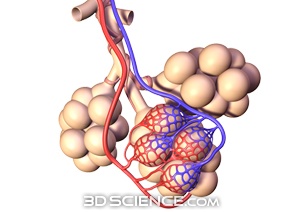
When you breathe, your lungs take in ___ and remove ___.
a)
air/oxygen
b)
oxygen/carbon dioxide
c)
carbon dioxide/waste
d)
waste/air
33.

Which system uses hormones to regulate body activities?
a)
Integumentary
b)
Urinary
c)
Endocrine
d)
Immune
34.

The skin is the major organ in which system?
a)
Integumentary
b)
Muscular
c)
Endocrine
d)
Immune
35.

The model shown is a representation of the ______ system
a)
urinary
b)
digestive
c)
circulatory
d)
integumentary
36.

I contain the kidneys and the urethra.
a)
Respiratory System
b)
Endocrine System
c)
Excretory System
d)
Immune System
37.
Which is a Chemical property?
a)
Thermal Conductivity
b)
Density
c)
Malleability
d)
Flammability
38.
What is an example of a Chemical change?
a)
Ripped paper
b)
boiled egg
c)
cracked egg
d)
sugar in water
39.
Which of the following is the correct equation for PHOTOSYNTHESIS?
a)
CO2 + light + H2O --> O2 + Sugar
b)
CO2 + sugar + H2O --> O2 + light
c)
O2 + light + H2O --> CO2 + Sugar
d)
CO2 + O2 + H2O --> Light+ Sugar
40.
What are the products of photosynthesis?
a)
water and carbon dioxide
b)
oxygen and glucose
c)
oxygen and carbon dioxide
d)
oxygen and water
41.
H2 + O2 ---> H2O
What are the reactants?
What are the reactants?
a)
H2 + O2
b)
H2O
c)
H2 + O2 ---> H2O
d)
O2
42.

In this image, what are the information to the right of the arrow (in black) is called the_______.
a)
Product
b)
Reactant
c)
Chemical Subscript
43.
The law of conservation of mass states that....
a)
Matter can be made
b)
Matter can be destroyed
c)
Matter can neither be made or destroyed
44.

What is this graph representing?
a)
Constant Speed
b)
Acceleration (speeding up)
c)
Deceleration (slowing down)
d)
No motion
45.

At 60 seconds, how far had this object traveled?
a)
0 m
b)
10 m
c)
20 m
d)
40 m
46.
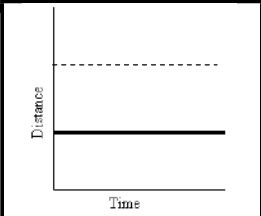
What does this graph represent?
a)
Constant speed
b)
Acceleration
c)
Not moving
47.
What is velocity?
a)
the quickness of an object
b)
the location of an object
c)
acceleration
d)
speed in a specific direction
Reset

