
 Worksheets
Light, EM Spectrum, Color & Optics Review
Total questions: 166
Worksheet time: 3hrs 49mins
Name
Class
Date
1.

Light travels in __________.
a)
Longitudinal Waves
b)
Transverse Waves
2.
An example of a luminous source.
a)
An object that reflects light
b)
An object that emits light
c)
An object that bends light
d)
An object that obstructs light
3.
An example of an illuminated source.
a)
An object that reflects light
b)
An object that emits light
c)
An object that bends light
d)
An object that obstructs light
4.
An opaque object...
a)
Does not transmit light
b)
Transmits light
c)
Transmits but distorts light
d)
illumination of a surface
5.
A translucent object...
a)
Does not transmit light
b)
Transmits light
c)
Transmits but distorts light
d)
Transmits Microwaves
6.
A transparent object...
a)
Does not transmit light
b)
Transmits light
c)
Transmits but distorts light
d)
Transmit infrared
7.
The unit of luminous flux is the ________.
a)
lemon
b)
lulumon
c)
lumen
d)
limited
8.
Diffraction is ...
a)
The distortion of a wave by passing through an object
b)
The reflection of a wave from a mirror
c)
The bending of a wave around a barrier
d)
The slowing down of a wave when entering a new medium
9.
Refraction is ...
a)
The distortion of a wave by passing through an object
b)
The reflection of a wave from a mirror
c)
The bending of a wave around a barrier
d)
The slowing down of a wave when entering a new medium
10.
The primary colors are ______.
a)
red yellow green
b)
red blue green
c)
blue green magenta
d)
yellow cyan magenta
11.
The secondary colors are __________.
a)
red yellow green
b)
red blue green
c)
blue green magenta
d)
yellow cyan magenta
12.
The primary pigments are __________.
a)
red yellow green
b)
red blue green
c)
blue green magenta
d)
yellow cyan magenta
13.
The secondary pigments are __________.
a)
red yellow green
b)
red blue green
c)
blue green magenta
d)
yellow cyan magenta
14.
Polarized light is ...
a)
light that has 2 planes of oscillation
b)
light that has 3 planes of oscillation
c)
light that has 1 plane of oscillation
d)
light that has 0 plane of oscillation
15.
Doppler Shift is the difference between the observed wavelength of light to the actual wavelength of light.
a)
True
b)
False
16.
When we see a firework burst into light in the sky and then hear the sound a short time later, this is evidence for what?
a)
Sound and light move at the same speed.
b)
Light moves faster than sound.
c)
Sound moves faster than light.
d)
Light has more energy than sound.
17.
Light is a ____________ wave and sound is a _____________ wave. (Choose the best terms for the blanks in order).
a)
transverse, longitudinal
b)
longitudinal, longitudinal
c)
transverse, transverse
d)
longitudinal, transverse
18.
All waves are made by________.
a)
pressure
b)
spectrums
c)
particles
d)
vibration
19.
Interference patterns of waves are made when _________________.
a)
Two waves always build up to make a bigger wave.
b)
Two waves subtract to make a smaller wave.
c)
Two waves are at the same place at the same time.
d)
waves avoid each other.
20.
High pitch waves always have _____.
a)
high frequency
b)
low frequency
c)
high amplitude
d)
low amplitude
21.
Loud waves always have __________.
a)
low amplitude
b)
low frequency
c)
high frequency
d)
high amplitude
22.
The Doppler Effect happens when there is ____________.
a)
a louder and softer sound combining.
b)
a high pitch and a low pitch combining.
c)
only a source moving.
d)
a source or receiver moving.
23.
If sound moves at 340 m/s and the frequency is 170 Hz, what is the wavelength of the sound?
a)
2 m
b)
.5 m
c)
57,800 m
d)
1 m
24.
The particles in a transverse wave move _________ to the wave motion.
a)
parallel
b)
acute
c)
obtuse
d)
perpendicular
25.
Particles in a longitudinal wave vibrate ________ to the wave motion.
a)
acute
b)
obtuse
c)
perpendicular
d)
parallel
26.
The number of waves given off by a light source is best described by _________.
a)
a few
b)
many
c)
a bunch
d)
an infinite number
27.
Refraction is when light ____________ a medium.
a)
bends through
b)
bends around
c)
bounces off
d)
is absorbed by
28.

A concave lens __________.
a)
Bends light rays towards each other and creates only real images
b)
Bends light rays towards each other and creates only virtual images
c)
Bends light rays away from each other and creates only virtual images
d)
Bends light rays away from each other and creates only real images
29.

A convex lens __________.
a)
Bends light rays towards each other and can create real images
b)
Bends light rays towards each other and creates only virtual images
c)
Bends light rays away from each other and creates only virtual images
d)
Bends light rays away from each other and creates only real images
30.
__________ objects reflect all colors; and, __________ object absorb all colors
a)
white ; black
b)
black ; white
c)
red ; violet
d)
violet ; red
31.
A red banner will reflect ________ and will ________ all other colors of light.
a)
only red light ; absorb
b)
all colors of light ; absorb
c)
all colors but red ; transmit
d)
only red light ; transmit
32.

The top of a spoon acts as a __________ mirror; the bottom of a spoon acts as a __________ mirror.
a)
concave ; convex
b)
convex ; concave
c)
both sides are concave
d)
both sides are convex
33.
What type of mirror gives you an upside down image when far away, then flips right-side up as you get close?
a)
Concave
b)
Convex
c)
Plane
d)
Hogwash! No such wizardry exists...
34.

Which explains why the fork appears different under water?
a)
light can't pass through the glass
b)
the wavelength of light lengthens
c)
the amount of light increases when going through water
d)
light is refracted at an angle
35.

The Law of Reflection states that he angle of incidence is _________ the angle of reflection.
a)
bigger than
b)
the same as
c)
smaller than
36.
Sunblock provides an opaque layer that prevents ______ from reaching your skin.
a)
Infrared Waves
b)
Microwaves
c)
Ultraviolet Rays
d)
X Rays
37.
A mirror with a surface that curves inward like the inside of a bowl is known as a __________.
a)
concave mirror
b)
convex mirror
c)
plane mirror
d)
flat mirror
38.
What type of waves are visible light waves?
a)
longitudinal
b)
compression
c)
mechanical
d)
electromagnetic
39.
Which of the following statements is true?
a)
Short wavelength means high frequency.
b)
Short wavelength means low frequency.
c)
Short wavelength means high amplitude.
d)
Short wavelength means low amplitude.
40.
When a wave bounces off of a surface, it is __________.
a)
reflecting
b)
refracting
c)
diffracting
d)
all of the above
41.
Where might you find a convex mirror?
a)
car headlights
b)
the corner of a convenience store
c)
inside a microscope
d)
in your eyeball
42.
Where might you find a convex lens?
a)
car headlights
b)
the corner of a convenience store
c)
inside a microscope
d)
in your eyeball
43.
What is visible light?
a)
is only produced artificially
b)
is a form of energy you can see
c)
is when an object is easy to lift
44.

Primary colors of light can combine to make _____.
a)
black light
b)
white light
c)
primary pigments
d)
ultraviolet light
45.

An object appears red because it ...
a)
reflects light waves of all colors
b)
reflects light waves of red
c)
absorbs light waves of red
d)
transmits light waves of all colors
46.
When all 3 primary pigment colors are mixed which color is produced?
a)
black
b)
magenta
c)
white
d)
cyan
47.
When red light is compared with violet light, ...
a)
both have the same frequency.
b)
both have the same wavelength.
c)
both travel at the same speed.
d)
red light travels faster than violet light.
48.

Which of the following types of electromagnetic wave travels through space the fastest?
a)
radio waves
b)
infrared waves
c)
microwaves
d)
They all travel through space at the same speed.
49.
Which of the following is NOT an electromagnetic wave?
a)
ultraviolet
b)
infrared
c)
radio waves
d)
sound waves
50.

Light travels at __________ km per second.
a)
30
b)
300,000
c)
300 x 10^8
d)
3,000,000
51.

The following is a drawing of what type of mirror?
a)
Convex Mirror
b)
Concave Mirror
c)
Plane Mirror
d)
Flat Mirror
52.

The following is a drawing of what type of mirror?
a)
Convex Mirror
b)
Concave Mirror
c)
Plane Mirror
d)
Flat Mirror
53.

Does the frog reflect or absorb green light?
a)
Reflect
b)
Absorb
54.

Does the scarf reflect or absorb yellow light?
a)
Reflect
b)
Absorb
55.
A curved piece of glass or other transparent material that is used to refract light is called a _____.
a)
MIrror
b)
Lens
c)
Reflector
d)
Optical fiber
56.
Mixing yellow paint and magenta paint produces which color?
a)
Red
b)
Green
c)
Blue
d)
Cyan
57.
Light that enters one end of a fiber optic cable reaches the other end by means of __________.
a)
magnification
b)
total internal reflection
c)
dispersion
d)
repeated intensification
58.
When light rays reflect off a rough surface, they...
a)
decrease their speed and change their angle
b)
scatter in many different directions
c)
diverge away from the normal
d)
converge toward the normal
59.
The amount of energy in a photon of light is proportional to the...
a)
speed of the corresponding light wave
b)
shape of the light wave it creates
c)
frequency of the corresponding light wave
d)
medium through which it travels
60.
The structure within the eye that is responsible for the largest percentage of refraction is known as the _____.
a)
iris
b)
retina
c)
cornea
d)
lens
61.
Resonance refers to an effect in which the...
a)
intensity of a sound decreases over time
b)
vibration of a string or column of air causes a standing wave at a natural frequency
c)
vibration of one object causes another object to vibrate at natural frequencies.
d)
pitch of a note is compared with a pure tone
62.
When you look at an orange, it appears orange because it...
a)
reflects orange light and absorbs other colors
b)
absorbs red and yellow light only
c)
absorbs orange light and reflects other colors
d)
reflects red and yellow light only
63.
The Particle Model of Light explains how light can...
a)
diffract when it passes through a normal opening
b)
refract when it passes through a lens
c)
be reflected off a mirror
d)
travel through empty space without a medium
64.
When light moves from a material in which its speed is higher to a material in which its...
a)
bent away from normal
b)
bent toward normal
c)
changed into a virtual image
d)
reflected off the boundary
65.
White light separates into different colors when it passes through a prism because of...
a)
droplets in the air
b)
differences in wave speed
c)
total internal dispersion
d)
reflection
66.
Resonance occurs when the vibration of one object causes another object to vibrate at a __________.
a)
natural frequency
b)
vibration
c)
normal
d)
wave
67.
The theoretical line perpendicular to the surface where a light ray hits a mirror is called the __________.
a)
normal
b)
Mason-Dixon line
c)
fake line
d)
line of science
68.
White light from the sun actually contains all the visible wavelengths of the...
a)
Electromagnetic Spectrum
b)
Entire state of Kansas
c)
Space-Time continuum
d)
Star Wars galaxy
69.
The energy of light is proportional to the _______ of the corresponding __________.
a)
frequency, wavelength
b)
wavelength, frequency
c)
height, length
d)
weight, mass
70.
If light moves from a material in which its speed is lower to one in which its speed is higher, the ray is bent away from the_____.
a)
normal
b)
unusual
c)
fish
d)
glass
71.
In the particle model of light, individual packets of light are called __________.
a)
photons
b)
packets
c)
packages
d)
waves
72.
Waves are rhythmic disturbances that carry energy through matter and space.
a)
True
b)
False
73.
Most of the electromagnetic spectrum consists of visible light.
a)
True
b)
False
74.
The main type of electromagnetic wave used in communications is ultraviolet waves.
a)
True
b)
False
75.
No light can pass through opaque materials.
a)
True
b)
False
76.
Some light can pass through a translucent material, but you can't see clearly through it.
a)
True
b)
False
77.
When the high portion of one wave fills in the low portion of another wave, constructive interference occurs.
a)
True
b)
False
78.
The _____ of a wave can be calculated by multiplying its wavelength by its frequency.
a)
velocity
b)
speed
c)
all of the above
d)
none of the above
79.
The _____ is the unit of frequency.
a)
Hertz
b)
Meter
c)
Nanometer
d)
Second
80.
If the frequency of a wave decreases and the wavelength remains the same, the _____ of the wave will decrease.
a)
Amplitude
b)
Direction of travel
c)
Quality
d)
Velocity
81.

What do points B and F represent?
a)
crest
b)
trough
c)
wavelength
d)
frequency
82.
The distance between successive identical parts of a wave is called the _____ .
a)
frequency
b)
period
c)
wavelength
d)
amplitude
83.
Which of the following is not an electromagnetic wave?
a)
sound
b)
radio
c)
light
d)
x-ray
84.
Heat lamps produce mostly__________.
a)
radio waves
b)
microwaves
c)
infrared waves
d)
ultraviolet waves
85.
Compared to the average speed of light in air, the average speed of light in water is _____.
a)
slower
b)
faster
c)
the same
d)
unknown
86.
The Earth receives a significant amount of UV radiation from the sun. Most of it does not reach the ground because it is...
a)
scattered by the upper atomosphere
b)
absorbed by the ozone layer in the upper atomosphere
c)
absorbed by the air of the upper atmosphere
d)
uv radiation never truly reaches the surface of our planet
87.
The amplitude of a wave is the distance between a point on one wave and the identical point on the next wave.
a)
True
b)
False
88.
Electromagnetic waves are...
a)
Transverse waves because their vibrations are perpendicular to the motion of the wave's energy
b)
Transverse because their vibrations are parallel to wave's energy
c)
Longitudinal because their vibrations are perpendicular to the motion of the wave's energy
d)
Longitudinal because their vibrations are parallel to the wave's energy
89.
The electromagnetic spectrum is made up of bands of waves with different __________.
a)
velocities
b)
frequencies
c)
reflections
d)
focal points
90.
What part of the electromagnetic spectrum can be seen by humans?
a)
visible light
b)
microwaves
c)
ultraviolet
d)
infrared
91.
The electromagnetic spectrum progresses from left to right in order of...
a)
Low energy waves to high energy waves.
b)
High energy to low energy
c)
Long wavelengths to short wavelengths
d)
Low energy to high energy and long wavelengths to short wavelengths
92.
Which type of electromagnetic wave has the greatest frequency and therefore, the most energy?
a)
Radio waves
b)
Infrared
c)
Gamma Rays
d)
Microwaves
93.
Which type of electromagnetic wave has the longest wavelength and therefore, the least amount of energy?
a)
Visible light
b)
Radio waves
c)
Ultraviolet waves
d)
Gamma rays
94.
Which part of the EM spectrum can travel in outer space?
a)
Visible light
b)
Microwaves
c)
Ultraviolet waves
d)
All of them
95.
Radio waves and __________ are used in communication.
a)
Microwaves
b)
Gamma rays
c)
Visible light
d)
Ultraviolet waves
96.
Objects containing heat can emit __________.
a)
radio waves
b)
infrared waves
c)
gamma rays
d)
ultraviolet waves
97.
What determines the color of an object?
a)
The colors that are transmitted
b)
The colors that are absorbed
c)
The colors that are refracted
d)
The colors that are reflected
98.

This diagram best represents __________.
a)
reflection
b)
refraction
c)
absorption
d)
diffusion
99.

Which image (A or B would NOT produce a clear image?
a)
A would not because it is specular reflection
b)
A would not because it is diffused reflection
c)
B would not because it is specular reflection
d)
B would not because it is diffused reflection
100.

When a pencil is placed in a glass of water the pencil appears broken at the surface of the water because the speed of light...
a)
is increasing
b)
stops
c)
is decreasing
d)
remains the same
101.
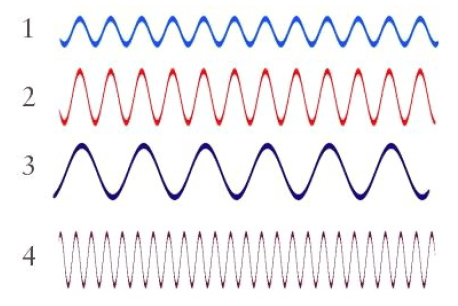
Which of the waves in this diagram has the greatest frequency?
a)
1
b)
2
c)
3
d)
4
102.
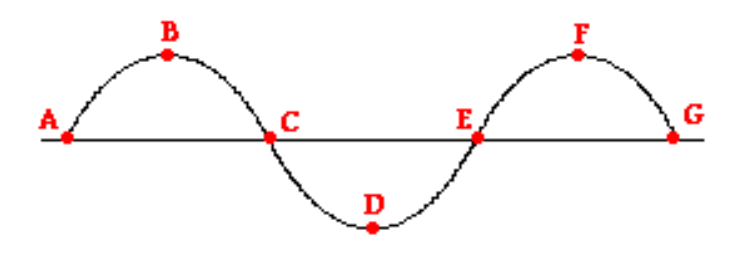
Which letter(s) represent the crest of the wave?
a)
A
b)
B & D
c)
B & F
d)
F
103.
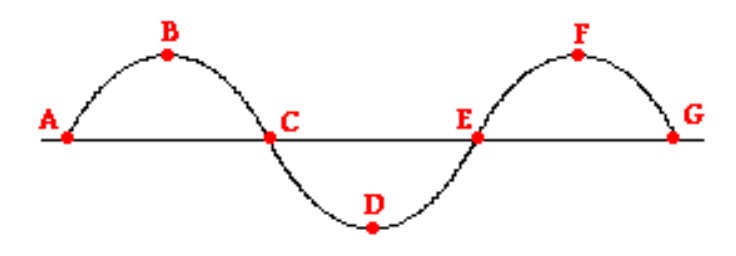
Which letter(s) represent the trough of the wave?
a)
A
b)
B & D
c)
D
d)
C & G
104.
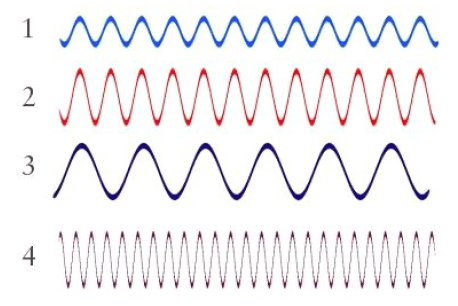
Which wave in the diagram has the greatest wavelength?
a)
1
b)
2
c)
3
d)
4
105.
Regular disturbances that carry energy through matter or space are _____.
a)
crests
b)
energy
c)
waves
d)
troughs
106.
What must be moving for the Doppler Effect to occur?
a)
the source
b)
the listener
c)
waves
d)
source and/or listener
107.
Which of the following represents constructive interference?
a)
crest meets trough
b)
trough meets trough
c)
amplitude meets crest
d)
amplitude meets trough
108.
If wave frequency doubles, the wavelength ____________.
a)
doubles
b)
is halved
c)
stays the same
d)
quadruples
109.
When the crest of one wave passes through the trough of another wave what occurs?
a)
the wave disappears
b)
gets faster
c)
constructive interference
d)
destructive interference
110.

Which EM wave has the longest wavelength?
a)
light
b)
radio
c)
ultraviolet
d)
red
111.
Which of the following does NOT belong in the electromagnetic spectrum?
a)
X-rays
b)
Sound waves
c)
Ultra violet waves
d)
Microwaves
112.
Which waves are used to show heat loss with heat sensitive cameras?
a)
Infrared radiation
b)
Ultraviolet radiation
c)
Microwaves
d)
Gamma rays
113.
Which type of waves are responsible for suntans and sunburns?
a)
Infrared radiation
b)
Ultraviolet radiation
c)
Radio waves
d)
X-rays
114.
Within the visible light spectrum, which color has the longest wavelength?
a)
Red
b)
Violet
c)
Yellow
d)
Green
115.
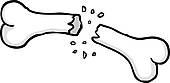
This type of EM wave reveals breaks in bones.
a)
Gamma rays
b)
X-rays
c)
Microwaves
d)
Radio waves
116.
Arrange the visible light colors in order from longest wavelength to shortest wavelength.
a)
Violet, Indigo, Blue, Green, Orange, Yellow, Red
b)
Red, Yellow, Green, Orange, Violet, Blue, Indigo
c)
Red, Orange, Yellow, Green, Blue, Indigo, Violet
117.
Select the correct order of waves on the EM spectrum from lowest to highest energy (longest to shortest wavelength).
a)
Radio, Micro, Infra, Visible, Ultra, X-ray, Gamma
b)
Gamma, X-ray, Ultra, Vis, Infra, Micro, Radio
c)
Vis, Micro, Infra, Ultra, X-ray, Gamma, Radio
d)
Micro, Radio, Vis, Infra, Ultra, X-ray, Gamma
118.
The number of wavelengths that pass a fixed point each second is known as the __________.
a)
frequency
b)
period
c)
longitudinal
d)
transverse wave
119.
When the frequency of a wave increases, what happens to the wavelength?
a)
The wavelength is not directly affected by the frequency of a wave.
b)
The wavelength increases.
c)
The wavelength decreases.
d)
More specific information is needed to form a conclusion about the wavelength.
120.

Which of these windows is opaque?
a)
Window 1
b)
Window 2
c)
Window 3
d)
None
121.

Which of these images are opaque?
a)
A & C
b)
A,C,E, & F
c)
D, E, & F
d)
A & E
122.

When a rainbow is formed, what causes the light to refract?
a)
A. Small raindrops
b)
B. Sunlight rays
c)
C. Tiny mirrors
d)
D. Glass prisms
123.
Smooth surfaces generally _______ a lot of light.
a)
reflect
b)
bend
c)
absorb
d)
twist
124.
What is a prism?
a)
a transparent object that separates white light
b)
an opaque object that appears black
c)
a translucent object
125.
Why do some objects appear white?
a)
They absorb all light
b)
They reflect all light
c)
They absorb some light and reflect some light
126.
The Law of Reflection states that:
The angle of incidence is _________ the angle of reflection.
The angle of incidence is _________ the angle of reflection.
a)
bigger than
b)
the same as
c)
smaller than
127.
Luminous means...
a)
Gives out its own light
b)
Reflects light from other things
128.

When light passes through a prism the light is bent and separates into the visible spectrum. Which color bends the most and has the shortest wavelength?
a)
Red
b)
Yellow
c)
Blue
d)
Violet
129.

_____ is a type of lens that is thicker in the middle and makes an object appear bigger.
a)
prism
b)
convex lens
c)
concave lens
d)
mirror
130.

______ is a type of lens that is thicker on its edges and makes an object appear smaller?
a)
mirror
b)
convex lens
c)
concave lens
d)
prism
131.

Why does white light ressemble a rainbow when it exits a prism?
a)
The prism adds more kinds of light.
b)
The prism changes some white light into electricity.
c)
The prism is filled with many different colors.
d)
The prism separates white light into its component colors.
132.

What kind of wave is shown?
a)
Transverse
b)
Longitudinal
133.

As a firetruck passes, the pitch of the siren changes. This is an example of what phenomenon?
a)
Refraction
b)
Diffraction
c)
Doppler Effect
d)
Reflection
134.

Which wave possesses the most energy?
a)
A
b)
B
c)
C
d)
They all have the same amount
135.
You are able to see yourself in a mirror because light _____ off of the mirror.
a)
absorbs
b)
reflects
c)
refracts
d)
shines
136.

Which diagram accurately shows light being refracted through a liquid?
a)
Image A
b)
Image B
c)
Image C
d)
Image D
137.

A light ray reflects from a mirror. If the ray strikes the mirror at an angle of 30° from the normal, the reflected ray would leave at an angle of ____.
a)
60°
b)
90°
c)
120°
d)
30°
138.

Red has a ______, _____ wavelength.
a)
long, slow
b)
long, fast
c)
short, slow
d)
short, fast
139.

As wavelength decreases in the electromagnetic spectrum the frequency _____.
a)
decreases
b)
stays the same
c)
increases
d)
doubles
140.
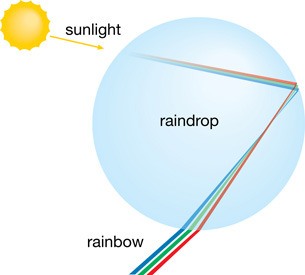
Light bending as it passes through a rain drop is an example of __________.
a)
Refraction
b)
Reflection
c)
Diffraction
d)
Interference
141.
What does it mean to refract?
a)
bounce off
b)
to bend
c)
curve outward
d)
reflect
142.

The combination of two or more waves that result in a single wave is known as __________.
a)
diffraction
b)
refraction
c)
reflection
d)
interference
143.
__________ is the term for the material through which a wave passes.
a)
Vacuum
b)
Medium
c)
Mechanical
d)
Space
144.

According to the Law of Reflection, a light ray striking a mirror...
a)
continues moving through the mirror in the same direction
b)
moves into the mirror at a slightly different angle
c)
bounces off the mirror toward the direction it came from
d)
bounces off the mirror at the same angle it hits.
145.
Adding red and green spotlights together produces what color?
a)
Cyan
b)
Yellow
c)
Blue
d)
Magenta
146.
If a car headlight emits only yellow light, grass which normally appears green would instead appear __________.
a)
Green
b)
Red
c)
Black
d)
Yellow
147.
The most harmful thing you can do to injure the good health of a green-leafed plant is to illuminate it with only __________.
a)
red light
b)
green light
c)
blue light
d)
all are equally bad
148.
Light and other forms of EM radiation given off by our Sun and other stars is due to __________.
a)
Nuclear fusion
b)
Nuclear fission
c)
Convection
d)
Radioactive decay
149.
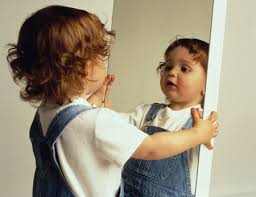
The image formed in a flat mirror is...
a)
larger than the object and farther away.
b)
reduced and closer to the mirror.
c)
a real image of the object.
d)
equal to the height and distance of the object.
150.

Why does the lower part of the child in the photo appear so much different in size from the upper part?
a)
The light rays that travel through water and then into air are refracted.
b)
The light rays that travel through water and then into air are enlarged.
c)
The light rays that travel through air and then into water are reflected.
d)
The light rays that travel through air and then into water are reduced.
151.
What is produced when water droplets refract and diffract sunlight?
a)
thunderstorm
b)
eclipse
c)
rainbow
d)
clouds
152.
The law which law states that "the angle which a light wave strikes an object is the same angle which the light wave is reflected" is known as the Law of _________.
a)
Refraction
b)
Resonance
c)
Reflection
d)
Retirement
153.
Which material would reflect the most visible light?
a)
a green leaf
b)
a black wall
c)
an orange
d)
a white shirt
154.

Cancer is often treated with _____waves.
a)
Ultraviolet
b)
Radio
c)
Infrared
d)
Gamma
155.

Which type of EM radiation produces the heat we feel radiating from a toaster?
a)
Radio waves
b)
Infrared waves
c)
X-rays
d)
Gamma rays
156.

Which picture most accurately shows the law of reflection?
a)
A
b)
B
c)
C
d)
D
157.

A student is seated at a table as shown in the drawing. When the student looks into the mirror, which objects will he see?
a)
Sun and Triangle
b)
Triangle and Square
c)
Heart and Sun
d)
Square and Sun
158.

Light travels...
a)
A. in ovals
b)
B. in circles
c)
C. in squares
d)
D. in straight lines
159.

Which pane of glass in the drawing is the most transparent?
a)
A
b)
B
c)
C
d)
E
160.

The diagram shows the image of a clock in a plane mirror. What time is shown?
a)
02:25
b)
02:35
c)
09:25
d)
09:35
161.

A man sees a stone at the bottom of a pool of water. Which path would light take from the stone to the man?
a)
A
b)
B
c)
C
d)
D
162.

A ray of light passes through a window. Which path does it take?
a)
A
b)
B
c)
C
d)
D
163.

A student shines a narrow beam of white light into a prism as shown in the drawing. He sees a spectrum of colors emerging from the prism. Which three colors does he see at X, at Y and at Z?
a)
X: blue, Y:yellow, Z:red
b)
X: red, Y:blue, Z:yellow
c)
X: red, Y:yellow, Z:blue
d)
X: yellow, Y:red, Z:blue
164.
Which color, red or blue, has the higher frequency and which has the longer wavelength?
a)
higher frequency: blue
longer wavelength: blue
longer wavelength: blue
b)
higher frequency: blue
longer wavelength: red
longer wavelength: red
c)
higher frequency: red
longer wavelength: blue
longer wavelength: blue
d)
higher frequency: red
longer wavelength: red
longer wavelength: red
165.
When white light is dispersed by a prism, compared with blue light, the red light is...
a)
slowed down less and refracted less.
b)
slowed down less and refracted more.
c)
slowed down more and refracted less.
d)
slowed down more and refracted more.
166.
Our Sun is a luminous object.
a)
True
b)
False
100 %

