
NEW
Font size
S
M
L
XL
 Worksheets
7th Grade Science Review 2
Total questions: 45
Worksheet time: 44mins
Name
Class
Date
1.
Dina knows that most volcanoes form near the boundaries of tectonic plates. She studies one volcano, however, that formed in the middle of a crustal plate. How could this have happened?
a)
Some plates give off more heat than others.
b)
The heat that formed the volcano came from above the plate.
The heat that formed the volcano came from above the plate.
c)
It formed along a hot spot, or a very hot part of the mantle.
d)
The volcano formed underground because a mountain was located above it.
2.
Jorge is investigating how ocean basins change over time. He knows that mid-ocean ridges are found in ocean basins. Which of the following statements about mid-ocean ridges and ocean basins is most accurate?
a)
Ocean basins are most active in places where there are no mid-ocean ridges.
b)
The crust at a mid-ocean ridge is younger than the crust in an ocean basin far from a mid-ocean ridge.
c)
The pushing together of tectonic plates creates ocean basins and mid-ocean ridges.
d)
A volcano is less likely to occur at a mid-ocean ridge than in another part of an ocean basin.
3.
Maya studies how plates move and cause features such as ocean basins, volcanoes, and mountains to form. She also learns that these movements cause earthquakes. Which important process drives the movement of these plates?
a)
ocean water circulation
b)
plate growth
c)
mantle convection
d)
volcanic eruptions
4.
Ravi learns that convection currents within the mantle cause tectonic activity on Earth’s surface. What happens in a convection current?
a)
Heated material sinks and cooler material rises.
b)
Heated material rises and cooler material sinks.
c)
Rock material melts and moves toward Earth’s core.
d)
Rock material hardens and becomes part of Earth’s mantle.
5.
Rock layers can be compressed together, forming mountains. What else can form mountains?
a)
convection in Earth’s core
b)
an earthquake
c)
melting of the asthenosphere
d)
a volcanic eruption
6.
Tectonic activity can produce earthquakes that are felt on Earth’s surface. Which of the following is a common result of a large earthquake?
a)
rapid change to Earth’s crust
b)
rapid change to Earth's mantle
c)
gradual change to Earth’s mantle
d)
release of magma from Earth’s interior
7.
Tectonic plates slide past each other at a transform boundary. Often, the plates get stuck and pressure builds up. Eventually, the plates snap free and release a large amount of energy as seismic waves. What event is being described here?
.
.
a)
a tsunami
b)
a storm surge
c)
an earthquake
d)
a volcanic eruption
8.
Earth’s surface can change suddenly. Which event represents magma beneath the surface rising and then pouring out as lava above the surface?
a)
a tusamni
b)
a storm surge
c)
an earthquake
d)
an eruption
9.
Earth’s tectonic plates move very slowly. Which of the following causes the movement of Earth’s tectonic plates?
a)
magnetic pole reversals
magnetic pole reversals
b)
large faults in mountain ranges
large faults in mountain ranges
c)
energy released from volcanic activity
energy released from volcanic activity
d)
convection of Earth’s upper mantle
convection of Earth’s upper mantle
10.
Scientists find a fossil of a fish on top of a mountain. What kind of evidence does the fossil provide scientists about the way this area might have changed over time?
a)
It show that fish were once able to live without water.
b)
It shows that oceans can change quickly and become land.
c)
It shows that the animals found on the mountain may have once been under water and raised up by natural processes.
d)
It shows that animals found on the mountain today evolved from fish.
11.
Plates slide past one another at ____________ boundaries.
a)
divergent
b)
convergent
c)
transform
d)
submergent
12.
Plates move towards one another at ______________ boundaries.
a)
divergent
b)
convergent
c)
transform
d)
detergent
13.
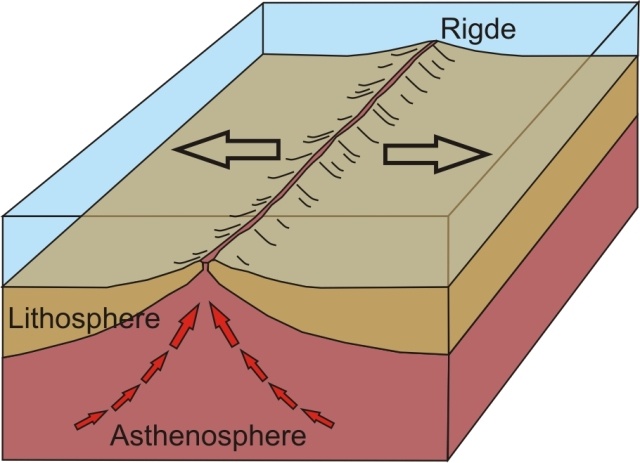
What kind of plate boundary is shown here?
a)
divergent
b)
convergent
c)
transform
d)
subducting
14.

What kind of plate boundary is shown here?
a)
divergent
b)
convergent
c)
transform
d)
submergent
15.
The crust and the uppermost mantle make up the ________________.
a)
lithosphere
b)
asthenosphere
c)
atmosphere
d)
hydrosphere
16.
Plates move away from one another at ___________ boundaries.
a)
divergent
b)
convergent
c)
transorm
d)
submergent
17.
A deep crack in the Earth's crust is called a _______________.
a)
canyon
b)
trench
c)
fault
d)
plate
18.
The plastic-like layer that is located directly under the lithosphere is known as the ____________.
a)
lithosphere
b)
asthenosphere
c)
atmosphere
d)
photosphere
19.

Which layer is made up of iron and nickel?
a)
Crust
b)
Mantle
c)
Inner Core
d)
Lithosphere
20.
The transfer of energy through empty space is called...
a)
convection
b)
radiation
c)
conduction
d)
density
21.
What are the two types of crust?
a)
top crust,bottom crust
b)
oceanic crust, continental crust
c)
water,land
d)
none of the above
22.
What layer of Earth do we live on?
a)
Crust
b)
Core
c)
Mantle
23.
Wegener's evidence supports his theory of a super continent that he named?
a)
Ultima
b)
Pangaea
c)
Plate Tectonics
d)
Continental Drift
24.
This theory states that the continents were once together in a super continent and then drifted apart
a)
Plate Tectonics
b)
Continental Drift
c)
Pangaea
d)
Superpostion
25.
Which of the following is evidence that supports continental drift?
a)
the presence of penguins at both the equator and Antarctica
b)
fossils of the same plant have been found on several continents
c)
the presence of glacial features in Antarctica
d)
the presence of volcanic rock in Antarctica
26.

What is a theory?
a)
An idea based on hypothesis and problems observed using five senses
b)
A belief, policy, or procedure that is not proposed or followed as the basis of action
c)
A supposition or a system of ideas intended to explain something, especially one based on general principles independent of the thing to be explained.
d)
A set of concepts that uses tests without evidences but uses the scientific method in order to prove a specific phenomena that happened on Earth or may happen to Earth
27.

Preserved remains of an organism that lived in the past…..
a)
fossil
b)
picture
c)
dinosaur
d)
organelle
28.

The man who proposed the theory of natural selection and evolution.
a)
Thomas Moore
b)
Gregor Mendel
c)
Neil Degrasse Tyson
d)
Charles Darwin
29.

Fossils, similar body shape, and similar DNA are all evidence that evolution has taken place on our planet. What is the fourth piece of evidence?
a)
Similarities in hair color
b)
Similar interests
c)
Similarities in early development
d)
Similar hunting patterns
30.

What characteristic did Darwin observe about the finches on the Galapagos Islands?
a)
Their feathers
b)
Their feet
c)
Their beaks
d)
Their body sizes
31.

What is the advantage of having different shaped beaks?
a)
To look different from other species.
b)
To be able to eat the food readily available in the environment.
c)
To protect itself against predators.
d)
To protect itself against prey.
32.
A well-tested concept that explains a wide range of observations is called a(an):
a)
hypothesis
b)
experiment
c)
cause and effect
d)
scientific theory
33.

Which of the following are reasons that giraffes may have developed long necks?
a)
to reach more abundant sources of food
b)
because females may have found long necked males more attractive
c)
They use their necks for fighting.
d)
all of the above
34.
What is a trait?
a)
a kind of fossil
b)
a genetic change
c)
a new species
d)
a genetically determined characteristic that can be passed from parent to offspring
35.

Peppered moths vary in color from light gray to black. In an area with a lot of smoky factories and soot covered trees, we expect
a)
no moths
b)
mostly dark moths
c)
mostly light moths
d)
equal numbers of light and dark colored moths.
36.
Where the better adapted organisms survive to pass traits along to offspring.
a)
Evolution
b)
Natural Selection
c)
Extinction
d)
Artifical Selection
37.
Why are advantageous traits more likely to be passed onto offspring?
a)
Because they are more likely to survive and reproduce.
b)
Because they come from dominant alleles.
c)
Because they come from recessive alleles.
d)
Because the trait is an acquired phenotype.
38.
Energy can be classified into two main categories, kinetic energy and potential energy. Kinetic energy is when an object is:
a)
standing still
b)
actively doing something
c)
changing states of matter
d)
objects do not have kinetic energy
39.
When a hot object touches a cooler object, heat energy is transferred from the warmer object to the cooler object through:
a)
radiation
b)
electrical energy
c)
conduction
d)
solar heating
40.
Which of the following is an example of potential energy?
a)
a ball rolling down a ramp
b)
a stretched rubber band
c)
a baseball flying into the outfield
d)
a snail moving across a rock
41.
What is an advantage of fossil fuels?
a)
it is the most available energy source
b)
it won't run out
c)
it can be found in every location around the world
d)
it is renewable
42.
The type of energy transmitted through space in the form of electromagnetic waves is...
a)
thermal
b)
sound
c)
electromagnetic
43.
Stored energy that an object has due to its position or chemical composition is...
a)
Potential
b)
Kinetic
c)
Mechanical
44.
What are the 3 ways heat energy is transferred?
a)
conduction, radiation, thermal
b)
conduction, radiation, convection
c)
conduction, convection, nuclear
45.
According to which law of energy, energy can't be created or destroyed?
a)
First law of motion
b)
The law of tacos
c)
Laws of Energy
d)
law of conservation of energy
Reset

