wayground logo

Free Printable Worksheets

Font size

S
M
L
XL
Worksheets

Angiosperm & Gymnopserm Reproduction/ Plant Life Cycle

Total questions: 49

Worksheet time: 38mins

Name
Class
Date
1.

Flowering seed plants are called

a)

Gymnosperms

b)

Nonvascular

c)

Angiosperms

d)

None of the above

2.

A flower is pollinated when a pollen grain lands on its ________.

a)

Seed coat

b)

Stigma

c)

Anther

d)

None of the above

3.

What is another name for ovules?

a)

Ovules

b)

Anther

c)

Endosperm

d)

Stigma

4.

Cone-bearing seed plants are called _______________.

a)

Angiosperms

b)

Gymnosperms

c)

Monocots

d)

Dicots

5.

Fertilized ovules develop into _________.

a)

Stigma

b)

Seeds

c)

Flowers

d)

None of the above

6.

Which is not a method of seed dispersal?

a)

Insects

b)

Mammals

c)

Hopping

d)

Wing

7.

Gymnosperms have needle-like or scalelike leaves and ______________________.

a)

Fibrous roots

b)

Deep roots

c)

Flowers

d)

Cones

8.

Most gymnosperms have reproductive structures called _____________.

a)

Fruit

b)

Cones

c)

Flowers

d)

None of the above

9.

Male cones produce _______________.

a)

Pollen

b)

Cones

c)

Ovules

d)

Flowers

10.

Female cones produce

a)

Pollen

b)

Cones

c)

Ovules

d)

Flowers

11.

What are the four main flower parts?

a)

Stigma

b)

Sepals

c)

Stamen

d)

Petals

e)

Pistil

12.

What are the two MAIN male parts of a flower?

a)

anther

b)

stigma

c)

filament

d)

sepal

e)

petal

13.

What are the four MAIN female parts of a flower?

a)

stigma

b)

anther

c)

ovules

d)

style

e)

ovary

14.

Where do the seeds of a gymnosperm come from?

a)

fruit

b)

flowers

c)

spores

d)

cones

15.
How is pollen able to move from a male cone to a female cone?
a)
blows loose in the wind
b)
through tiny little water droplets
16.

Conifers are called conifers because they produce _______________ ?

a)

flowers

b)

cones

c)

cons

d)

fruit

17.
What are the thin narrow leaves of a conifer called?
a)
broad leaves
b)
conicals
c)
needles
d)
lobed leaves
18.
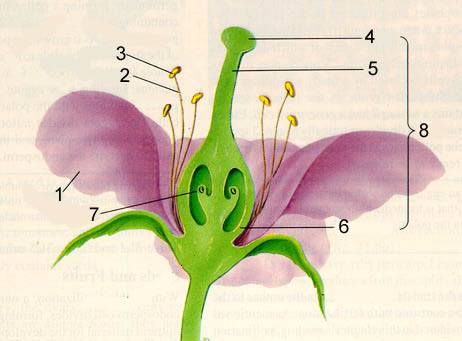
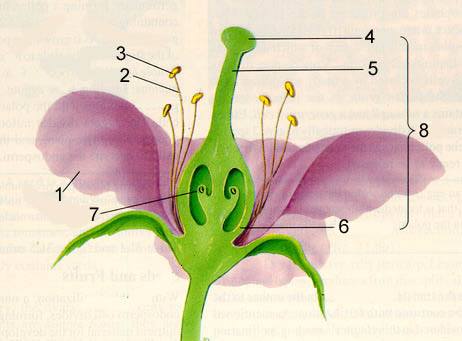
What is #1 pointing to?
a)
ovary
b)
petal
c)
stigma
d)
stamen
19.
What is #8 pointing to?
a)
petal
b)
stamen
c)
pistil
d)
ovary
20.
The male part of the flower is known as the _____.
a)
stamen
b)
pistil
c)
ovary
d)
petal
21.
The female part of the flower is known as the ____.
a)
stamen
b)
anther
c)
filament
d)
pistil
22.
What is #2 pointing to?
a)
anther
b)
filament
c)
ovary
d)
style
23.
What is #3 pointing to?
a)
stigma
b)
filament
c)
ovary
d)
anther
24.
What is #4 pointing to?
a)
anther
b)
style
c)
stigma
d)
ovary
25.
What is #5 pointing to?
a)
anther
b)
filament
c)
stigma
d)
style
26.
What is #6 pointing to?
a)
stigma
b)
style
c)
ovary
d)
petal
27.
What is #7 pointing to?
a)
anther
b)
ovary
c)
ovule
d)
petal
28.
In what part of the flower does fertilization take place?
a)
anther
b)
stigma
c)
ovary
d)
filament
29.
Where is pollen made?
a)
ovary
b)
petal
c)
pistil
d)
anther
30.
What is the sticky part of the flower that catches pollen?
a)
style
b)
stigma
c)
ovary
d)
petal
31.
What part of the flower will turn into a fruit?
a)
petal
b)
ovary
c)
ovule
d)
stamen
32.
What part of the flower will turn into a seed?
a)
ovary
b)
anther
c)
ovule
d)
filament
33.

What does the sepal do?

a)

It is the protective covering of the flower bud.

b)

It is the colored portion that attracts bees.

c)

It produces pollen.

d)

It produces the pistil.

34.

Why are flower petals colored?

a)

They attract different kinds of animals.

b)

The colors attract different pollen.

c)

The colors show which flowers are poisonous to bugs.

d)

They attract seeds.

35.
A seed sprouts into a young plant called a ________.
a)
seedling
b)
tree
c)
leaf
36.
first stage of plant life cycle (plant is just starting to grow)
a)
seed production
b)
germination
c)
plant development
d)
fertilization
37.
Pollination occurs when______ travels from the male part of the flower to the female part of the flower.
a)
seed
b)
wind
c)
pollen
d)
roots
38.
A seed can move by wind, water, and ________.
a)
clouds
b)
singing
c)
cars
d)
animals
39.
Small leaf-like structures forming an outer circle at the base of a flower.
a)
petals
b)
sepal
c)
anthers
d)
dicots
40.
When a seed sprouts and begins the early growth of a young plant.
a)
germination
b)
pollination
c)
seed dispersal
d)
fertilization
41.

What part of the seed provides food for growth of a tap root?

a)

Seed coat

b)

Embryo

c)

Endosperm

42.

What part of the seed allows for absorption of water, heat, and light?

a)

Embryo

b)

Endosperm

c)

Seed coat

43.

What part of the seed stays alive until the right conditions occur and it begins to grow?

a)

Embryo

b)

Endosperm

c)

Seed Coat

44.

The stages in the plant life cycle are what?

a)

Seed, seedling, maturity

b)

Seed, seedling, shrub, maturity

c)

Seed, shrub, maturity

d)

Seed, seedling, flower

45.

Which seed dispersal method involves sticking to an animal’s fur?

a)

Wind

b)

Bursting

c)

Shakers

d)

Catching a lift

46.

Why is it necessary for a plant to disperse its seeds?

a)

To limit reproduction

b)

To stop overcrowding

c)

To stay within its colony

d)

None of the above

47.

The major function of leaves is to _____.

a)

Store food

b)

Make food

c)

Absorb water and minerals

d)

Move water to other plants

48.

The major function of roots are to _____.

a)

Store food

b)

Make food

c)

Absorb water and minerals

d)

Move water to other plants

49.

Where does photosynthesis take place?

a)

Roots

b)

Stems

c)

Leaves