Wayground logo

Free Printable Worksheets

Font size

S
M
L
XL
Worksheets

Evolution Bonus Review

Total questions: 40

Worksheet time: 28mins

Name
Class
Date
1.
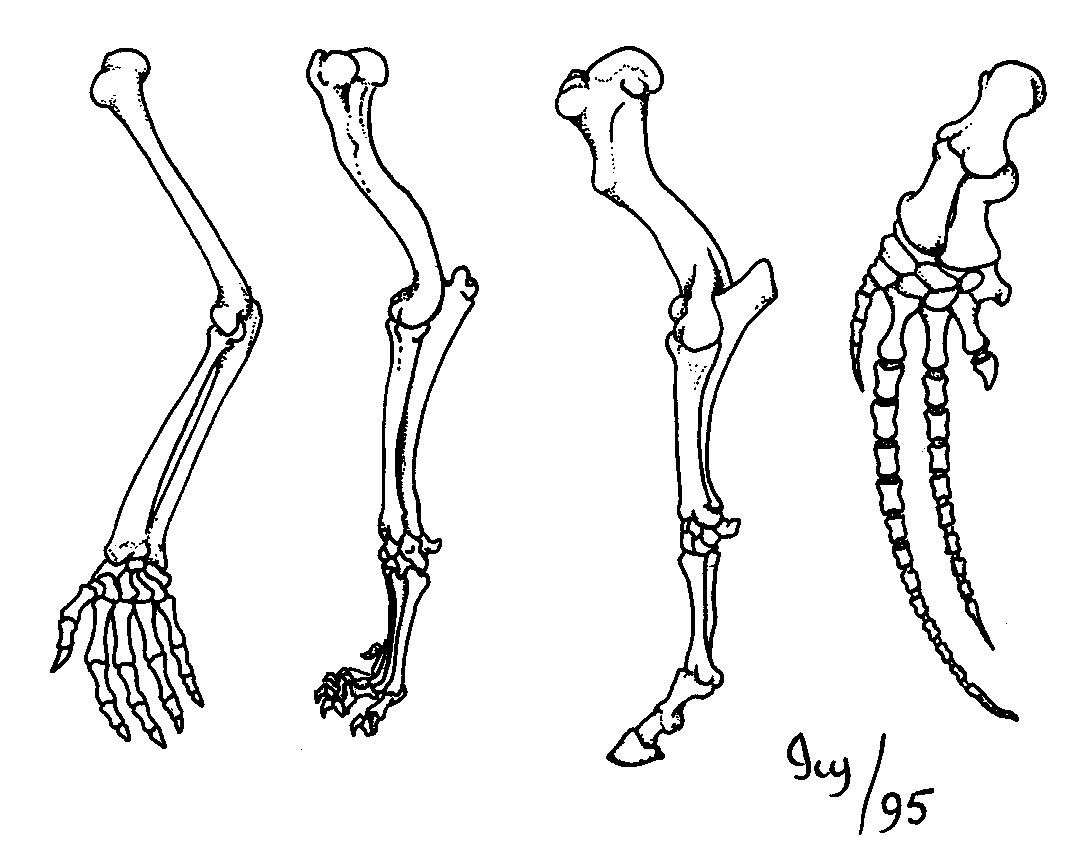
What are homologous structures?
a)
similar in function but different in structure
b)
remnants of organs that that functioned in earlier ancestors
c)
episodes of speciation
d)
similar in structure but different in function
2.
True or False: Natural Selection acts on existing variation
a)
False
b)
True
3.
Which of the following explains how natural selection causes a trait to become predominant in a population?
a)
Individuals with traits that are favorable to the environment reproduce more.
b)
Traits of an individual change in order to adapt to changes in enviornment.
c)
organisms select which traits they wish to inherit
d)
all of these answers
4.
Intermediate fossil forms are important evidence of evolution because they show
a)
how organisms change over time
b)
how animals behaved in their environments
c)
how the embryos of organisms develop
d)
molecular homologies
5.
Whales are aquatic mammals that contain a pelvis bone.  Even though it does not aid in its movement, the function must have been used by a common ancestor of the whale.  Thus, the pelvis is referred to as a(n)
a)
vestigial structure
b)
analogous structure
c)
homologous structure
6.
Which process produced the two different types of beaks in the ground finch and the tree finch?
a)
artificial selection
b)
geographical distribution
c)
adaptive radiation
d)
disuse of the beak
7.
Process in which certain organisms are chosen by humans based on their traits to produce offspring with the desirable traits
a)
Selection
b)
Artificial selection
c)
Natural selection
d)
Evolution
8.
Favors the middle of the population.
a)
Disruptive selection
b)
Stabilizing selection
c)
Directional selection
9.
Middle is wiped out, extremes survive.
Red is previous, blue represents the change.
a)
Stabilizing selection
b)
Disruptive selection
c)
Directional selection
10.
The entire curve moves in one direction or the other. Red is previous, blue represents the change.
a)
Stabilizing selection
b)
Disruptive selection
c)
Directional selection
11.
What is convergent evolution?
a)
evolution toward similar traits in unrelated species
b)
evolution toward different traits in closely related species
c)
elimination of a species from Earth
d)
the rise of two or more species from one existing species
12.
What were the first organisms on Earth?
a)
Eukaryotes
b)
Prokaryotes
c)
Plants
d)
Animals
13.
What is required for evolution?
a)
overproduction (too many organisms)
b)
competition
c)
variation
d)
all of these
14.
Who said giraffes long neck came from stretching their necks and they passed this acquired trait onto their offspring?
a)
Darwin
b)
Lamark
c)
Mendel
15.
Which best describes these fossils?
a)
The oldest fossils can be found on the lower layers
b)
The oldest fossils can be found at the top layers
c)
The youngest fossils are always found on the bottom layers
d)
You can not tell the age of any of these fossils
16.
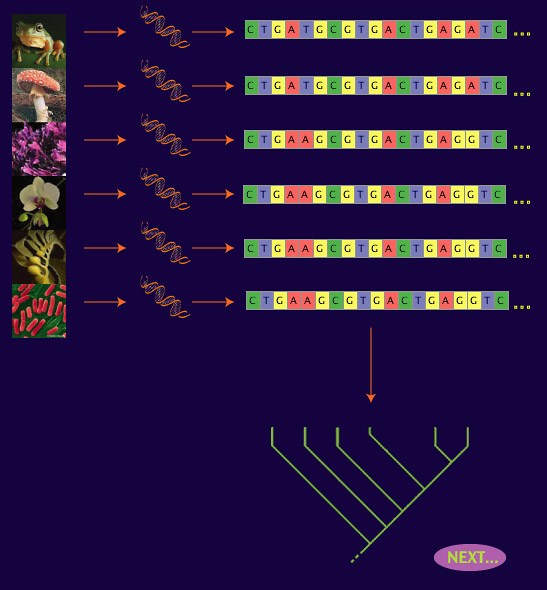
If species A and B have very similar genes and proteins, what is probably TRUE?
a)
species A and B share a relatively recent common ancestor
b)
species A evolved independently of species B for a long period
c)
species A is younger than species B
d)
species A is older than species B
17.
According to this cladogram, birds are LEAST related to -
a)
Amphibians
b)
Sharks
c)
Ray Finned Fish
d)
Crocodiles
18.
Individuals that are well adapted to their environment will survive and produce:
a)
Fewer mutations
b)
Stronger genes
c)
More offspring
d)
Better traits
19.
Which trait do only humans have, according to the cladogram?
a)
jaws
b)
mammary glands & hair
c)
terrestrial during all life stages
d)
opposable thumbs
20.
Structures with the same parts have different functions; suggests that organisms share a common ancestry
a)
vestigial structures
b)
homologous structures
c)
adaptive radiation
d)
fossil
21.
Inherited trait that helps an organism survive is a(n) __________.
a)
Fossil
b)
Adaptation
c)
Ancestor
d)
Natural selection
22.
Two organisms that are closely related would have
a)
very similar DNA sequence
b)
exactly the same DNA sequences
c)
no proteins in common
d)
completely different DNA sequence
23.
Which term refers to the process by which individuals that are better suited to the environment survive and reproduce therefore passing down their genes to their offspring? 
a)
Evolution 
b)
Variation 
c)
Adaptation
d)
Natural Selection 
24.
When the DNA of an organism is altered it is referred to as…
a)
Mutation
b)
Gene Flow
c)
Genetic Drift
d)
Sexual Selection
25.
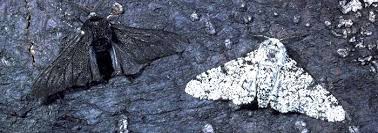
Predict which moth would increase in population
a)
light 
b)
dark
26.
What is an organism that has similar characteristics and can reproduce?
a)
species
b)
organism
c)
embryology
d)
vestigial 
27.
Who is the father of evolution?
a)
Darwin
b)
Mendel
c)
Newton
d)
Einstein
28.
Which of the following is a term for a group of similar organisms that can reproduce fertile offspring?
a)
individual
b)
population
c)
species
d)
fossil
29.
a bird that can easily outcompete other birds for food and that can produce many eggs has a high
a)
life expectancy
b)
mutation rate
c)
fitness
d)
adaptability
30.
What increases genetic variation when animals move  from one population to another
a)
genetic drift
b)
sexual selection
c)
bottleneck effect
d)
gene flow
31.

In Darwin's theory of evolution, he uses his idea of _________________ to explain evolution.

a)

descent by modification

b)

species dying out

c)

when species use new traits

32.

Which pair of structures is homologous but not analagous?

a)

bird and bat wing

b)

bat and moth wing

c)

moth wing and dolphin flipper

d)

dolphin flipper and bird wing

33.

Geographic isolation

a)

physically separates two populations but they still interact

b)

physically separates populations and prevents interactions

c)

causes genetic changes and prevents interactions

d)

causes genetic changes and allows interactions

34.

When populations breed at different times, the isolating mechanism is

a)

temporal isolation

b)

behavioral isolation

c)

ecological isolation

d)

mechanical isolation

35.

When a mutation occurs

a)

a change in selection pressure occurs

b)

a changes in the genes of the predator species

c)

an increase in variation occurs

d)

an increase in the number of genes in the population

36.

Which statement does not apply to Darwin

a)

inheritance of acquired characteristics

b)

heritable variation exists in populations

c)

more fit = more offspring

d)

competition creates a struggle for existence

37.

Which best applies to natural selection?

a)

assortative mating

b)

genetic drift

c)

differential reproductive success

d)

gene flow

38.

Which of the following is an example of a piece of evolutionary evidence?

a)

analogous traits

b)

homologous traits

c)

sexual selection examples

d)

convergent evolution

39.

When studying embryology, which is NOT a chordate characteristic?

a)

postanal tail

b)

notochord

c)

vertebrae

d)

pharyngeal pouches

e)

dorsal nerve cord

40.

What is microevolution?

a)

changes in the frequencies of alleles in a gene pool

b)

genes mutating in response to environmental changes

c)

reacting to changes in the environment

d)

creating new species where none existed before