
 Worksheets
2014 SOL Released Science Test
Total questions: 46
Worksheet time: 1hrs 2mins
Name
Class
Date
1.

Mushroom
a)
Producer
b)
Consumer
c)
Decomposer
2.

Worm
a)
Producer
b)
Consumer
c)
Decomposer
3.

Octopus
a)
Producer
b)
Decomposer
c)
Consumer
4.

Acorn
a)
Producer
b)
Consumer
c)
Decomposer
5.
A fungus is found growing on dead leaves on the forest floor. The fungus is an example of a -
a)
decomposer
b)
carnivore
c)
predator
d)
producer
6.
Which of these best explains why the sun is not visible during the night?
a)
The moon blocks the sun from view.
b)
That side of the sun faces away from Earth.
c)
The sun stops creating light at night.
d)
That side of Earth faces away from the sun.
7.
What would you be most likely to find at a transform boundary?
a)
Earthquakes
b)
Volcanoes
c)
Mountains
d)
Rift
8.
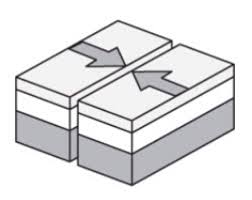
Name the boundary
a)
convergent boundary
b)
divergent boundary
c)
transform boundary
d)
sergent boundary
9.

What kind of plate boundary is shown here?
a)
divergent
b)
convergent
c)
transform
d)
strike slip
10.

a)
400 g
b)
200 g
c)
300 g
d)
450 g
11.
During pollination, pollen is transferred from a stamen to a -
a)
petal
b)
stem
c)
sepal
d)
stigma
12.

What is the female part of the plant called?
a)
Stigma
b)
Pistil
c)
Stamen
d)
Style
13.
Which of these is an impact made by humans?
a)
Marble being dug from a rock quarry
b)
Marble forming from sedimentary rock
c)
oceans drying and exposing limestone
d)
Limestone forming from shells of ocean animals
14.
Lobster pots are used by fishermen to catch lobsters in shallow water. In which area of the ocean would commercial fishermen most likely place their lobster pots?
a)
On the bottom of an ocean trench
b)
On top of a mid-ocean ridge
c)
On the continental slope
d)
On the continental shelf
15.
What is the process of transporting sediments from location to another?
a)
Deposition
b)
Erosion
c)
Weathering
d)
Compaction
16.
The process of breaking up Earth's surface into sediment is called...
a)
sediment
b)
erosion
c)
weathering
d)
deposition
17.

Which two processes result in the formation of igneous rock?
a)
Burial and cementing
b)
Weathering, erosion, and deposition
c)
Recrystallization and cementation
d)
Melting and solidification
18.

Which cell part is necessary for producing food?
a)
cell membrane
b)
vacuole
c)
chloroplast
d)
cytoplasm
19.

What is sugar?
a)
element
b)
compound
c)
mixture
20.

What is gold?
a)
element
b)
compound
c)
mixture
21.
Which plant part develops into a fruit?
a)
flower
b)
stem
c)
leaf
d)
root
22.
A student wants to test the effects of type of exercise on heart rate. What is the dependent variable?
a)
heart rate
b)
type of exercise
c)
amount of exercise
d)
time of day exercise occurs
23.
Which of these is a qualitative observation?
a)
The boy is 5 feet tall.
b)
There are six birds in the tree.
c)
The birds are tiny.
d)
There are more blue birds than black birds.
24.
When experimenting with the growth of a plant, a scientist uses three (of the same type of) plants, two different fertalizers, equal light, and equal water. What type of variable is the water?
a)
Dependent
b)
Independent
c)
Control
25.

Qualitative or Quantitative:
The butterfly is on a pink flower.
The butterfly is on a pink flower.
a)
Qualitative
b)
Quantitative
26.
There are nine dolphins in this pod.
a)
qualitative
b)
quantitative
27.

A connection of food chains with many food energy paths in an ecosystem is a ____________
a)
ecosystem
b)
food web
c)
environment
d)
population
28.

Which of the following is a herbivore?
a)
cricket
b)
frog
c)
hawk
d)
shrew
29.
The arrows in a food chain or web represents what?
a)
They point to the organism that is being eaten.
b)
It shows how sunlight flows within an ecosystem.
c)
They show what direction the energy is flowing between organisms.
d)
They represent how water is transferred within a habitat.
30.

Use the diagram to answer the question.
The Mayfly is a food source for which 3 organisms?
The Mayfly is a food source for which 3 organisms?
a)
Frog, Dragon Fly and snake
b)
Frog, trout and dragon fly
c)
Frog, salamander and trout
d)
Frog and phytoplankton
31.
When stirred together, which 2 substances form a solution?
a)
sand and salt
b)
sugar and salt
c)
sand and water
d)
sugar and water
32.
The greater the frequency of a sound wave, the -
a)
lower the pitch
b)
higher the pitch
c)
softer the sound
d)
louder the sound
33.
What do plants give off after photosynthesis?
a)
Oxygen
b)
carbon
c)
nitrogen
d)
hydrogen
34.
What is a vertebrate?
a)
Animal with no back bone
b)
Animal with a nerve cord
c)
Animal with a backbone
d)
Animal with a notochord
35.
What is an invertebrate?
a)
Animal with a backbone
b)
Animal without a nerve cord
c)
Animal without a backbone
d)
None of the above
36.
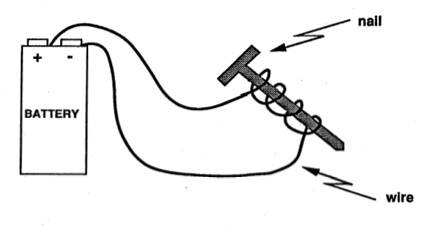
This is a picture of a simple electromagnet. How can the electromagnet be made stronger?
a)
Add more coils of wire to the nail.
b)
Use a smaller battery.
c)
Reverse the poles of the magnet.
d)
Remove all the coils and the nail.
37.
The moon's __________ pulls the water on the earth towards it causing tides to occur.
a)
gravitational force
b)
light
c)
shadow
d)
orbit
38.

This is a ____ plant.
a)
gymnosperm
b)
angiosperm
c)
vascular
d)
nonvascular
39.
Vascular plants...
a)
Take water in through its surroundings
b)
Takes water in through roots
c)
Both of these
40.
A skunk cabbage grows in a swamp and produces an odor similar to a skunk. Why should people preserve a plant like the skunk cabbage?
a)
It depends on a moist environment.
b)
It has a certain role in the ecosystem.
c)
It is prized by gardeners for its flowers.
d)
It has leaves that are about the same shape as each other.
41.
The rougher the surface, the faster an object will travel over the surface.
a)
True
b)
False
42.
How does friction affect speed?
a)
more friction decreases speed
b)
more friction increases speed
c)
less friction decreases speed
43.

What are 2 factors that determine the amount of friction between 2 objects?
a)
Force and roughness between surfaces
b)
hills and valleys and how smooth or rough the surface is
c)
Amount of force and amount of surface the comes in contact
d)
The force and the weight exerted on the surfaces
44.

What property of light makes this pencil appear to be bent or broken?
a)
Reflection
b)
Refraction
c)
Diffraction
d)
Absorption
45.

Concave or Convex?
a)
Concave
b)
Convex
46.
Which pair of colors is in order from the longest wavelength of light in the visible spectrum to the shortest?
a)
green, orange
b)
yellow, red
c)
violet, blue
d)
red, violet
100 %

