Wayground logo

Free Printable Worksheets

Font size

S
M
L
XL
Worksheets

Heat and Thermal Energy I

Total questions: 20

Worksheet time: 19mins

Name
Class
Date
1.
_______________ describes how much energy is required to raise an object's temperature.
a)
Conduction
b)
Convection
c)
Specific Heat
d)
Radiation
2.
Calculate the energy transferred when raising the temperature of 16kg of water by 3˚C (c=4,186 J/(kg K))
a)
785 J
b)
1.26*10^5 J
c)
2.2 kJ
d)
2.0*10^5 J
3.
In terms of differences in temperature between objects in thermal contact, in what direction does heat flow?
a)
from hot temperature to cold temperature
b)
from cold temperature to medium temperature
c)
from cold temperature to hot temperature
d)
from hot temperature to medium temperature
4.

If water heats slower than sand, then ----- is said to have a higher specific heat capacity.

a)

Sand

b)

Water

c)

They both have the same specific heat capacity.

5.
What is the total of all the energies in a substance?
a)
The kinetic energy
b)
The internal energy
c)
The potential energy
6.
What is the symbol for Thermal Energy?
a)
Q
b)
t
c)
m
d)
C
7.
What unit do you use to measure Thermal Energy?
a)
J/Kg ºC
b)
Kg
c)
ºC
d)
J
8.
What is the equation to measure change in Thermal Energy?
a)
Q=mc∆t
b)
Q=mc
c)
Q= ∆mct
d)
m=QC
9.
A material was cooled from 100ºC to 40ºC.  What is the temperature change?
a)
60ºC
b)
40ºC
c)
-60ºC
d)
-40ºC
10.
The amount of energy required to raise the temperature 1ºC for every kilogram is called____?
a)
Thermal Energy
b)
Specific Heat
c)
Temperature
d)
Kinetic Energy
11.
Copper, Stainless Steel, Carbon Steel, and Zinc were all heated using the same thermal energy.  What material would be the coolest after being heated?
a)
Copper
b)
Carbon Steel
c)
Zinc
d)
Stainless Steel
12.
A high specific heat means...
a)
It heats up quickly with energy added
b)
It requires more energy to change temperature
13.

Select the state changes that latent heat of fusion applies to.

a)

melting

b)

evaporating

c)

freezing

d)

condensing

e)

sublimation

14.

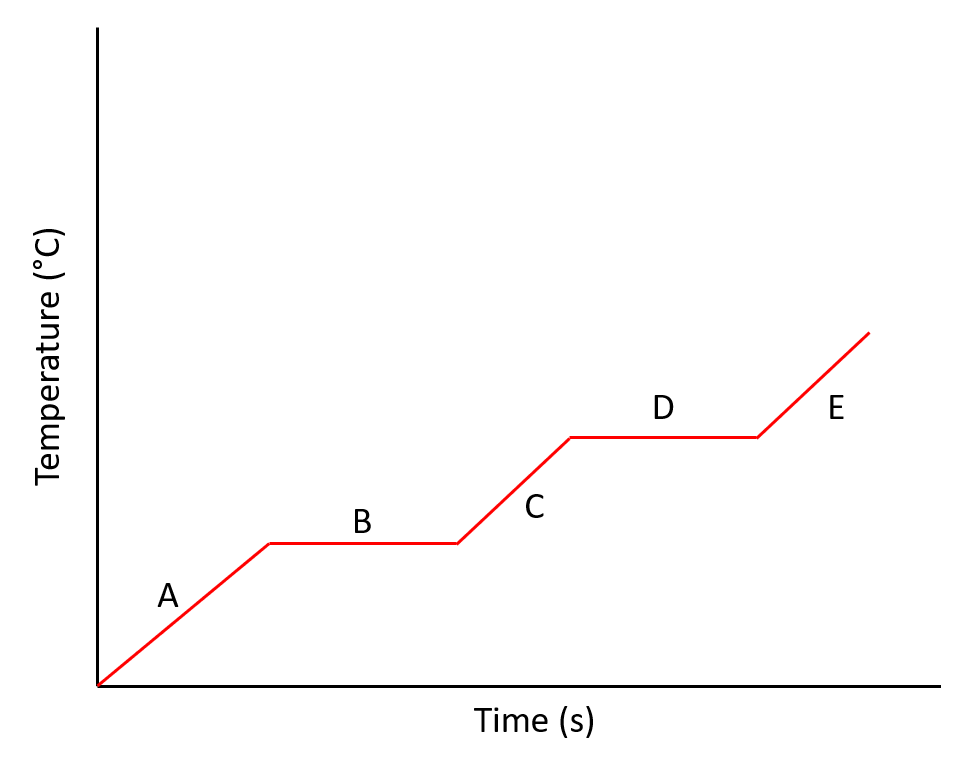
The diagram shows a heating curve for ice. Which line represents the ice melting?

a)

A

b)

B

c)

C

d)

D

e)

E

15.

Why are lines B and D flat?

a)

The ice is melting

b)

The ice is freezing

c)

All of the thermal energy is used to break the bonds

d)

They stopped the stopwatch

e)

They stopped heating the ice.

16.

This formula is used to find the amount of heat (energy) neccesary when there's a phase change

a)

Q= (h)(ΔT)

b)

Q=(m)(L)

c)

Q=(m)(c)(ΔT)

d)

Q=(k)(A)(dT)

17.

Latent heat is

a)

the heat absorbed or released at a boiling process during a change of phase

b)

the heat absorbed or released at a constant temperature during a change of phase

c)

the heat absorbed or released at a constant temperature during a change of phase of 1 kg object

d)

the heat absorbed or released by an object to increase or decrease its temperature by 1 degree Celcius

18.

How much energy is required to freeze 150 g of water?
 [lv=2260000 J kg−1; lf=334000 J kg−1]\left[l_v=2260000\ J\ kg^{-1};\ l_f=334000\ J\ kg^{-1}\right]  

a)

50 100 cal

b)

339 000 J

c)

339 000 cal

d)

50 100 J

19.

How much energy is required to change 5 kg of ice at 0  °\degree C into water at the same temperature? (latent heat of fusion is 3.36 X 10610^6 J/kg )

a)

16.1 X 10^6 J

b)

16.8 X 10^6 J

c)

15.1 X 10^6 cal

d)

16.8 X 10^6 cal

20.

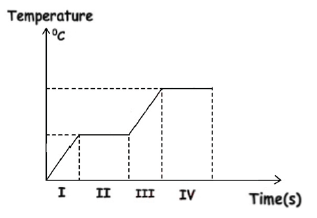
Consider the following temperature-time graph when a solid is heated. which part of the graph involves latent heat of vaporization?

a)

Part I

b)

Part II

c)

Part III

d)

Part IV