
NEW
Font size
S
M
L
XL
 Worksheets
Earth Review
Total questions: 55
Worksheet time: 1hrs 28mins
Name
Class
Date
1.
The process by which water, wind, ice, and changes in temperature break down rock into fragments called sediments.
a)
Deposition
b)
Erosion
c)
Weathering
d)
Igneous Rock
2.
Rock that forms when minerals form from solutions or sediment from older rocks get pressed and cemented together.
a)
Sedimentary Rock
b)
Metamorphic Rock
c)
Igneous Rock
3.
Rock that forms when pressure, temperature, or chemical processes change existing rock.
a)
Igneous Rock
b)
Sedimentary Rock
c)
Metamorphic Rock
d)
Rock Cycle
4.
The process by which metamorphic rocks are formed...
a)
heat and pressure
b)
compaction and cementation
c)
melting and cooling
5.
The process by which igneous rocks are formed...
a)
heat and pressure
b)
melting and cooling
c)
compaction and cementation
6.
A metamorphic rock can become ______.
a)
igneous
b)
metamorphic
c)
sedimentary
d)
all of these
7.
An igneous rock can become ______.
a)
metamorphic
b)
sedimentary
c)
igneous
d)
all of these
8.
The process by which sediment is moved from one place to another. Can be caused by water, wind, ice, and gravity.
a)
Rock Cycle
b)
Uplift
c)
Deposition
d)
Erosion
9.
How old is planet Earth?
a)
10 thousand years
b)
4.6 billion years
c)
1.5 million years
d)
5 hundred years
10.
What is unique about planet Earth compared to other planets in our solar system?
a)
It is the only planet with mountains
b)
It is the only planet with liquid water on the surface
c)
It is the only planet with weather
d)
It is the closest planet to the sun
11.
What element is found at the core of the Earth?
a)
Copper
b)
Iron
c)
Aluminum
d)
Lead
12.
What does the word accretion mean?
a)
gradual accumulation of additional layers or matter.
b)
separating out different constituents of a planetary body
c)
gradual break down of a planet
d)
none of these
13.
Which layer is most dense?
a)
the inner core
b)
the outer core
c)
the mantle
d)
the crust
14.
What pulled the small particles floating in space closer and closer together eventually forming our planet?
a)
wind
b)
megnets
c)
gravity
d)
magic
15.
Early in the Earths life, our planet was...
a)
very hot and molten
b)
a solid ball of rock
c)
very cold
d)
covered in water
16.
When the inner planets (and moons) were bombarded by asteroids, what did the asteroids leave behind?
a)
craters
b)
calderas
c)
mountains
d)
valleys
17.
The moon probably formed when...
a)
A piece of the Earth broke off due to it's fast rotation
b)
A Mars-sized object rammed into the Earth
c)
Earth captured the moon gravitationally as it attempted to pass by.
d)
the molten bubble of the Earth budded.
18.

Why is Mercury covered with craters, but Earth is not?
a)
Earth's atmosphere protects and weathers
b)
Earth's moon blocks asteroids
c)
asteroids just missed Earth
d)
most asteroids land in Earth's oceans
19.
Meteorites have clues about our planet's past.
a)
true
b)
false
20.
T/F: Thermal convection cells in the mantle cause seafloor spreading.
a)
True
b)
False
21.
T/F: Geologist use radioactive dating to find the absolute age of rocks
a)
True
b)
False
22.

The currently accepted hypothesis for the driving mechanism of plate tectonics is based on _________.
a)
density differences between oceanic and continental crust
b)
the distribution of earthquakes and volcanoes
c)
thermal convection cells in the asthenosphere and mantle
d)
gravimetric and magnetic anomalies
23.
Why is the age of a zircon grain older than the age of the sandstone that it was found in?
a)
because of the principle of included fragments
b)
It is much less stable than the sandstone.
c)
because of the principle of superposition
d)
It is much more stable than the sandstone
24.
What happened as Earth differentiated during its formative period?
a)
Heavier materials sank toward the core, and lighter materials rose.
b)
Widely separated land areas started looking different from one another.
c)
The Atlantic and Pacific Oceans developed from the original global ocean.
d)
Outgassing formed an oxygen atmosphere.
25.

How were asteroids and meteorites a heat source for Precambrian Earth?
a)
Their impact on Earth generated energy
b)
Their bombardment of Earth caused them to sink to the core.
c)
Their gravitational contraction generated energy.
d)
Their radioactive decay of isotopes generated energy.
26.
What evidence supports the hypothesis that Earth is 4.6 billion years?
a)
the age of rocks from the Moon
b)
the age of zircon grains in granitic crustal rocks
c)
the age of meteorites
d)
all of the above answers are correct
27.
Which of the following does NOT show evidence that Earth is approximately 4.6 billion years old?
a)
zircon crystals
b)
Precambrian fossils
c)
meteorites
d)
moon rocks
28.
What happens to magma that is heated up at the core?
a)
It falls
b)
It rises
29.
Which of the following changes would end Earth's tectonic activity?
a)
Earth's crust becomes a cooler solid
b)
Earth's mantles becomes a warmer semiliquid
c)
Earth's mantle becomes cooler and solid.
d)
Earth's outer core becomes warmer
30.
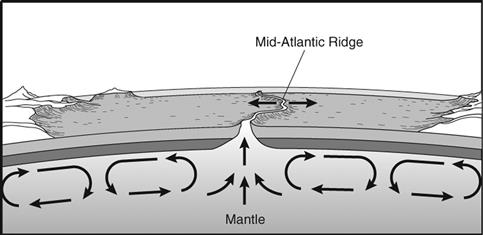
The diagram represents the movement of the mantle under the earth's crust. Which process is represented by the diagram?
a)
rotation
b)
conduction
c)
radiation
d)
convection
31.
Convection currents in the mantle are thought to be the driving force behind tectonic movement. At which location do the convection currents cause the plates to diverge?
a)
strike-slip fault
b)
subduction zone
c)
mid oceanic ridges
d)
folded mountains.
32.

The diagram shows what can occur when two continental plates collide.Which characteristic of the Indian Plate explains why it moves under the Eurasian Plate?
a)
It is larger.
b)
It is denser.
c)
It is molten.
d)
It is younger.
33.
Scientists think that convection currents flow in Earth’s ____.
a)
continents
b)
mantle
c)
lithosphere
d)
inner core
34.
Scientists believe that differences in ____ cause hot, plastic-like rock in the asthenosphere to rise toward Earth's surface.
a)
magnetism
b)
weight
c)
density
d)
force
35.
What kind of currents cause heat transfer in the Earth?
a)
convection currents
b)
radiation currents
c)
conduction currents
d)
ocean currents
36.
forms when a large piece of Earth's crust are tilted. uplifted, or dropped between large faults
a)
fault-block mountains
b)
uplifted mountains
c)
single volcanic peaks
d)
Basin and Range Province
37.
example hot spot volcano
a)
Mauna Kea, Hawaii
b)
Basin and Range Province
c)
Adirondack Mountains
d)
fault-block mountains
38.
The tallest mountains on Earth are formed by _______________.
a)
oceanic to continental convergence
b)
ocean to ocean convergence
c)
continental to continental convergence
d)
hot spots
39.

Plates sliding past each other in opposite directions
a)
Convergent
b)
Divergent
c)
Subduction
d)
Transform
40.
What are mid-ocean ridges?
a)
A chain of underwater waterfalls
b)
A chain of underwater volcanos
c)
A chain of underwater mountains
d)
A chain of underwater rocks
41.
The Great Rift Valley in Africa and the Mid-Ocean Ridge were all created by this boundary
a)
Divergent
b)
Convergent
c)
Reform
d)
Transform
42.
Deepest spot in the ocean
a)
Monterey Canyon
b)
Mariana Trench
c)
Puerto Rico Trench
d)
Mid-Atlantic Ridge
43.
Guyot
a)
flat topped seamount
b)
volcanic island
c)
submarine canyon
d)
deep trench
44.

What is the elevation of point B?
a)
800 ft
b)
850 ft
c)
900 ft
d)
1000 ft
45.

What is the elevation of A?
a)
10 meters
b)
20 meters
c)
40 meters
d)
120 meters
46.
What do contour lines that are farther apart represent?
a)
waterfall
b)
steep area
c)
gentle slope
d)
river
47.

What is the profile view to Topographic Map #1?
a)
A
b)
B
c)
C
d)
D
48.

What is the profile view to Topographic Map #2?
a)
B
b)
C
c)
D
d)
E
49.

Which topographic map matches formation C?
a)
1
b)
2
c)
3
d)
4
50.

A mountaineer is planning an expedition. He wants to follow the easiest possible path, which means he needs to find the most gentle slope up the mountain. Which route should the mountaineer choose?
a)
Route A
b)
Route B
c)
Route C
d)
Route D
51.

Which of the following pairs is correctly matched?
a)
6 and F
b)
1 and A
c)
1 and B
d)
2 and C
52.

What is the difference in elevation between Point X and Point Y?
a)
120 m
b)
240 m
c)
360 m
d)
340 m
53.

A satellite image of an area in Florida shows a river with slight bends along its length. A second satellite image taken of the same area 10 years later shows the same river with a different course. What is the best explanation for the difference in the shape of the river's course between the two satellite images?
a)
Wind blew waves across the water surface, eroding away the bank on one side of the river until the river's course changed its shape
b)
Regular freezing and thawing of the river split the soil along the river banks, changing the shape of the river
c)
Water eroded the banks of the river and deposited the eroded soil on opposite banks, causing the river to form tighter bends
d)
Acid rain chemically weathered the banks along the river, forcing the river to wind back and forth
54.
Wind blowing sand from one location to another is an example of...
a)
Weathering
b)
Erosion
c)
Deposition
d)
Sand dunes
55.
A two-dimensional representation of a three-dimensional land surface.
a)
shadow graphic map
b)
linear graphic map
c)
topographic map
d)
contourgraphic map
Reset

