
 Worksheets
Force + Motion Unit
Total questions: 58
Worksheet time: 37mins
Name
Class
Date
1.

What is this graph showing?
a)
Constant Speed
b)
Acceleration (speeding up)
c)
Deceleration (slowing down)
d)
No motion
2.

What does this graph represent?
a)
Constant speed
b)
Acceleration
c)
Not moving
3.

What is the speed of this object at 3 seconds?
a)
5 m/s
b)
45 m/s
c)
5 s/m
d)
45 s/m
4.

What is this objects speed at 2 s?
a)
5 m/s
b)
5 s/m
c)
20 m/s
d)
20 s/m
5.

How far did they run?
a)
A)100 seconds
b)
B)100 meters
c)
C)18 meters
d)
D)18 seconds
6.
How long did it take Charlie to finish the race?
a)
A)14 meters
b)
B)12 seconds
c)
C)16.5 seconds
d)
D)14 seconds
7.
What does the flat line mean for Charlie?
a)
He stayed at the same speed
b)
He slowed down
c)
He stopped running
d)
He stayed at the same speed but at a slower rate
8.

What is the average speed of the object shown in the graph?
a)
A)2 m/s
b)
B)4 m/s
c)
C)1 m/s
d)
D)10 m
9.

What is the average speed of the object?
a)
10 cm/s
b)
5 cm/s
c)
2 cm/s
d)
1 cm/s
10.
What is the correct metric unit for speed?
a)
mph
b)
km/h
c)
m/s
d)
s/m
11.
The tendency of an object at rest to stay at rest unless it is acted upon by a force is called ___________________
a)
inertia
b)
motion
c)
gravity
d)
lubricant
12.
What is the correct unit for measuring force?
a)
pounds
b)
newtons
c)
grams
d)
kilograms
13.

What is the net force?
a)
40 N left
b)
0 N Balalnced
c)
400 N right
d)
40 N right
14.
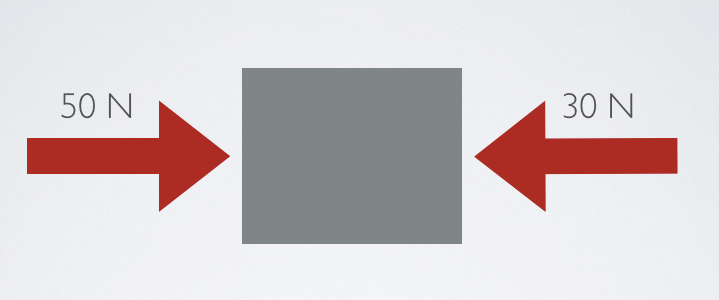
How will this object move?
a)
It won't move.
b)
It will move to the right.
c)
It will move to the left.
d)
It will move up.
15.

How will this object move?
a)
It won't move.
b)
It will move to the right.
c)
It will move to the left.
d)
It will move in both directions.
16.

What is the net force?
a)
30 N left
b)
25 N right
c)
5 N left
d)
55 N right
17.
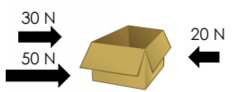
Calculate the Net Force.
a)
60N, Left
b)
40N, Right
c)
0N
d)
60N, Right
18.
Force is a vector quantity which means it is measured in _______ and _________ .
a)
magnitude and direction
b)
force and motion
c)
speed and velocity
d)
friction and gravity
19.
Which is a synonym for magnitude?
a)
mass
b)
strength
c)
motion
20.
Velocity is a vector unit, which means it is measured in ______ and ________.
a)
magnitude and direction
b)
force and motion
c)
speed and direction
d)
friction and gravity
21.

Wheels on a skateboard most likely experiences-
a)
Rolling Friction
b)
Sliding Friction
c)
Fluid Friction
d)
Static Friction
22.

Swimming fish experience-
a)
Rolling Friction
b)
Sliding Friction
c)
Fluid Friction
d)
Static Friction
23.
Friction is a force that acts in an ___________ direction of movement.
a)
similar
b)
opposite
c)
parallel
d)
west
24.
Which type of friction occurs when solid surfaces slide over each other?
a)
rolling
b)
static
c)
sliding
d)
fluid
25.
Which type of friction occurs when objects are not moving?
a)
static
b)
sliding
c)
fluid
d)
rolling
26.
How does friction affect speed?
a)
more friction decreases speed
b)
more friction increases speed
c)
less friction decreases speed
27.
What does friction produce?
a)
light
b)
sound
c)
heat, maybe even fire
d)
gravity
28.

Force the opposes motion between 2 surfaces
a)
force
b)
Newton
c)
friction
d)
gravity
29.
Two factors effecting the magnitude (strength) of the force of gravity between 2 objects are...
a)
mass and distance
b)
mass and matter
c)
distance and weight
d)
weight and mass
30.
Any object with mass has gravity.
a)
True
b)
Sometimes
c)
False
d)
Never
31.
As distance between two objects increase the pull of gravity
a)
Increases
b)
Decreases
c)
Stays the same
32.
The amount of matter in an object is
a)
pressure
b)
weight
c)
mass
d)
force
33.
A person would weigh more on Jupiter than on the Earth because . . .
a)
Jupiter has more mass, and therefore more gravity
b)
Jupiter has less mass, and therefore more gravity
c)
Jupiter has more mass, and therefore less gravity
d)
Jupiter has less mass and therefore less gravity
34.
If an object has MORE _______, it will have more gravitational force.
a)
mass
b)
distance
35.
Objects with greater _________ also have greater inertia.
a)
speed
b)
mass
c)
temperature
d)
friction
36.
Because of inertia, a resting object will remain at ________.
a)
rest
b)
a constant speed
c)
school
d)
inertia
37.
Because of inertia, a moving object will keep moving in ________.
a)
curved path
b)
straight line
c)
one spot
d)
elliptical orbit
38.
You push on a tree with 20 N of force. If the tree doesn't move, the tree is pushing back on you with _____of force.
a)
20N
b)
40N
c)
10N
d)
70N
39.
a push or pull
a)
inertia
b)
force
c)
movement
d)
friction
40.
What is Newton's first law of motion?
a)
law of inertia
b)
force is acceleration x mass
c)
f=ma
d)
force
41.

a)
1st law
b)
2nd law
c)
3rd law
42.

a)
1st law
b)
2nd law
c)
3rd law
43.

a)
1st law
b)
2nd law
c)
3rd law
44.
F = m x a
a)
1st law
b)
2nd law
c)
3rd law
45.
Action/Reaction
a)
1st law
b)
2nd law
c)
3rd law
46.
Equal and Opposite
a)
1st law
b)
2nd law
c)
3rd law
47.

This person bought coffee and put it on the seat next to them. If they stopped quickly and the coffee spilled which law would that represent?
a)
Newton's 1st Law
b)
Newton's 2nd Law
c)
Newton's 3rd Law
48.

When you step on a Lego. You push on the Lego and the Lego pushes back on you.
a)
Newton's 1st Law
b)
Newton's 2nd Law
c)
Newton's 3rd Law
49.

A student leaves a pencil on a desk and the pencil stays in the same spot until another student picks it up.
a)
Law of Inertia
b)
Law of Acceleration
c)
Law of Conservation of Momentum
50.

Pushing a child on a swing is easier than pushing an adult on the same swing, because the adult has more inertia.
a)
Newton's 1st Law
b)
Newton's 2nd Law
c)
Newton's 3rd Law
51.

A person not paying attention while skateboarding hits a rock. The skateboard stops...the person doesn't.
a)
The Law of Inertia
b)
The Law of Acceleration
c)
The Law of Conservation of Momentum
52.

Rockets are launched into space using jet propulsion where exhaust accelerates out from the rocket and the rocket accelerates in an opposite direction.
a)
The Law of Inertia
b)
The Law of Acceleration
c)
The Law of Conservation of Momentum
53.

A magician pulls a tablecloth out from under dishes and glasses on a table without disturbing them.
a)
Newton's 1st Law
b)
Newton's 2nd Law
c)
Newton's 3rd Law
54.
Speed =
a)
distance/time
b)
time/distance
c)
time x distance
55.
Time =
a)
distance/time
b)
distance/ speed
c)
speed x distance
56.
Distance =
a)
speed x time
b)
speed/time
c)
time/speed
57.
velocity =
a)
speed/distance
b)
distance/speed + direction
c)
distance/time + direction
d)
time / speed
58.
average speed =
a)
distance/time
b)
total distance/ total time
100 %

