
 Worksheets
Physics Test Review
Total questions: 60
Worksheet time: 1hrs 6mins
Name
Class
Date
1.
A greater applied force is required to move an object with a greater mass than one with a smaller mass.
a)
True
b)
False
2.
The SI units for force are...
a)
Kilograms
b)
Newtons
c)
Meters per second
d)
Pounds
3.
If a baseball and a cannonball are dropped from the same height at the same time, which ball will hit the ground first?
a)
the cannonball
b)
the baseball
c)
The balls land at the same time.
d)
the ball with the larger volume
4.
According to Newton’s first law of motion, a moving object that is not acted on by an unbalanced force will
a)
remain in motion.
b)
eventually come to a stop.
c)
change its momentum.
d)
accelerate.
5.
Which of the following explains the difference between speed and velocity?
a)
One has motion, and the other does not.
b)
One has direction, and the other does not.
c)
One involves time, and the other does not.
d)
One involves acceleration, and the other does not.
6.
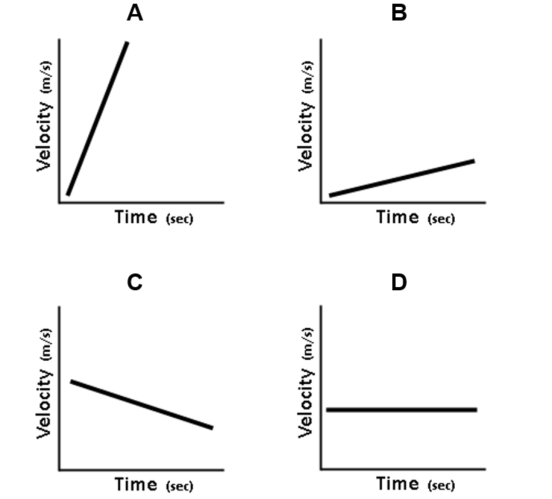
How does Newton’s third law explain how a rocket takes off?
a)
The rocket’s acceleration is positive, while the gasses acceleration is negative but the direction is the same.
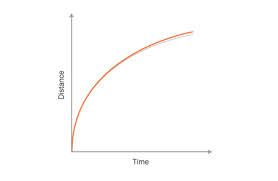
b)
The rocket is at rest until ignition.
c)
The hot gasses move in one direction, while the rocket moves in the opposite direction but with equal force.
7.
Acceleration is caused by a force acting on a mass.
a)
Newton’s first law of motion
b)
Newton’s second law of motion
c)
Newton’s third law of motion
8.
For a force on an object there is an equal and opposite force.
a)
Newton’s first law of motion
b)
Newton’s second law of motion
c)
Newton’s third law of motion
9.
Without any force to change it, an object at rest stays at rest and an object in motion stays in motion
a)
Newton’s first law of motion
b)
Newton’s second law of motion
c)
Newton’s third law of motion
10.
If a force of 26 N is exerted on two balls, one with a mass of 0.52 kg and the other with a mass of 0.78 kg, which ball will have the greater acceleration? (F=ma)
a)
The one with a mass of .78 kg will have the greatest acceleration.
b)
The one with a mass of .52 kg will have the greatest acceleration.
c)
They will both accelerate at the same rate.
11.
A greater applied force is required to move an object with a greater mass than one with a smaller mass.
a)
True
b)
False
12.
If you are driving forward and suddenly break, what would happen to your body and which law does that demonstrate?
a)
go back, 1st Law
b)
move forward, 1st Law
13.

What force slows objects down and keeps them from moving?
a)
Friction
b)
Acceleration
14.

If there is a big mass, it would need a stronger force to accelerate it. Which law does this describe?
a)
Newton's 1st Law
b)
Newton's 2nd Law
c)
Newton's 3rd Law
15.
One object has twice as much mass as another object. The first object also has twice as much...
a)
velocity
b)
inertia
16.

What is the force applied to all objects on Earth?
a)
Earthquakes
b)
Gravity
17.

A student leaves a pencil on a desk and it stays there until I pick it up.
a)
1st Law
b)
2nd Law
18.
Which has more Inertia? (and more force to move)
a)
Truck
b)
Ant
19.
Which law states that if I push against a wall, the wall pushes against me?
a)
Law 2
b)
Law 3
20.
An object at rest will _______ if no outside forces are applied.
a)
Stay at rest
b)
Increase Velocity
c)
Decrease Mass
d)
move
21.
A distance vs. time graph shows an object's
a)
frame of reference
b)
speed
c)
acceleration
d)
favorite food
22.
On a distance vs. time graph, the steeper the slope _____
a)
the slower the speed
b)
the faster the speed
c)
less acceleration
d)
greater acceleration
23.

How long did it take this object to travel 10 m?
a)
0 s
b)
10 s
c)
15 s
d)
20 s
24.

At 60 seconds, how far had this object traveled?
a)
0 m
b)
10 m
c)
20 m
d)
40 m
25.
Velocity is
a)
speed
b)
direction
c)
speed with a direction
26.

LT4: The graph shows Ashley riding her bike to Maria's house.
What was occurring from point B to point C?
What was occurring from point B to point C?
a)
She was increasing her speed.
b)
She stopped for 4 minutes
c)
She was decreasing in speed
27.

LT4: The graph shows Ashley riding her bike to Maria's house.
What is occurring from point A to point B?
What is occurring from point A to point B?
a)
they are traveling at a constant speed
b)
they are decreasing in speed
c)
they stopped to take a break
28.

This graph shows
a)
An object stopped
b)
An object speeding up
c)
An object slowing down
d)
An object moving at constant speed
29.

This graph shows
a)
An object stopped
b)
An object moving at constant speed
c)
An object slowing down
d)
An object speeding up
30.

A proper quantity showing velocity would be
a)
25 m/s.
b)
30 m south.
c)
15 m/s north.
d)
10 m.
31.
Speed is equal to
a)
Distance/Time
b)
Time/Distance
c)
Time x Distance
d)
Acceleration
32.

This graph shows
a)
An object speeding up
b)
An object stopped
c)
An object speeding up
d)
An object slowing down
33.

Which runner stopped for a rest?
a)
Albert
b)
Bob
c)
Charlie
34.
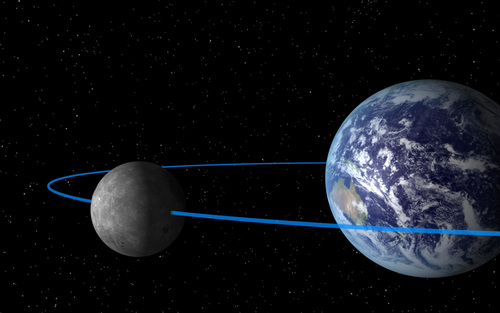
This force attracts all objects toward each other.
a)
Newton
b)
gravity
c)
weight
d)
path
35.
The law of universal gravitation is credited to whom?
a)
Einstein
b)
Beckett
c)
Rose
d)
Newton
36.

The amount of matter in an object is what?
a)
pressure
b)
weight
c)
mass
d)
neutrinos
37.
The force of gravity on an object is called what?
a)
weight
b)
mass
c)
pressure
d)
ping
38.

This is a push or pull in any direction.
a)
shove
b)
force
c)
motion
d)
distance
39.
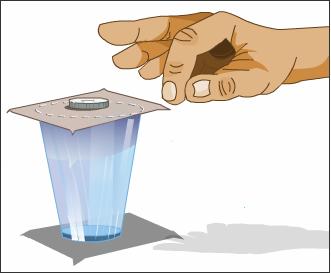
What is the tendency of an object to resist a change in motion?
a)
coffee
b)
motion
c)
inertia
d)
gravity
40.
What two main factors keep a planet in motion?
a)
mass and size
b)
weight and mass
c)
force and motion
d)
gravity and inertia
41.
As distance between two objects increase, the pull of gravity
a)
Increases
b)
Decreases
c)
Stays the same
42.

Where would you have to travel to reduce your weight but not lose any mass?
a)
The moon
b)
The Sun
c)
Jupiter
d)
Saturn
43.
The force of gravity is also known as
a)
Mass
b)
Weight
c)
Distance
d)
Acceleration
44.

Which has greater mass?
a)
the apples
b)
the oranges
c)
neither
45.
On which celestial object would your mass be the greatest?
a)
Earth
b)
Jupiter
c)
Sun
d)
Your mass doesn't change on different celestial objects
46.

What is the net force?
a)
20 N
b)
0 N
c)
400 N
d)
40 N
47.

What is the net force?
a)
10 N
b)
0 N
c)
25 N
d)
1 N
48.
The sum of all forces acting on an object.
a)
Contact Force
b)
Balanced Force
c)
Unbalanced Force
d)
Net Force
49.
What will cause an object to move?
a)
Applied forces
b)
Balanced forces
c)
Unbalanced forces
50.
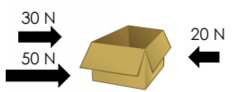
Calculate the Net Force.
a)
60N, Left
b)
40N, Right
c)
0N
d)
60N, Right
51.

Calculate the Net Force.
a)
40N, Left
b)
40N, Right
c)
0N, Balanced
d)
75N, Right
52.

On the Picture the balloon pushes the air right. What is the second force in this interaction pair?
a)
The air pulls the ball left
b)
Gravity pulls the balloon down
c)
The air pushes the balloon left.
d)
The air pulls the balloon right.
53.
Which of the following are examples of changing velocity?
a)
Turning left onto Route 50 while moving 35m/s
b)
Traveling at light speed in a rocket in outer space
54.
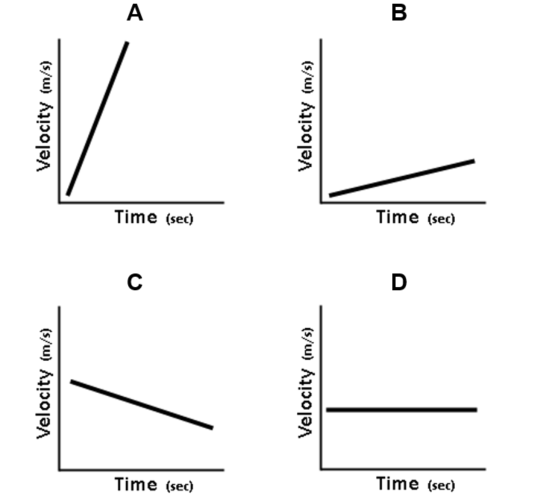
Which graph represents zero acceleration (constant velocity)?
a)
A
b)
B
c)
C
d)
D
55.

Which graph shows the object standing still?
a)
A
b)
B
c)
C
d)
D
56.
Which graph represents the greatest acceleration?
a)
A
b)
B
c)
C
d)
D
57.
What is this graph showing?
a)
Constant Speed
b)
Acceleration (speeding up)
c)
Deceleration (slowing down)
d)
No motion
58.

A roller coasters accelerates from an initial speed of 6.0 m/s to a final speed of 70 m/s over 4 seconds. What's the acceleration?
a)
24 m/s2
b)
18 m/s2
c)
16 m/s2
d)
16 m/s
59.

Describe the speed of the object from 4-6 seconds using the distance vs. time graph.
a)
Increasing speed
b)
Decreasing speed
c)
Not moving
d)
Constant speed
60.
John took 90 minutes to bicycle to his grandmother's house, a total of six kilometers. What was his speed (pay attention to units)?
a)
540 km/hr
b)
.066 km/hr
c)
4 km/hr
d)
9 km/hr
100 %

