
 Worksheets
Weather and Environment Review
Total questions: 59
Worksheet time: 36mins
Name
Class
Date
1.
Where you will find the ozone layer.
a)
stratosphere
b)
thermosphere
c)
exosphere
d)
mesosphere
2.
Where weather occurs.
a)
stratosphere
b)
thermosphere
c)
troposphere
d)
mesosphere
3.
Where we live.
a)
stratosphere
b)
thermosphere
c)
troposphere
d)
mesosphere
4.
Where you will find Aurora Borealis (Northern Lights)
a)
troposphere
b)
ionsophere
c)
exosphere
d)
mesosphere
5.
The most common gas in the atmosphere (78%).
a)
Nitrogen
b)
Oxygen
c)
Carbon Dioxide
d)
Trace gases
6.
What two gases are found throughout all layers of the atmosphere?
a)
Nitrogen and carbon dioxide
b)
Nitrogen and oxygen
c)
Oxygen and carbon dioxide
d)
Trace gases and water vapor
7.
What happens to the air pressure the higher up in space you go?
a)
the air pressure increases
b)
the air pressure decreases
c)
the air pressure stays the same
d)
there is no air pressure
8.
What kind of weather happens during a cold front?
a)
Light rain or light snow
b)
Heavy rain or heavy snow
c)
Clear skies, temp. warms
d)
Clear skies, temp. cools
9.

It's been like this for the last 3 days. What kind of front is shown?
a)
warm front
b)
cold front
c)
occluded
d)
stationary
10.

A _____________ is moving in, so this must be a ____________ front.
a)
thunderstorm, warm
b)
bank of high wispy clouds, warm
c)
tornado, occluded
d)
thunderstorm, cold
11.

Which front is this?
a)
Warm front
b)
Cold front
c)
Occluded front
d)
Stationary Front
12.
Increase in which gas is primarily responsible for increased global warming?
a)
Carbon dioxide
b)
Water vapor
c)
Methane
d)
Nitric oxides
13.

When you throw something "away", where does it end up?
a)
Outer space
b)
Landfills
c)
My trashcan is a magical trash-disappearing portal
d)
Who cares?
14.

This is a lava lamp. When the light bulb heats the wax, the wax rises. When the wax cools, it falls. This cycle of rising/falling is an example of:
a)
Conduction.
b)
Convection.
c)
Radiation.
15.
What kind of heat transfer happens when the sun is heating your body?
a)
Conduction
b)
Radiation
c)
Convection
d)
Density
16.
Which human activity would most likely deplete nonrenewable resources?
a)
use of natural enemies to eliminate insect pests
b)
development of wildlife refuges
c)
governmental restriction of industrial pollution
d)
increased use of fossil fuels
17.
Albert wants to practice conservation. He has decided to examine his lifestyle in order to identify areas in which he can reduce the resources he consumes, reuse resources he already has, and recycle resources that he cannot reuse. In which of the following ways can Albert best reduce the resources he currently consumes?
a)
Use paper grocery bags as gift wrap
b)
Ride a bike to work instead of taking his car
c)
Subscribe to a daily rather than a weekly newspaper
d)
Use an organic rather than synthetic fertilizer in his garden
18.
Many common products, such as wooden furniture, paper, and books, are made from trees. Which of the following is a likely consequence of humans cutting down a forest in order to make use of the natural resources there?
a)
the decrease of chemical runoff into the oceans
b)
increased acid rain
c)
the increase of light pollution in cities
d)
the destruction of habitats
19.
What are renewable resources?
a)
Resources that are used faster than they form
b)
a. Resources that can replenish themselves over time
c)
a. Resources that exist only in urban areas
d)
Resources that exist only in rural areas
20.
Which of the following is a renewable resource?
a)
coal
b)
solar energy
c)
natural gas
d)
oil
21.
When fertilizers run off farmland into streams and ponds, the nitrogen content of the water increases. This can lead to rapid growth of algae in a process called eutrophication. How can this process affect other organisms in the water?
a)
Oxygen is used up as algae is decomposed, reducing the amount available to other organisms.
b)
The water becomes better able to support aerobic organisms.
c)
The algae provide food for fishes and other organisms, leading to decreased algae populations.
d)
The extra nitrogen provides additional food for the other organisms, increasing their population.
22.

What is one way that humans can lessen their ecological footprint?
a)
Recycle
b)
Eat more meat
c)
Drive large vehicles
d)
Increase agricultural area
23.
What is deforestation?
a)
throwing someone out of a window
b)
selectively cutting trees for lumber, making sure the forest remains healthy
c)
allowing more animals to graze on the land than it can support
d)
cutting and removal of rainforest
24.
What are some consequences of deforestation?
a)
increased population in cities
b)
building of more infrastructure
c)
soil erosion, loss of biodiversity, loss of ability to remove CO2
d)
more mercury and cyanide released into rivers
25.
If the human population continues to change at the same rate, what will the population most likely be by the year 2050?
a)
12 billion
b)
5 billion
c)
1 trillion
d)
8 billion
26.
what is the meaning of conduction
a)
when heat transfers from objects that are not touching
b)
heat rise
c)
cold fall
d)
when heat transfers from objects that are touching
27.
whater boiling is an example of ____
a)
conduction
b)
radiation
c)
density
d)
convection
28.
heat rises
a)
true
b)
false
29.

Warm air rises and the cool air sinks demonstrates this type of heat transfer.
a)
conduction
b)
convection
c)
radiation
d)
Insolation
30.

The Gulf Stream is a current that brings warm ocean water from the south to the north. What type of heat transfer is this?
a)
conduction
b)
convection
c)
radiation
d)
Insolation
31.
Ironing a shirt is an example of...
a)
condensation
b)
conduction
c)
convection
d)
radiation
32.
You get sunburned due to __________ from the sun.
a)
conduction
b)
convection
c)
radiation
33.
You're holding hands with your best friend. Your friend's hands are REALLY warm and yours are really cold. After a few minutes, this has changed. How might you explain what happened?
a)
The cold energy from your hand transferred to your friend's hand through conduction.
b)
The heat energy from your friend's hand transferred to your hand through conduction.
c)
The cold energy from your hand transferred to your friend's hand through convection.
d)
The heat energy from your friend's hand transferred to your hand through convection.
34.
Mittens help keep your hands warm in winter because:
a)
They are conductors of heat.
b)
They are fuzzy.
c)
They are conductors of electrical energy.
d)
They are insulators.
35.
Hurricane Katrina happened in what U.S. city in 2005?
a)
Chicago, IL
b)
Atlanta, GA
c)
Jacksonville, FL
d)
New Orleans, LA
36.
When an enormous amount of water saturates an area of land that usually dry, this is known as a....
a)
Blizzard
b)
Drought
c)
Heatwave
d)
Flood
37.
A heavy snowstorm with strong winds and extremely cold temperatures is known as a....
a)
Flood
b)
Drought
c)
Blizzard
d)
Heat Wave
38.
A storm with strong winds that can reach up to 300 miles per hour is called a....
a)
Cyclone
b)
Tornado
c)
Hurricane
d)
Tsunami
39.
A barometer measures what characteristic of air?
a)
Air Temperature
b)
Air pressure
c)
Wind speed
d)
Wind direction
40.
What does temperature actually measure?
a)
How fast atoms are moving and transferring energy
b)
How high air pressure is in a given space.
c)
The amount of atoms in an area.
d)
The mass of the atoms in a given area.
41.
Why are there global winds?
a)
because the cold air sinkes from the poles to the equator
b)
because the earth is rotating from east to west
c)
because the sun heats the air at the equator more than anywhere else on earth
42.
Why do hurricanes lose so much of their power when they hit land?
a)
they run into high pressure which kills hurricanes
b)
land is cooler than water therefore the hurricane loses the energy it needs from warm temperatures
c)
the land breezes shear the hurricane therefore making it harder for it to stay together
d)
the hurricane no longer receives heat and moisture from the warm ocean it uses for fuel
43.
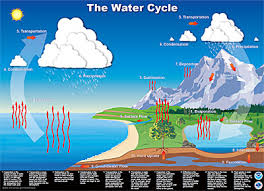
During which stage do clouds form?
a)
condensation
b)
evaporation
c)
precipitation
44.
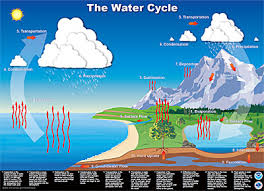
Which stages does liquid water from the ocean turn into water vapor?
a)
condesantion
b)
evaporation
c)
precipitation
d)
run off
45.
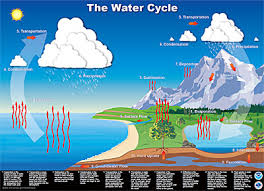
Which stage does ground water try to return to the ocean or soak into the ground?
a)
condensation
b)
evaporation
c)
precipitation
d)
run off
46.

What is A?
a)
Solid
b)
Liquid
c)
Gas
47.

What is B?
a)
Solid
b)
Liquid
c)
Gas
48.

What is C?
a)
Solid
b)
Liquid
c)
Gas
49.

What is it called when plants give off water vapor as a waste product?
a)
condensation
b)
evaporation
c)
sublimation
d)
transpiration
50.
Use product in original form, but in new way.
a)
Reduce
b)
Reuse
c)
Recycle
51.
Prevents the generation of waste. It’s the preferred—but often-overlooked—strategy.
a)
Reduce
b)
Reuse
c)
Recycle
52.
What does recycle mean?
a)
Make smaller
b)
Make bigger
c)
Converting waste into something that can be used again.
d)
Throw away
53.
What does reuse mean?
a)
Use again
b)
Throw away
c)
To buy again
d)
To make again
54.

3. What fossil fuel is in the image?
a)
Natural Gas
b)
Steam
c)
Coal
d)
Petroleum
55.

2. What fossil fuel is in the image?
a)
Coal
b)
Natural Gas
c)
Petroleum
56.
1. Which fossil fuel is solid?
a)
Coal
b)
Natural Gas
c)
Petroleum
57.
4. Fossil fuels came from the fossilized remains of plants and animals from long ago.
a)
True
b)
False
58.
5. The Earth provides humans with an unlimited amount of fossil fuels. They are considered renewable.
a)
True
b)
False
59.
Most of our electricity comes from ....
a)
Burning gasoline
b)
Burning coal and Natural Gas
c)
Burning Nitrogen
d)
Burning Petroleum
100 %

