
 Worksheets
Electricity!
Total questions: 55
Worksheet time: 33mins
Name
Class
Date
1.
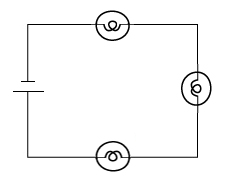
The picture shows an electrical circuit. This circuit is a series circuit because:
a)
It has 3 light bulbs.
b)
The same current flows through all three light bulbs.
c)
It uses a single battery.
d)
The electrical current is divided between the three light bulbs.
2.

A pathway for electricity to travel is called___________
a)
current
b)
static electrcity
c)
circuit
d)
circle
3.
What is a switch's function in a circuit?
a)
to make the current hotter or colder
b)
turn on and off the flow of current
c)
the pathway that current flows
d)
to add more power to the circuit
4.
In a parallel circuit if one light bulb goes OUT; then they ALL go out. TRUE OR FALSE?
a)
TRUE
b)
FALSE
5.
When there is only one path for electrons to move through it is called a _____. When one light goes out, they all go out.
a)
closed circuit
b)
parallel circuit
c)
series circuit
d)
open circuit
6.

This is the symbol for a _____?
a)
switch
b)
light
c)
battery
d)
wires
7.

What is this symbol for?
a)
light bulb
b)
switch
c)
battery
d)
resistor
8.

Does this diagram represent a series or parallel circuit?
a)
series circuit
b)
parallel circuit
9.
A conductor is?
a)
material that current can pass through easily
b)
material that current cannot pass through easily
c)
magnet
d)
electric current
10.

What kind of circuit is this?
a)
Series
b)
Consecutive
c)
Parallel
d)
Training
11.

What kind of circuit is this?
a)
Series
b)
Consecutive
c)
Parallel
d)
Training
12.
Electricity is the flow of _________.
a)
Protons
b)
Neutrons
c)
Electrons
13.

Would would best complete this circuit?
a)
A wire
b)
A switch
c)
A battery
d)
A light bulb
14.
Metals such as copper, iron, gold, and silver are ...
a)
conductors
b)
brittle
c)
insulators
d)
resistors
15.

Compared to thin wires, electrical resistance in thick wires is:
a)
greater
b)
less
c)
the same
16.

What types of charges attract?
a)
Positive and Positive
b)
Positive and Neutral
c)
Negative and Neutral
d)
Positive and Negative
17.
What charge does an electron have?
a)
negative (-)
b)
positive (+)
c)
neutral or no charge (0)
18.
What charge does a proton have?
a)
negative (-)
b)
positive (+)
c)
neutral or no charge (0)
19.

A continuous flow of electricity is called_____________
a)
series
b)
circuit
c)
static
d)
current
20.
Which of these materials is a good insulator?
a)
Plastic and metal
b)
Metal and rubber
c)
Plastic and rubber
21.
What is a material that resists, or does NOT allow, energy to flow through?
a)
circuit
b)
insulator
c)
series
d)
conductor
22.
Lightning is an example of this, which is the loss of static electricity as electric charges transfer from one object to another.
a)
Electroscope
b)
Static Discharge
c)
Versorium
d)
Scary
23.
Electrical charges that are the same _______ each other, and electrical charges that are different _______ each other.
a)
Attract, Repel
b)
Repel, Attract
c)
Attract, Attract
d)
Repel, Repel
24.
An electrochemical cell converts ______ energy into ______ energy.
a)
Chemical to Light
b)
Electrical to Chemical
c)
Chemical to Electrical
d)
Electrical to Light
25.
In electrochemical cells there are two different metals called _______, which are immersed in a substance (paste or liquid) called ________, that conducts electric current.
a)
Electrodes, Electrolytes
b)
Electrolytes, Electrodes
c)
Wet Cells, Dry Cells
d)
Dry Cells, Wet Cells
26.
A process in which substances change into new substances with different properties is called a
a)
Iodine Reaction
b)
Physical Reaction
c)
Chemical Reaction
d)
Iron Reaction
27.
The type of electrochemical cell found in automobile batteries and uses a liquid as the electrolyte is...
a)
Wet Cell
b)
Dry Cell
28.
The type of electrochemical cell that is used as an energy source in a flashlight and the electrolyte is a paste
a)
Wet Cell
b)
Dry Cell
29.
A combination of two or more electrochemical cells in a series is called a...
a)
Volt
b)
Battery
c)
Generator
d)
Wire
30.
The measure of how difficult it is for charges to flow through a material.
a)
Static Discharge
b)
Resistance
c)
Voltage
d)
Power
31.
A complete, unbroken path through which electric charges can flow is called...
a)
Electric Force
b)
Electric Field
c)
Electric Current
d)
Electric Circuit
32.
The continuous flow of electric charges through a material is called...
a)
Electric Field
b)
Electric Force
c)
Electric Current
d)
Electric Circuit
33.
A material through which charges can easily flow
a)
Insulators
b)
Conductors
c)
Resistors
34.
This law states that charges are not created or destroyed. They are transferred.
a)
Conservation of Matter
b)
Conservation of Atoms
c)
Ohm's Law
d)
Conservation of Charges
35.
The transfer of electrons from one part of an object to another part, caused by the electric field of another object, without the two objects touching is called...
a)
Conduction
b)
Induction
c)
Friction
36.
In a _________ circuit, if one bulb goes out then the entire circuit doesn't work.
a)
Series
b)
Parallel
37.
In a _________ circuit, if more bulbs are added, overall brightness doesn't change.
a)
Series
b)
Parallel
38.
In a ________ circuit there are multiple paths for the current to take.
a)
Series
b)
Parallel
39.
The unit for current is the
a)
Volt
b)
Ohm
c)
Electron
d)
Amp
40.
In a series circuit, if more light bulbs are added, the bulbs become
a)
Hotter
b)
Brighter
c)
Dimmer
41.
According to Ohm's Law, if there is a constant voltage in a circuit and the current increases, resistance
a)
Decreases
b)
Increases
c)
Stays the Same
42.
When an atom has an equal number of protons and electrons, the charge of the atom is
a)
Positive
b)
No Charge
c)
Negative
43.
the type of current that is used in outlets
a)
apparating current
b)
diverting current
c)
AC
d)
DC
44.
measure of resistance
a)
watt
b)
ohm
c)
volt
d)
amp
45.
measure of power
a)
watt
b)
ohm
c)
volt
d)
amp
46.

Is the circuit pictured complete or incomplete?
a)
Complete
b)
Incomplete
47.
If V = 120 v and R = 20 ohms, what does current equal?
a)
2400 amps
b)
6 amps
c)
140 amps
d)
100 amps
48.
A hair dryer uses 1500 watts of electricity. If you run it for 2 hours, how much will this cost at $0.10 per kwh?
a)
$0.10
b)
$0.30
49.

Is Circuit A series or parallel?
a)
series
b)
parallel
50.
Which circuit diagram represents Circuit B?
a)
C
b)
D
c)
E
51.
How many volts will be on bulb 3 in Circuit Diagram D?
a)
3.0 V
b)
1.5 V
c)
0.75 V
d)
12 V
52.
Will removing bulb 1 in circuit B cause bulb 3 to go out?
a)
Yes
b)
No
c)
Cannot be determined
53.
Which wire has the least resistance (everything else being the same)?
a)
2 foot wire
b)
4 foot wire
c)
6 inch wire
d)
1 meter wire
54.
Which wire has the least resistance (everything else being the same)?
a)
10 degrees Celcius
b)
20 degree Celcius
c)
100 degrees Celcius
d)
Absolute Zero
55.
What is a disadvantage of using fuses?
a)
When a fuse burns out, it cannot be used again.
b)
A fuse shuts off when the current gets too high.
c)
A fuse contains a thin strip of metal that can melt.
d)
A fuse prevents circuits from overheating.
100 %

