wayground logo

Free Printable Worksheets

NEW

Font size

S
M
L
XL
Worksheets

Cambridge Checkpoint Science 9: Forces in Action

Total questions: 50

Worksheet time: 51mins

Name
Class
Date
1.
What two types of measurements make up DENSITY
a)
Mass and Volume
b)
Temperature and Mass
c)
Grams and Centimeters
d)
Volume and Weight
2.

Abdullah has a rock. The rock has a mass of 14g and a volume of 2cm3. What is the density of the rock?

a)

7 mL

b)

7 g/cm3

c)

28 g/cm3

d)

1/7 g/cm3

3.
An object should float in a liquid if it is 
a)
Denser than the liquid 
b)
Less dense than the liquid
c)
Lighter than metal
d)
 Shaped like a ball 
4.
What is the volume of Object X?
a)
10.0 cm3
b)
15.0 cm3
c)
20.0 cm3
d)
25.0 cm3
5.
Helium balloons rise on earth because
a)
helium is less dense than air
b)
helium is more dense than air
c)
helium is cooler than air
d)
helium is warmer than air
6.

What is the formula for Mass?

a)

Mass/Volume

b)

Density x Volume

c)

Mass/Density

7.

What is the formula for Volume?

a)

Mass/Volume

b)

Density x Volume

c)

Mass/Density

8.
I have two objects with the same volume but different masses.  Which object will be more dense?
a)
The object with less weight.
b)
The object with more weight.
c)
The object with more mass.
d)
The object with less mass.
9.
What is the volume of 150 grams of lead if it has a density of 11.3 g/cm3?
a)
13.3 g
b)
13.3 cm3
c)
.075 g
d)
1695 cm3
10.
Density is...
a)
the amount of mass in an object
b)
the amount of space an object takes up
c)
the amount of mass in a given space
d)
the weight of an object
11.
This pumice has a mass of 35.4 grams.  Water the same size as this pumice has a mass of 41.2 grams.  Will it sink or float?
a)
sink
b)
float
c)
same
12.
The density of this material is 2 g/cm3.
There are 24 cm3  Find the total mass.
a)
12 grams
b)
48 grams
c)
12 g/cm3
d)
48 g/cm3
13.
Find the volume of this piece of brass.  
a)
50 g
b)
10 cm
c)
6 cm3
d)
12 cm3
14.
Here are 5 cubic centimeters (cm3).    All together they  have a mass of 20 g what is the density?
a)
20 g/cm3
b)
80 grams
c)
 4 g/cm3
d)
80 g/cm3
15.

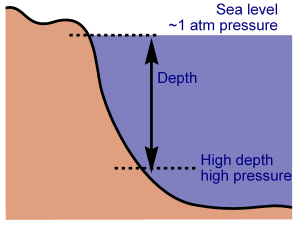
When you increase your depth under water, the water pressure on your body

a)

increases

b)

decreases

c)

stays the same

16.

How do you Calculate Pressure

a)

Force(N)/Area(m2)

b)

Force(kg)/Area(mi2)

c)

Area(m2)/Force(N)

17.

Why won't you sink in mud if you wear boots?

a)

Because the surface area is larger creating less pressure.

b)

Has air in it to keep you floating.

c)

Because the mud won't want you.

18.

Diagram shows the design of a dam. Why does the thickness of the dam increase with its depth?

a)

The design of this structure is stronger.

b)

Water pressure increases with depth.

c)

The cost of construction is lower.

d)

Water pressure acts uniformly in all directions.

19.

What is pressure?

a)

The amount of force exerted on a surface

b)

The surface area of an object

c)

The weight of an object

20.
What is the unit of measurement for pressure?
a)
pascal
b)
grams
c)
milliters
d)
meters
21.
What pressure does a 4000N horse exert on the ground if each foot is 10cm2?
a)
40 N/cm2
b)
100 N/cm2
c)
400 N/cm2
d)
10 N/cm2
22.
Army tank tracks are useful for travelling through the mud because..
a)
they decrease the force the vehicle exerts on the ground
b)
they increase the force the vehicle exerts on the ground
c)
they decrease the pressure the vehicle exerts on the ground
d)
they increase the pressure the vehicle exerts on the ground
23.
Which of these animals would probably cause the greatest pressure on the ground?
a)
A fat cow with big feet
b)
A fat cow with small feet
c)
 A calf with big feet
d)
A calf with small feet
24.
Look at the pressure triangle. How do we calculate the area?
a)
f ÷ a
b)
f x p
c)
p x f
d)
f ÷ p
25.
Look at the pressure triangle. How do we calculate the force?
a)
f ÷ a
b)
f x p
c)
p x a
d)
f ÷ p
26.
As you climb up a mountain what happens to the air pressure?
a)
decreases
b)
increases
c)
stays the same
27.
Compared to a man standing on a tall mountain, a man standing at sea level 
a)
has less atmospheric pressure on him 
b)
has more atmospheric pressure on him 
c)
weighs less 
d)
has more mass 
28.
Which of the statements is true?
a)
The bottom of the boot exerts more pressure than the high-heeled shoe as a result of an increase in surface area.
b)
The bottom of the  high-heeled shoe exerts more pressure than the boot as a result of an decrease in surface area.
c)
The bottom of the high-heeled shoe exerts the same pressure as the bottom of the boot.
29.
If the horse reared up on 2 legs what effect would it have on the pressure?
a)
it will exert half the pressure it did before
b)
it will exert the same pressure it did before
c)
it will exert twice the  pressure it did before
d)
it will exert four times the pressure it did before
30.
What happens?
a)
Neither piston moves
b)
Piston A goes up and B goes down
c)
Piston B goes up and A goes down
d)
Both pistons go down
31.
Where is pressure the greatest on the dam?
a)
D
b)
C
c)
B
d)
A
32.

Which situation produces more force on the floor?

a)

standing on one foot

b)

standing on two feet

c)

standing on four feet

d)

all produce the same force

33.

Which situation produces more pressure on the floor?

a)

standing on one foot

b)

standing on two feet

c)

standing on four feet

d)

all produce the same pressure

34.
Which container will have lower pressure?
a)
left
b)
right
c)
they both have the same pressure
35.

What can change the pressure of a gas?

a)

Temperature

b)

Volume

c)

Concentration or amount in set container

d)

All of the above

36.

Pressure is _________ __________ to the volume a gas is held in.

a)

Directly proportional

b)

Indirectly proportional

c)

Inversely proportional

d)

Negatively correlated

37.

You can increase the pressure in a container full of gas by:

a)

making the container smaller.

b)

making the container bigger.

c)

cooling the gas.

d)

taking some of the gas out.

38.

If you put more gas into a container the pressure increases because:

a)

the particles all cool down.

b)

there is more space for the particles to move around.

c)

more particles fall to the bottom of the container.

d)

there are more particles, so there are more collisions with its walls.

39.

The air is being sucked out of this bottle. Why is it collapsing?

a)

There is more pressure inside than outside.

b)

There is more pressure outside than inside.

c)

There are more particles inside it.

d)

Air particles are sticking to the walls and pulling them in.
40.
How can we increase the gas pressure inside a sealed container?
a)
Increase the number of particles inside the container
b)
Increase the temperature
c)
Decrease the volume of the container
d)
All of these
41.
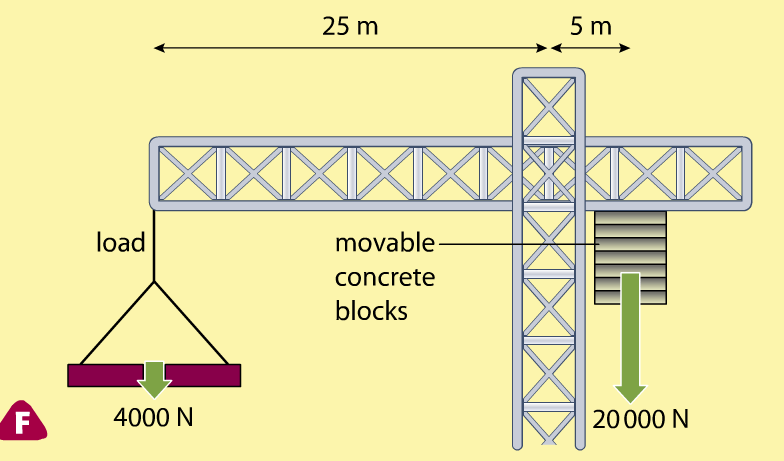
What is the anticlockwise moment acting on this crane?
a)
80,000Nm
b)
100,000Nm
c)
120,000Nm
d)
140,000Nm
42.

What is the moment acting on the seesaw?

a)

1.6Nm clockwise

b)

1.6Nm anticlockwise

c)

4N clockwise

d)

4N anticlockwise

e)

0.4m anticlockwise

43.
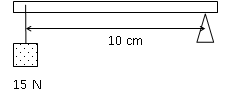
What is the moment produced by the 15 N?
a)
15 Nm (clockwise)
b)
150 Nm (anti - clockwise)
c)
1.5 Nm (anti - clockwise)
d)
0.15 Nm (clockwise)
44.
A seesaw is unbalanced with two people of different masses sitting equal distances from the center. Which of the following will result in equilibrium?
a)
The larger person moving further away from the center.
b)
Moving the smaller person closer to the center.
c)
Moving the smaller person further from the center.
d)
Making the larger person do nothing.
45.
The easiest way to open a heavy door  is by applying the force
a)
Near the hinges
b)
In the middle of the door
c)
At the edge of the door far from the hinges
d)
At the top of the door
46.

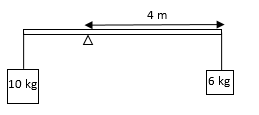
Two masses of mass 10.0 and 6.0 kg are hung from massless strings at the end of a light rod. The rod is virtually weightless. A pivot (fulcrum) is placed off center and the system is free to rotate. If the 6.0 kg mass is 4.0 m away from the pivot, how far away is the 10.0 kg mass if the system is not rotating?

a)

0.42 m

b)

2.4 m

c)

4.8 m

d)

4.2 m

47.
A wrench is used to tighten a nut. A 15N perpendicular force is applied 50cm away from the axis of rotation, and moves a distance of 10 cm as it turns. What is the torque applied to the wrench?
a)
7.5 Nm
b)
1.5 Nm
c)
750 Nm
d)
150 Nm
48.

A nut can be loosened more easily with

a)

a short spanner because a larger turning effect can be produced.

b)

a long spanner because a larger turning effect can be produced.

c)

a long spanner because a larger force can be produced.
d)

a short spanner because a larger force can be produced.

49.

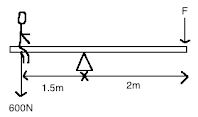
A boy of weight 600N sits on the see-saw as shown at a distance of 1.5m from the pivot. What is the force F required at the other end to balance the see-saw?

a)

450 N

b)

350 N

c)

4.5 N

d)

200 N

50.

The figure below shows a man lifting a heavy rock using a steel bar. He pushes downwards on the end of the bar with a force F.


Which pivot positions allows the force F to be as small as possible?

a)

A

b)

B

c)

C

d)

D