wayground logo

Free Printable Worksheets

NEW

Font size

S
M
L
XL
Worksheets

3/3 Photosynthesis Quiz Reg.

Total questions: 53

Worksheet time: 34mins

Name
Class
Date
1.

The process in which plant cells make energy

a)

Exothermic

b)

Endothermic

c)

Cellular Respiration

d)

Photosynthesis

2.

How do humans get glucose so they can live?

a)

breathe it in

b)

photosynthesis

c)

eat food

d)

drink liquids

3.

Mitochondria and Chloroplasts are:

a)

organelles

b)

cells

c)

only in humans

d)

only in plants

4.

For photosynthesis, a plant needs water, sun, and...

a)

oxygen

b)

carbon dioxide

c)

glucose

d)

mitochondria

5.
The ____________ is the most photosynthetic part of a plant.
a)
leaf
b)
flower
c)
roots
d)
stem
6.
the products of photosynthesis are...
a)
glucose and sunlight
b)
carbon dioxide and water
c)
glucose and chlorophyll
d)
oxygen and glucose
7.
Glucose is a ...
a)
sugar
b)
carbohydrate
c)
source of quick energy
d)
all are correct
8.
The vascular tissue of the plant that transports water is the...
a)
roots
b)
phloem
c)
xylem
d)
stem
9.
The leaf structure that allows carbon dioxide to enter the leaf and Oxygen to exit the leaf is...
a)
phloem
b)
stomata
c)
vein
d)
stem
10.
This is ...
a)
mitochondria
b)
chloroplast
c)
cell
d)
phloem
11.
What part of the leaf allows Carbon dioxide in and oxygen out of the leaf?
a)
xylem
b)
phloem
c)
cuticle
d)
stomata
12.

Which part of a flower is known to attract pollinators?

a)

Stem

b)

Leaf

c)

Pollen

d)

Colorful Petals

13.

Which part of a plant anchors the plant to the ground and soaks up water and minerals?

a)

stem

b)

leaves

c)

roots

d)

petals

14.

Which of the following is NOT another word for the energy a plant takes in to make photosynthesis happen?

a)

Sunlight

b)

Radiant Energy

c)

Light Energy

d)

Thermal Energy

15.

Plants take in radiant energy and turn it into what form of energy?

a)

Chemical

b)

Thermal

c)

Potential

d)

Kinetic

16.

Photosynthesis produces Glucose for plants. This is a form of __________________________ for plants.

a)

Chemical energy

b)

Thermal energy

c)

Light energy

d)

Radiant energy

17.

In which organelle does photosynthesis occur?

a)

Cell Wall

b)

Chlorophyll

c)

Chloroplast

d)

Cytoplasm

18.

What is the byproduct of photosynthesis? What does the plant release?

a)

Oxygen

b)

Carbon Dioxide

c)

Water

d)

Glucose

19.

When light intensity goes up, the rate of photosynthesis goes _______.

a)

up

b)

down

c)

at the same rate. It does not change.
20.
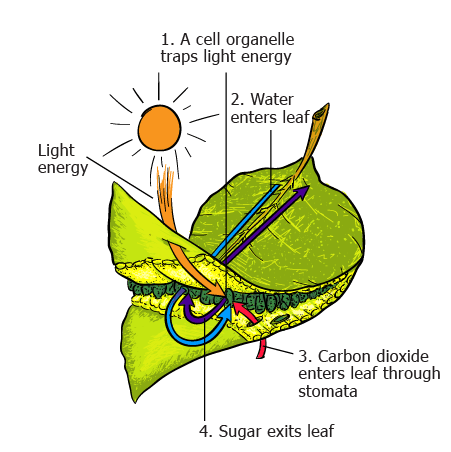
Which of the following is the correct equation for PHOTOSYNTHESIS?
a)
CO+ light + H2O --> O+ Sugar
b)
CO+ sugar + H2O --> O+ light
c)
O2 + light + H2O --> CO+ Sugar
d)
CO+ O2 + H2O --> Light+ Sugar
21.
What process occurs when light energy is captured in autotrophs and converted into sugar?
a)
Photosynthesis
b)
Cellular Respiration
22.
What is the ultimate ORIGINAL source of energy for living things
a)
Sugar
b)
Sun
c)
Moon
d)
Carbon Dioxide
23.
Which organisms perform Photosynthesis?
a)
Only Autotrophs
b)
Only Heterotrophs
c)
Autotrophs and Heterotrophs
24.
Which of the following is an example of an AUTOTROPH?
a)
Appletree
b)
Dog
c)
Mushroom
d)
Human
25.
Which of the following is an example of a HETEROTROPH?
a)
Grass
b)
Algae
c)
Lemon Tree
d)
Bear
26.
Which gas is removed from the atmosphere during photosynthesis?
a)
hydrogen
b)
oxygen
c)
nitrogen
d)
carbon dioxide
27.
What is photosynthesis?
a)
The process in which humans eat their food
b)
When a photographer takes a photo.
c)
To get your pictures from the photo lab.
d)
The process in which plants make their food.
28.
If all four plants were watered daily but placed in a closet, receiving no sunlight, what process would NOT occur?
a)
Ingestion of carbon dioxide
b)
Filtration of water through the soil
c)
Photosynthesis
d)
Water absorbtion
29.
Look at the image
What substances and organelle work together to absorb sunlight to perform photosynthesis in this example?
a)
cell wall and chloroplast
b)
mitochondria and water
c)
vacuole and carbon dioxide
d)
chloroplast and chlorophyll
30.

What time of day (24 hour period) do plants photosynthesize?

a)

nighttime only

b)

daytime only

c)

daytime and nighttime

d)

only in the summer months

31.

REVIEW QUESTION: Which lab tool is used to make tiny objects look much bigger?

a)

telescope

b)

microscope

c)

scale

d)

graduated cylinder

32.
What three things do plants need?
a)
Water, air, and sunlight.
b)
Water, soil, and sunlight.
c)
Water, soil, and air.
d)
Love, family, and Cheetos.
33.
The energy released from sugar was once energy from what?
a)
The energy from sugar was once energy from water.
b)
The energy from sugar was once energy from the air.
c)
The energy from sugar was once energy from the sun.
d)
The energy from sugar was once energy from an iPad battery.
34.
Which of these is NOT AN IMPACT photosynthesis has on an ecosystem:
a)
Oxygen for animals and humans to breathe
b)
Food for us to eat
c)
Taking CO2 out of the air
d)
Taking oxygen out of the air
35.

Which organelle stores water for use in photosynthesis?

a)

Chloroplast

b)

Cell Membrane

c)

Vacuole

d)

Nucleus

36.
Which of these conditions would decrease the rate of photosynthesis in a plant?
a)
Above average precipitation
b)
Changing the daylight hours from 14 hrs to 10 hrs
c)
Changing the CO2 concentration from 380 ppm to 410 ppm
d)
All of these choices
37.

What is the main purpose of photosynthesis?

a)

To make food

b)

To create energy

c)

To release oxygen

d)

To absorb sunlight

38.
Why do we eat food?
a)
to provide energy/fuel
b)
to eliminate waste products
c)
to prevent diseases
d)
to kill pathogens
39.

A green powder is heated & a gas is given off while it turns to a black solid. This describes

a)

Physical Change

b)

Chemical Change

c)

Change in State

d)

Change in Temperature

40.
Which body system breaks down food and sends nutrients to all of the body's organs?
a)
nervous
b)
spinal
c)
skeletal
d)
digestive
41.
A cell is...
a)
the basic unit of structure and function in living organism
b)
an organism
c)
a basic part of everything that we see
d)
found only in animals, not plants
42.

This is a

a)

animal cell

b)

plant cell

c)

tissue

d)

flower

43.
Which structures are found in every living cell?
a)
cell membrane and cytoplasm
b)
chloroplasts and mitochondria
c)
a cell wall and nucleus
d)
chloroplasts and cell wall
44.

What is the stimulus in this example?

a)

Internal

b)

Light

c)

Touch

d)

Temperature

45.

Which type of reproduction involves one parent and results in offspring that are identical to each other and the parent?

a)

sexual reproduction

b)

asexual reproduction

c)

neither

46.
Which trait could be influenced by the environment?
a)
Fur color changes with seasons
b)
Fur color changes as you get older
c)
Height is affected by what you eat
d)
You can stretch to grow taller
47.
What is NOT an inherited trait of humans?
a)
Favorite type of music
b)
Freckles
c)
Hair color
d)
Height
48.
Which of these did you inherit from you parents?
a)
Your ability to read
b)
Your natural hair color
c)
The language you speak
d)
Whether you have a suntan
49.

Organisms with traits that are best suited for their environments are likely to have a greater chance for survival. These helpful traits, which arise due to genetic mutations, are known as _____________________.

a)

Mutation

b)

Adaptations

c)

Natural Selection

d)

Evolution

50.

Which is an example of selective breeding?

a)

A giraffe's long neck.

b)

Clipping a horse's tail so it's not too long.

c)

Training a horse to run faster.

d)

Cross breeding a labrador retriever with a poodle .

51.

The differences among a species, like different bird beaks, are called

a)

genes.\

b)

variations

c)

traits

d)

alleles

52.
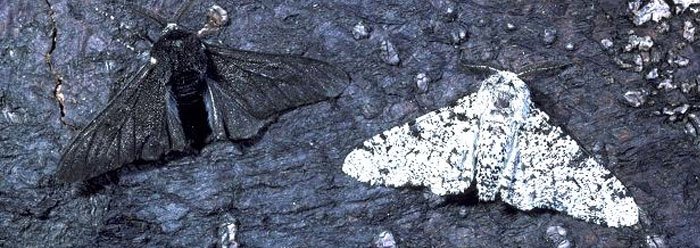
The trees these moths used to live on were white, but have been covered in soot from coal factories. Which moth will be more successful in this environment?
a)
Dark moth
b)
Light moth
c)
Both will be equally successful
d)
Neither will be successful
53.
What process is being shown in this image?
a)
Variation
b)
Natural Selection
c)
Selective Breeding
d)
Homeostasis