
 Worksheets
STAAR Review: Category 2
Total questions: 61
Worksheet time: 37mins

What kind of energy is being shown in the picture?
Light
Gravitational
Potential
Kinetic

As the ball is dropped, the potential energy decreases while the kinetic energy increases however the amount of energy stays the same.
True
False
Which is the best example of kinetic energy?
A car sitting on top of a hill
A skateboard on the sidewalk
A wagon rolling down a hill
A powerwheel parked in the yard
What is changed to increase the potential energy of an object being dropped?
Temperature
Gravity
Height
Volume

Which two points have the same potential energy?
U & V
S & T
T & X
S & X

What happens as the ball on the pendulum goes from center to the right in the diagram?
Kinetic energy increases while potential energy decreases
Potential energy increases as kinetic energy decreases
Potential energy increases as kinetic energy increases
Potential and Kinetic energy is lost

How does energy change?
The cart has more kinetic energy at the top than when it is going down the hill.
The cart has potential energy at the top while kinetic energy increases going down.
The cart has potential energy that is lost going down the hill.
The cart has kinetic energy at the top of the hill and no potential energy.

The ball's potential energy is equal to it's mechanical energy.
True
False

A toy car is traveling up a ramp. What happens to the energy as it goes up the ramp?
Kinetic energy increases while potential decreases.
Potential energy increases while kinetic decreases.
Both potential and kinetic energy increases.
Both potential and kinetic energy decreases.

Which position has the most kinetic energy?
1
2
3
4

Which position has the highest potential energy?
1
2
4
6
What energy transformation takes place when you turn on an electric light?
Chemical > light + heat
Chemical > electrical + heat
Mechanical > light + heat
Electrical > light + heat
Electrical → Mechanical → Sound
Which device were the students most likely observing?
Balanced or Unbalanced: A runner jumping over a hurdle.
balanced
unbalanced
Balanced or Unbalanced: A lamp sitting on a table.
balanced
unbalanced
Balanced or Unbalanced: A car accelerating around a mountain curve.
balanced
unbalanced
Balanced or Unbalanced: Two ice skaters moving in a straight line at a constant speed.
balanced
unbalanced
The overall forces acting on an object is called
net force
balanced force
total force
unbalanced force
Forces are measured in (a) .
When an object has balanced forces acting on it, the object __________.
moves to the right
stays still
moves to the left
can move in any direction
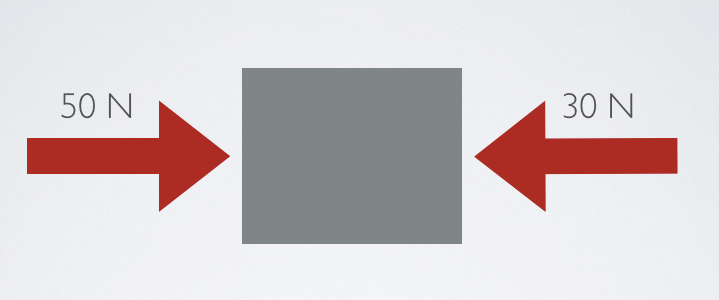


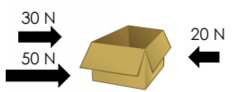


Calculate the net force shown in the diagram?
(a)


An archer pulls the bowstring back, then releases the string and the arrow flies forward. Pulling the string back is the...
action force
reaction force
net force
inertia
When an unbalanced force acts on an object, the force ______________________.
changes the motion of the object
is cancelled by another force
does not change the motion of an object
is equal to the weight of the object
1st
Law of Motion
2nd
Law of Motion
3rd
Law of Motion
1st
Law of Motion
2nd
Law of Motion
3rd
Law of Motion
What is the acceleration of a 50 kg object pushed with a force of 500 newtons?
100 m/s2
25,000 m/s2
10 m/s2
25 m/s2

A cannonball with a mass of 0.5 kg is flying at an acceleration of 10 m/sec/sec. What is its force?
50 Newtons
5 Newtons
20 Newtons
9.5 Newtons
What is Newton's 2nd Law?
Every action has an equal and opposite reaction
An object at rest stays at rest, an object in motion stays in motion.
F = ma
Friction

If the man pushes with an equal amount of force, which object will accelerate more?
Car because it has more mass
Lawnmower because it has less mass
Car because it has less mass
Lawnmower because it has more mass
A 25 kg bike accelerates at 10 m/s2. What was the force?
250 N
2.5 N
25 N
15 N
If an object was accelerating at 5 m/s2, and a force of 10 newtons was required to accelerate it, what was the object's mass?
50 kg
2 kg
0.5 kg
5 kg
True or False. 800 N = 800 kg ⋅ m/s2
True
False
_____ is the distance an object travels per unit time. It is the rate of change in position.
motion
distance
displacement
speed
The distance between Dallas and Houston is about 385 kilometers. It takes about 3.35 hours to drive between each city. What is the average speed in kilometers per hour?
Solve to the thousandth's place. You may round up to the hundredth's place. Record the number only.
(a)

Students complete a lab to graph motion. A student has to walk 20 meters and record the time every 5 meters. The distance and time are shown in the table. What was the average speed of the total walk in meters per second?
Solve to the thousandth's place. You may round up to the hundredth's place. Record the number only.
(a)


What is this graph showing?
Fast constant speed
Slow constant speed
At rest
Accelerating
What is acceleration?
an increase in speed
a decrease in speed
a change in direction
all of these are examples

Describe the object's motion from A to B (TWO Answers):
Speeding Up
Slowing Down
Constant Speed
Not Moving
Describe the object's motion from B to C:
Speeding Up
Slowing Down
Constant Speed
Not Moving
A girl on a bike rides down a hill 500 meters long in 50 seconds. What is her speed?
100 m/s
10 m/s
1,000 m/s
10 mph
A trip to Florida takes 10 hours. The distance is 816 km. Calculate the average speed.
81.6 km/hr
81.6 mph
82 m/s
816 km/h

