
 Worksheets
Everything
Total questions: 56
Worksheet time: 34mins
Name
Class
Date
1.

______ are made of ________.
a)
Elements; compounds
b)
Compounds; elements
c)
Compounds; mixtures
d)
Elements; mixtures
2.
This layer of Earth is the thickest part
a)
crust
b)
outer core
c)
mantle
d)
inner core
3.

What is Pangaea?
a)
The name of a German Scientist
b)
the name of the supercontinent that existed millions of years ago
c)
another name for continental drift
d)
the name of an ancient fossil
4.
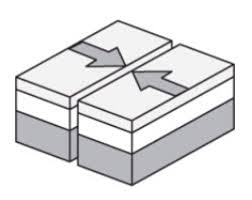
Name the boundary
a)
convergent boundary
b)
divergent boundary
c)
transform boundary
d)
sergent boundary
5.

Name the boundary
a)
convergent boundary
b)
divergent boundary
c)
transform boundary
d)
sergent boundary
6.
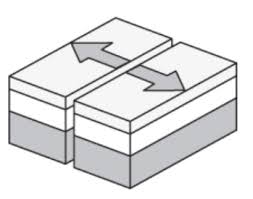
Name the boundary
a)
convergent boundary
b)
divergent boundary
c)
transform boundary
d)
sergent boundary
7.

A subduction zone is formed...
a)
when one tectonic plate sinks below another
b)
at every type of convergent plate boundary
c)
at every type of divergent plate boundary
d)
at transform boundaries
8.

What are mid-ocean ridges?
a)
A chain of underwater waterfalls
b)
A chain of underwater volcanos
c)
A chain of underwater mountains
d)
A chain of underwater rocks
9.

Who is the person credited with developing the theory of continental drift?
a)
Harry Hess
b)
Galileo
c)
Alfred Wegener
d)
Newton
10.
During sea floor spreading, molten material rises up from the mantle...
a)
along the continents
b)
at the mid ocean ridges
c)
deep ocean trenches
d)
at north and south poles
11.
Which of the following is where one plate slides under another plate?
a)
submarine zone
b)
divergence zone
c)
subduction zone
d)
lower zone
12.
Associated with transform boundaries.
a)
Volcanoes
b)
mountains
c)
trenches
d)
earthquakes
13.
Oceanic crust is
a)
Younger and less dense than continental crust
b)
Thinner, younger and more dense than continental crust
c)
Older, thicker and less dense that continental crust
d)
Bigger and younger than continental crust
14.

Which of the following occurs because of convection currents?
a)
Tectonic plates on the crust move.
b)
The mantle increases in size.
c)
Pressure in the crust increases.
d)
Pressure in the crust decreases.
15.
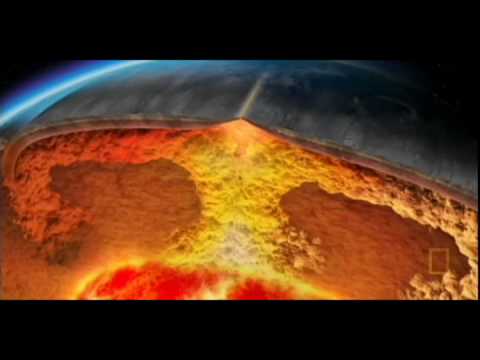
Scientists think that convection currents that move the plates flow in Earth's
a)
Continental crust
b)
Oceanic crust
c)
Asthenosphere
d)
Lithosphere
16.
The mantle of Earth is made partly of magma. When magma rises and sinks, this is called ______________.
a)
a conduction current
b)
a hot spot
c)
a volcanic eruption
d)
a convection current
17.
If you traveled from the center of Earth to the surface, the pressure would...
a)
increase
b)
decrease
c)
stay the same
d)
unsure
18.

The physical layer of Earth made of solid rock and soil is called the ___________.
a)
mesosphere
b)
lithosphere
c)
asthenosphere
d)
mantle
19.
Where does the heat come from that drives this convection current in the mantle?
a)
The sun
b)
The crust
c)
the mantle
d)
the core
20.

Which liquid is the least dense?
a)
oil
b)
water
c)
syrup
d)
plastic bottle
23.

Which box has a higher density?
a)
Box A
b)
Box B
c)
cannot be determined
d)
they are the same
22.

What would happen to the convection currents if the heat from the inner core disappeared?
a)
They would stop.
b)
They would change directions.
c)
It would not change.
d)
They would speed up.
23.
Which box has a higher density?
a)
Box A
b)
Box B
c)
cannot be determined
d)
they are the same
24.
Pure substances are found on ...
a)
The Periodic Table
b)
the bottom of the sea
c)
the skin
d)
mixtures
25.

______ represent pure substances on The Periodic Table.
a)
Elements
b)
Compounds
c)
Chemical symbols
d)
Letters
26.
Evidence of a chemical change includes...
a)
color change
b)
freezing
c)
breaking
d)
boiling
27.
A chemical change always
a)
smokes
b)
has total potential energy
c)
creates a new substance
d)
displays a color change
28.

Precipitate
a)
glue
b)
chunky, yellow stuff
c)
white solid formed
d)
rain
29.

A rotten egg displays characteristics of a(n)
a)
Easter bunny
b)
prank
c)
chemical change
d)
kinetic energy
30.
Gas production during a chemical change is seen as
a)
clouds
b)
bubbles
c)
balloons
d)
air
31.

NaCl(salt) contains ___ elements.
a)
2
b)
3
c)
4
d)
1
32.

___ have luster.
a)
Gases
b)
Solids
c)
Metals
d)
Non-metals
33.

Clay; moldability is as
a)
sad; happy
b)
rain; sunshine
c)
Metals; malleability
d)
Non-metals; conductivity
34.
The total energy of potential+kinetic must equal...
a)
100 joules
b)
50%
c)
50
d)
100%
35.
As _____ increases; ______ decreases.
a)
kinetic; other
b)
potential; kinetic
c)
energy; potential
d)
kinetic; energy
36.
The Law of ______ of Energy explains that energy circulates.
a)
Conversation
b)
Conservation
c)
Kinetic and Potential
d)
Sustaining
37.
The Law pf Conservation applies to _____ and ____.
a)
time; matter
b)
matter; energy
c)
energy; natural resources
d)
space; energy
38.
In an energy ____, energy CHANGES from one form to another.
a)
transfer
b)
transformation
c)
gain
d)
loss
39.
Conduction occurs through
a)
air
b)
waves
c)
circulating
d)
touch
40.

Radiation is associated with...
a)
waves
b)
holes
c)
boiling
d)
poison
41.

Batteries transform ____ energy to ______ energy.
a)
electrical; electrical
b)
electrical; chemical
c)
chemical; electrical
d)
radiant; chemical
42.
Objects will exchange heat until both objects reach___.
a)
equilibrium
b)
different temperatures.
c)
freezing
d)
boiling
43.
Heat is transferred from ____ temperatures to ____.
a)
lower; equal
b)
equal; higher
c)
higher; lower
d)
lower; higher
44.
Distance/time=
a)
speed
b)
pace
c)
direction
d)
acceleration
45.

Density is how _____ molecules are.
a)
hot
b)
fast
c)
attracted
d)
compact
46.

Volume is how much space an objects occupies.
a)
True
b)
False
47.
Renewable natural resources are available on nearly a perpetual basis. PERPETUAL means...
a)
daily
b)
rare
c)
frequent
d)
holiday
48.

Fossil fuels generally require _____ to release the stored energy.
a)
burning
b)
boiling
c)
stirring
d)
lighting
49.
Organic indicates that the matter contains _____.
a)
Oxygen
b)
Carbon
c)
Iron
d)
Bromine
50.

Biomass is
a)
fossils
b)
organic matter
c)
wood
d)
carcasses
51.

Net force of unbalanced forces is...
a)
0
b)
negative
c)
greater than 0
d)
equal to 1
52.
If an earthquake occurs at a ____ boundary, the forces were ____.
a)
subduction; equal
b)
transform; balanced
c)
transform; unbalanced
d)
divergent; unbalanced
53.
Mountains form because _____ plates have _____ forces.
a)
oceanic; balanced
b)
continental; unbalanced
c)
continental; balanced
d)
oceanic; volcanic
54.
A horizontal line on a distance vs. time graph, indicates that there is ____ change in distance.
a)
0
b)
some
c)
little
d)
a high amount
55.

Longitude lines run ______.
a)
horizontally
b)
vertically
56.

Ms. Carter's favorite farm animal?
a)
horse
b)
chicken
c)
pig
d)
duck
100 %

