
 Worksheets
Geological Processes Review #2
Total questions: 52
Worksheet time: 43mins
Name
Class
Date
1.
Heat and pressure deep beneath Earth's surface can change any rock into
a)
sedimentary rock
b)
igneous rock
c)
metamorphic rock
2.
Sediments being pressed and glued together forms what type of rock?
a)
sedimentary rock
b)
igneous rock
c)
metamorphic rock
3.
Rock that forms from the cooling of magma below the surface or lava at the surface is called
a)
sedimentary rock
b)
igneous rock
c)
metamorphic rock
4.
A series of processes on Earth's surface and interior that slowly changes rocks from one kind to another is called the
a)
sedimentary rock
b)
rock cycle
c)
rock change
5.
Which type of rock results from melting and cooling of magma?
a)
Igneous
b)
Metamorphic
c)
Sedimentary
d)
Extrusive
6.
Which type of rock forms from extreme heat and pressure?
a)
Igneous
b)
Sedimentary
c)
Organic
d)
Metamorphic
7.
A metamorphic rock changes into an igneous rock by what two processes?
a)
Melting and cooling
b)
Extreme heat and pressure
c)
Compaction and cementation
d)
Weathering and erosion
8.
True/False: Igneous rocks can only turn into metamorphic rocks.
a)
True
b)
False
9.
What are the 3 major types of rocks?
a)
Igneous, Metamorphic, Sedimentary
b)
Metamorphic, Igneous, Cementation
c)
Brown, Red, Gray
d)
Streak, Hardness, Breakage
10.

Each rock type can follow only one pathway of the rock cycle.
a)
True
b)
False
11.
In order for a metamorphic rock to form, _______ is needed.
a)
Pressure
b)
Heat
c)
Heat and Pressure
d)
Weathering
12.
The process by which metamorphic rocks are formed...
a)
heat and pressure
b)
erosion and deposition
c)
melting and cooling
13.
Rock that forms when pressure and temperature change existing rock.
a)
Igneous Rock
b)
Sedimentary Rock
c)
Metamorphic Rock
d)
Rock Cycle
14.
True or False: Once a rock is sedimentary, it cannot become an igneous rock.
a)
True
b)
False
15.
_______ rock forms from magma/lava
a)
Metamorphic
b)
Sedimentary
c)
Igneous
16.
In order for a metamorphic rock to form, _______ is needed.
a)
Pressure
b)
Heat
c)
Heat and Pressure
d)
Weathering
17.
what is the rock cycle.
a)
molten rock that is stored underground.
b)
rock material that forms where rocks are broken down into smaller pieces.
c)
a process that changes one type of rock into another type of rock.
18.

The 3 types of rock in the rock cycle are...
Select all that apply
a)
Igneous
b)
Magma
c)
Sedimentary
d)
Metamorphic
19.

When does the rock cycle end?
a)
when a rock is formed
b)
Never
c)
When a rock changes shape
d)
When the year ends
20.

What does sediments mean?
a)
pieces of rock
b)
colorful rocks
c)
large rocks
d)
erosion
21.
The thinnest layer of the Earth is the ___________.
a)
mantle
b)
crust
c)
core
22.
Tectonic plates are made up of continental crust and ________ crust.
a)
continental
b)
oceanic
c)
plates
d)
mantle
23.
What is the thickest layer of the Earth?
a)
the crust
b)
the mantle
c)
the outer core
d)
the inner core
24.
What is the core made of?
a)
steel
b)
iron
c)
aluminum
d)
iron and nickel
25.
What describes the outer core?
a)
solid
b)
liquid
c)
viscous
d)
gas
26.
Why is the inner core solid?
a)
its unknown
b)
what it's made of
c)
the pressure
d)
it is colder than the outer core
27.
Which layer of the Earth is the only liquid layer?
a)
Outer Core
b)
Inner Core
c)
Mantle
d)
Lithosphere
28.
Which layer(s) of the Earth make up the asthenosphere?
a)
Part of the mantle
b)
Crust, mantle, Core
c)
Crust and upper mantle
d)
Only the crust
29.
What is the correct order (starting from the surface) of Earth's layers?
a)
crust, outer core, inner core, mantle
b)
mantle, outer core, inner core, crust
c)
crust, mantle, outer core, inner core
d)
outer core, inner core, crust, mantle
30.
What layer is a semisolid and acts like a plastic?
a)
Lithosphere
b)
Mantle
c)
Asthenosphere
d)
crust
31.
What happens to pressure as we move from the crust to the inner core?
a)
Pressure Decreases
b)
Pressure Increases
c)
Nothing
32.
What happens to temperature as we move from the crust to the inner core?
a)
Decreases
b)
Increases
c)
Nothing
33.
Less dense materials rise to the top.
a)
True
b)
False
34.
Which layer of Earth has the GREATEST density?
a)
crust
b)
mantle
c)
outer core
d)
inner core
35.
Which layer of Earth is made up of tectonic plates?
a)
outer core
b)
inner core
c)
asthenosphere
d)
lithosphere
36.
What is the name of the layer that contains the uppermost mantle and crust
a)
Asthenosphere
b)
Mesosphere
c)
Lithosphere
d)
Transosphere
37.
Which type of plate boundary would cause mountains to form
a)
Transform
b)
Convergent
c)
Divergent
d)
Reform
38.

Scientists think that convection currents that move the plates flow in Earth's
a)
Continental crust
b)
oceanic crust
c)
Asthenosphere
d)
Lithosphere
39.
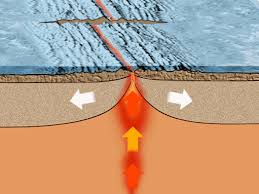
Where does molten material from the mantle rise up during the process of sea-floor spreading?
a)
Along the mid-ocean ridge
b)
At the north and south poles
c)
Along the edges of all the continents near the shoreline and beaches
d)
at the equator
40.
which one is hotter?
a)
the crust
b)
mantle
c)
Inner core
41.
What is the driving force to plate tectonics occurring when warm magma rises and cooler magma sinks?
a)
An oceanic current
b)
A conventional current
c)
A convection current
d)
A magnetic current
42.
Evidence to support continental drift included ______________.
a)
remains of human beings on a number of continents
b)
similar fossils found on different continents
c)
how the continents drifted
d)
written records
43.
_____________ came up with the theory of continental drift.
a)
Alfred Einstein
b)
Alfred Wegener
c)
Harry Hess
d)
Barack Obama
44.

Identify layer #20.
a)
mantle
b)
pizza crust
c)
inner core
d)
outer core
45.
What was the name given to all the continents when they were joined as one super continent
a)
Supreme Continent
b)
United States
c)
Bill Nye's World
d)
Pangea
46.
The lithosphere combines what two layers?
a)
Athenosphere & Crust
b)
Crust & Upper Mantel
c)
Mantel & Athenosphere
47.
What happens to temperature as we move from the crust to the inner core?
a)
Decreases
b)
Increases
48.
What happens to pressure as we move from the crust to the inner core?
a)
Pressure Decreases
b)
Pressure Increases
c)
Nothing
49.
Which layer of the earth is under the highest pressure?
a)
Crust
b)
Mantle
c)
Outer Core
d)
Inner Core
50.
Oceanic crust is thicker than continental crust.
a)
True
b)
False
51.
Geologists' main evidence about the structure of Earth's interior comes from
a)
temperature measurements in deep mines
b)
observations of other planets
c)
exploration of caves
d)
rock samples and seismic waves
52.
Why have geologists not reached the mantle?
a)
It is too hot for humans to go there.
b)
It is too smelly for humans to go there.
c)
It doesn't have Wi-Fi so none of their instruments work.
d)
Scientists have not figured out how to time travel.
100 %

