wayground logo

Free Printable Worksheets

NEW

Font size

S
M
L
XL
Worksheets

Standard 1-4: Phases of Matter and Phase Changes

Total questions: 59

Worksheet time: 54mins

Name
Class
Date
1.
Which state of matter has a definite shape?
a)
solid
b)
liquid 
c)
gas
d)
plasma
2.
Which state of matter take up ALL the space inside a container? 
a)
solid
b)
liquid
c)
gas
d)
all of the above
3.
The drops of water that appear on the outside of a glass of cold juice on a warm day are an example of?
a)
Sublimation: A solid turning into a gas.
b)
Condensation: A gas changing to a liquid.
c)
Evaporation: A liquid changing to a gas.
d)
Deposition: A gas changing to a solid.
4.
Freezing point and melting point are the same temperature.
a)
True
b)
False
c)
It depends on the substance
5.
A substance that has a definite shape and volume.
a)
evaporation
b)
gas
c)
liquid
d)
solid
6.
What happens to particles when they are heated?
a)
They speed up and spread out
b)
They slow down and compress
c)
They stop moving
d)
They move closer together and speed up
7.
All changes in the state of matter of a substance requires a change in
a)
vibration
b)
water
c)
permission
d)
energy
8.
At higher temperatures
a)
particles in an object have less energy
b)
particles in an object move faster
c)
a gas contracts
9.
Boiling is the term we use to describe which phase change?
a)
Solid to a liquid
b)
Solid to a gas
c)
Gas to a liquid
d)
Liquid to a gas
10.
Change from gas to liquid...
a)
condensation
b)
evaporation
c)
expansion
d)
movement
11.
Change from Liquid to Solid is called......
a)
fusion
b)
Freezing
c)
sublimation
d)
evaporation
12.
Change from liquid to gas is called....
a)
expansion
b)
vaporization
c)
condensation
d)
sublimation
13.
All phase changes in the state of matter of a substance requires a change in
a)
vibration
b)
water
c)
permission
d)
energy
14.
When a substance changes from a gas to a liquid it is called
a)
Evaporation
b)
Condensation
c)
Freezing
d)
Melting
15.
The main difference between amorphous and crystalline solids is:
a)
One has definite shape, the other has definite volume.
b)
One has a pattern, the other does not.
c)
A crystalline solid example is glass.
d)
An amorphous solid example is sugar.
16.
In an exothermic reaction, heat is ...
a)
taken in or absorbed
b)
given out or released
17.
In an endothermic reaction, heat is ...
a)
taken in or absorbed
b)
given out or released 
18.
When you freeze water, it turns to ice.  What kind of change is this?
a)
 Physical
b)
Chemical
19.
After you mix two substances together, a new substance forms.  This is an example of:
 
a)
 Physical Change
b)
 Chemical Change
20.
Evaporation is what kind of change?
a)
Endothermic
b)
Exothermic
21.
Condensation and raining are examples of what?
a)
Exothermic
b)
Endothermic
22.
In an endothermic reaction the system is releasing energy.
a)
True
b)
False
23.
When iron nails get rusty, heat is released.  What process is this?
a)
Exothermic
b)
Endothermic
24.
Particles move quickest
a)
solid
b)
liquid
c)
gas
d)
solid, liquid and gas
25.
Particles slide past each other
a)
solid
b)
liquid
c)
gas
d)
solid, liquid and gas
26.
Definite shape and definite volume
a)
solid
b)
liquid
c)
gas
d)
solid, liquid and gas
27.
What does this picture represent? 
a)
solid
b)
liquid
c)
gas
d)
plasma
28.
What does this picture represent? 
a)
solid
b)
liquid 
c)
gas
d)
plasma
29.
Which of the following is not true about gases?
a)
They spread out to fill their containers
b)
They have a low density. 
c)
The particles move very slowly. 
d)
The volume changes with whatever shape the room is. 
30.
Which state of matter do the particles in this picture represent?
a)
solid
b)
liquid
c)
gas
d)
plasma
31.
Which of the phases have particles that have a fixed volume but not a fixed shape? 
a)
solid
b)
liquid
c)
gas
d)
plasma
32.
a skin-like surface on a drop of water
a)
Dome
b)
Conserve
c)
Surface Tension
d)
Gas
33.
when water is cold, but not frozen, it will move closer together
a)
Expand
b)
Contract
c)
Liquid
d)
Absorb
34.
What is a change in the state of matter. For example, a solid goes to a liquid or gas, liquid to a gas or solid, or gas to a solid or liquid.
a)
phase change
b)
physical properties
c)
state of matter
d)
mixture
35.
Crystalline solids have...
a)
a flat repeating pattern
b)
a 3-D repeating pattern
c)
no repeating pattern
36.
Which type of vaporization happens from the surface?
a)
Vaporization
b)
Boiling
c)
Evaporation
d)
Sublimation
37.
Condensation is the change of state from _______ to ______ as a result of losing heat energy.
a)
Solid, Liquid
b)
Solid, Gas
c)
Liquid, Gas
d)
Gas, Liquid
38.
What is the change from a Solid to a Gas due to the gaining of energy?
a)
Condensation
b)
Vaporization
c)
Sublimation
d)
Deposition
39.
When the particles in a solid are NOT arranged in a regular repeating pattern?
a)
Viscosity
b)
Amorphous
c)
Sublimation
d)
Crystalline
40.
When objects absorb heat, the particles...
a)
gain energy and vibrate at fixed position.
b)
gain energy and increase in size.
c)
gain energy and move slower.
d)
gain energy and move faster.
41.
What is viscosity?
a)
A liquid's resistance to flow.
b)
a liquids flow.
c)
a liquid
d)
gas to solid.
42.
Solids with a random distribution of atoms ?
a)
Crystalline solid
b)
Amorphous solid
c)
Geometric solid
d)
Atomic Solid
43.
Solids where atoms are arranged in an orderly geometric pattern?
a)
Crystalline solid
b)
Amorphous solid
c)
Geometric solid
d)
Atomic Solid
44.

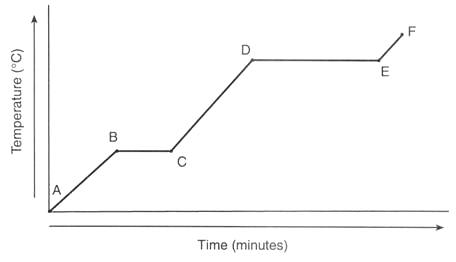
What line segment represents only the solid state? (Diagram F)

a)

A-B

b)

B-C

c)

C-D

d)

D-E

45.

Between which points is the temperature of the substance remaining constant? (Diagram F)

a)

A-B only.

b)

A-B, C-D, E-F

c)

B-C only.

d)

B-C, D-E

46.

A substance's heating curve is shown in the graph. What is its boiling point? (Diagram B)

a)

100 C

b)

60 C

c)

80 C

d)

20 C

47.

Is the substance gaining or losing energy? (Diagram D)

a)

Gaining

b)

Losing

48.

What phase change is occurring at line segment B-C if the graph is exothermic? (Diagram E)

a)

melting

b)

freezing

c)

boiling

d)

condensation

49.

Which line segment demonstrates vaporization occurring? (Diagram E)

a)

B-C

b)

C-D

c)

D-E

d)

E-F

50.
What happens when thermal energy is taken away from particles?
a)
They move faster and farther apart
b)
They move slower and closer together
51.
During a phase change, the temperature
a)
increases
b)
decreases
c)
fluctuates
d)
stays the same
52.

An ice cube feels cold when we hold it. Which of the following best explains why?

a)

Heat moves from our hands into the ice cube.

b)

Cold moves from our hands into the ice cube.

c)

Heat moves from the ice cube into our hands.

d)

Cold moves from the ice cube into our hands.

53.
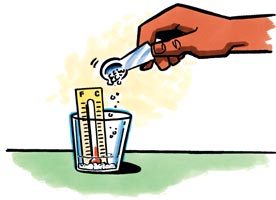
Which process does the diagram show?
a)
freezing
b)
boiling
c)
evaporation
d)
melting
54.

Hot things have ____________ thermal energy than cold things

a)

more

b)

less

c)

same

d)

potato

55.

Cold things often have a _________ kinetic energy because_______

a)

lower; particles are moving around less

b)

lower; particles are moving around more

c)

higher; particles are moving around the same

d)

higher; particles do not move

56.

As temperature increases, molecules _____________

a)

move slower

b)

move the same

c)

move faster

d)

stop moving

57.

What happens to the particles of a substance as it changes from a solid to a liquid?

a)

They move closer together

b)

They move farther apart

c)

Their mass increases

d)

Their mass decreases

58.

Explain why gases are compressible while solids and liquids are not.

a)

Gases have high density

b)

Gases have weak intermolecular forces

c)

Gases have strong intermolecular forces

d)

Gases have low kinetic energy

59.

What is the main reason solids have a definite shape?

a)

Strong intermolecular forces

b)

High kinetic energy

c)

Weak intermolecular forces

d)

Low density