
 Worksheets
Wave Behaviors Heroic Quest
Total questions: 60
Worksheet time: 1hrs 25mins
Name
Class
Date
1.
What type of material is the most transparent?
a)
A Window
b)
Window with a curtain
c)
A mirror
d)
A notebook
2.
Which object would be the best at reflecting light waves?
a)
windows
b)
mirrors
c)
notebooks
d)
tables
3.
As light travels through a lens in causes an object to appear larger, this is due to which behavior?
a)
Transmission
b)
Reflection
c)
Absorption
d)
Refraction
4.
When standing in the sun this behavior allows you to warm up as light and other waves hit your clothes.
a)
Reflection
b)
Refraction
c)
Absorption
d)
Transmission
5.
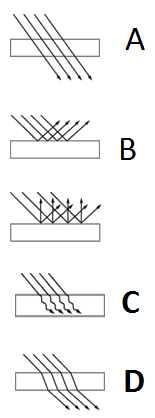
Which of the figures represents reflection?
a)
A
b)
B
c)
C
d)
D
6.

Which of the following represents refraction?
a)
A
b)
B
c)
C
d)
D
7.
You hold a piece of paper and notice that some light travels through it. This means it is....
a)
Transparent
b)
Translucent
c)
Opaque
8.
Prisms separate light into the colors of the rainbow using what behavior of waves?
a)
Reflection
b)
Refraction
c)
Absorption
d)
Transmission
9.
A piece of wax paper will let some light pass through it and the objects look blurry since wax paper is considered to be.
a)
translucent
b)
transparent
c)
opaque
d)
reflective
10.
When a wave strikes and object and bounces off. (example echo)
a)
medium
b)
refraction
c)
reflection
d)
interference
11.
which material does sound travel the fastest?
a)
solid
b)
liquid
c)
gases
12.
A _______ separates sunlight into the colors of the visible spectrum
a)
prism
b)
both prism and mirror
c)
mirror
d)
solid cube
13.
Refraction occurs when _____________
a)
the wave's speed changes
b)
in response to echoes
c)
as a result of reflected impages in a mirror
d)
none of the above
14.
An object that blocks all of the light from passing through is...
a)
transparent
b)
clear
c)
opaque
d)
translucent
15.
A block of wood is opaque.
a)
true
b)
false
16.

This shows that some light is passing through the glass of milk. This means the glass of milk is __________________.
a)
opaque
b)
translucent
c)
transparent
17.
What happens when light hits an object you can see?
a)
The light turns corners.
b)
The light curves around the object.
c)
The object reflects the light.
d)
The light and the object do not form a shadow.
18.
What is a property of a transparent object?
a)
Almost all of the light rays that reach it are scattered.
b)
Almost all of the light rays that reach it are absorbed.
c)
Almost all of the light rays that reach it are reflected.
d)
Almost all of the light rays that reach it pass through it.
19.
Which is translucent?
a)
tissue paper
b)
air
c)
wood
d)
clear plastic
20.
What is most likely to happen to light that hits an opaque object?
a)
All of the light passes through the object.
b)
None of the light passes through the object.
c)
Most of the light disappears.
d)
Some of the light passes through the object.
21.
Which is transparent?
a)
a wooden fence
b)
clean water
c)
aluminum foil
d)
a purple balloon
22.
If you wanted a gift to be a surprise, what kind of container would you put it in?
a)
transparent
b)
thick
c)
opaque
d)
translucent
23.
What does it mean to refract? (refraction)
a)
bounce off
b)
to bend
c)
curve outward
24.
What happens when light hits a mirror?
a)
it makes a color
b)
it reflects
c)
it makes a rainbow
d)
it passes through
25.
How does light travel?
a)
in a wavy path
b)
in a straight path
c)
in a zig zag path
26.
A convex lens curves ____________.
a)
outward
b)
inward
c)
opaque
d)
refracts
27.
A concave lens curves _____________.
a)
outward
b)
inward
c)
opaque
28.
What is a prism?
a)
a transparent object that separates white light
b)
an opaque object that appears black
c)
a translucent object
29.
What do all waves have in common?
a)
nothing
b)
they carry energy
c)
they absorb light
d)
you can see them
30.
A wood door is
a)
translucent
b)
transparent
c)
opaque
31.
What happens to blue light when it hits a shirt that appears blue?
a)
The light is reflected.
b)
The light is absorbed.
c)
The light is refracted.
d)
The light is blocked.
32.
Why do we see objects as black?
a)
They absorb all the light
b)
They reflect all the light
c)
They absorb some light and reflect
33.
4. What separates white light into different colors?
a)
transmission
b)
absorption
c)
scattering
d)
refraction
34.
Seeing your face in a mirror is an example of
a)
Refraction
b)
Fiber Optics
c)
Reflection
d)
Absorption
35.
What kind if lens would you find in your eye?
a)
opaque
b)
concave
c)
convex
d)
prism
36.
An example of a longitudinal wave is a
a)
water wave
b)
rope wave
c)
stadium wave
d)
sound wave
37.
Which statement best describes a wave medium?
a)
the material through which a wave travels
b)
a point halfway between the crest and the trough of a wave
c)
the distance from one wave crest to another
d)
the speed at which waves travel in water
38.
Which statement describes the relationship between frequency and wavelength?
a)
When frequency increases, wavelength increases
b)
When frequency increases, wavelength decreases
c)
When frequency increases, wavelength remains constant
d)
When frequency increases, wavelength varies unpredictably
39.
For wave refraction to take place, a wave must
a)
increase in velocity
b)
enter a new medium
c)
increase in frequency
d)
merge with another wave
40.

What is causing you to be able to see two sets of mountains in this picture?
a)
refraction of light
b)
reflection of light
c)
transmission of light
d)
absorption of light
41.

The black rectangles represent light waves. What is happening to them as they move from left to right?
a)
They are being reflected.
b)
They are being refracted.
c)
They are being transmitted.
d)
They are being absorbed.
42.

Hey! That straw looks broken. Why?
a)
reflection
b)
refraction
c)
transmission
d)
absorption
43.

Why are those people casting shadows?
a)
They are transparent
b)
They are translucent.
c)
They are opaque.
44.

What's going on here?
a)
Red light is being refracted; all other colors are absorbed.
b)
Red light is being absorbed; all other colors are reflected.
c)
Red light is transmitted; all other colors are refracted.
d)
Red light is reflected; all other colors are absorbed.
45.
Paul is fishing out on the Resevoir. He sees a fish from his boat and goes to spear it but misses by a lot but sees that the fish has not moved. What caused him to think the fish was some where else?
a)
reflection
b)
transmission
c)
absorption
d)
refraction
46.
An example of this is an echo
a)
refraction
b)
reflection
c)
transmission
d)
absorption
47.
What kind of wave is pictured below?
a)
compressional wave
b)
transverse wave
c)
sound wave
d)
mechanical wave
48.
What do we call the bottom of a transverse wave?
a)
crest
b)
trough
c)
wavelength
d)
amplitude
49.
What do we call the top of the wave?
a)
crest
b)
trough
c)
amplitude
d)
frequency
50.
Waves that require a medium are called
a)
mechanical waves
b)
transverse waves
c)
light waves
d)
gamma rays
51.
Light is a type of energy that travels as an ______________ ____________.
a)
longitudinal wave
b)
electric current
c)
electromagnetic wave
d)
magnetic wave
52.
An electromagnetic wave
a)
never moves.
b)
can travel only through empty space.
c)
cannot travel through matter.
d)
can travel through empty space or matter
53.
What is the major source of energy on Earth?
a)
EM waves from the sun
b)
photosynthesis
c)
fossil fuels
d)
plants that are used as food
54.
The part of the electromagnetic spectrum that human sees is
a)
ultraviolet light.
b)
visible light.
c)
infrared light.
d)
x-ray.
55.

Electromagnetic waves________________travel through space.
a)
Never
b)
Cannot
c)
Can
d)
Wish they could
56.
which of the following does NOT belong in the electromagnetic spectrum:
a)
X-ray
b)
sound wave
c)
ultra violet rays
d)
microwaves
57.
In visible light, which color has the longest wavelength?
a)
Red
b)
Violet
c)
Yellow
d)
Green
58.
How much of the electromagnetic spectrum is visible?
a)
All of it
b)
None of it
c)
Most of it
d)
Only a small part
59.
The spreading out of waves through an opening or around the edge of an obstacle is...
a)
reflection
b)
refraction
c)
diffraction
d)
interference
60.
More energy = _______ Frequency
a)
higher
b)
lower
c)
slower
d)
medium
100 %

