
 Worksheets
Nuclear Reactions
Total questions: 52
Worksheet time: 57mins
Name
Class
Date
1.
Takes two small nuclei and combines them into a larger nucleus
a)
fission
b)
fusion
2.
The splitting of a nucleus into smaller nuclei is
a)
fusion
b)
fission
c)
half-life
d)
gamma radiation
3.
How do nuclear power-plants work?
a)
Fusion
b)
Half-life
c)
Fission
d)
Fusion or fission
4.
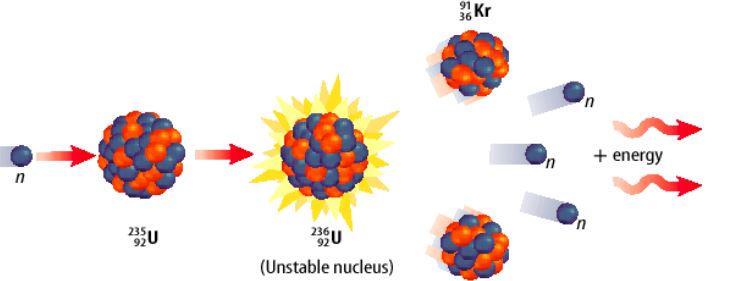
This is an example of...
a)
Fission reaction
b)
Fusion reaction
c)
Decomposition reaction
d)
Decay
5.
Where does fusion occur naturally?
a)
Underwater
b)
All around us
c)
In the radioactive waste
d)
On the sun
6.
Which atoms combine together during fusion reaction on the sun?
a)
Helium and Hydrogen atoms
b)
Hydrogen atoms
c)
Hydrogen and Lithium atoms
d)
Hydrogen and Carbon atoms
7.
An example of an uncontrolled fission reaction is _______________
a)
Nuclear power plants
b)
Radio active decay
c)
Atomic Bomb
d)
On the surface of the sun
8.
What metal gives off radiation?
a)
carbon
b)
cobalt
c)
uranium
d)
titanium
9.
What were the two names of the atomic bomb bombs used in WW2
a)
Little Girl,Dragon breath
b)
Little boy,Fat man
c)
Big Women,Tiger
d)
Little boy,Fat Father
10.
How is nuclear fusion different from nuclear fission?
a)
In fusion, the product is a larger atomic nucleus.
b)
Fission produces energy but fusion does not.
c)
Fusion produces energy but fission does not.
d)
In fission, the product is a larger atomic nucleus.
11.
What are some of the outcomes of nuclear fusion?
a)
Produce larger materials from the collision of smaller materials.
b)
Release energy.
c)
Produce smaller materials from the collision of larger materials.
d)
Produce larger materials from the collision of smaller materials & Release energy
12.
In nuclear fusion, smaller atoms are forced together to create larger atoms. Does this process release, absorb or maintain energy?
a)
Absorb energy
b)
Maintain energy
c)
Release energy
13.
In this example of nuclear fusion, the products contain an expelled __________ which also contributes to the release of energy.
a)
helium
b)
neutron
c)
proton
d)
electron
14.
The product of nuclear fission includes
a)
neutrons and electrons
b)
several nuclei and neutrons
c)
several nuclei and electrons
d)
several nuclei and protons
15.
Which of the following is true about nuclear fission?
a)
The mass of the product is greater than the mass of the original nucleus
b)
The mass of the product is less than that of the original nucleus
c)
The mass of the product is the same as the mass of the original nucleus
d)
The mass of the product is 100 times greater than the original nucleus
16.
What is a chain reaction?
a)
When electrons travel are emitted causing electricity
b)
When a nuclear fission reaction occurs, the protons emitted can strike other nuclei in the sample, and cause them to split
c)
When a nuclear fission reaction occurs, the neutrons emitted can strike other nuclei in the sample, and cause them to split
d)
When a nuclear fission reaction occurs, the electrons emitted can strike other nuclei in the sample, and cause them to split
17.
What is a beneficial aspect of nuclear fission?
a)
The ability to absorb energy
b)
The ability to release tremendous amounts of energy
c)
The ability to produce more energy than nuclear fusion
d)
There are no beneficial aspects of nuclear fission
18.
What is true about nuclear fusion?
a)
The mass of the product is less than that of the original nucleus
b)
The mass of the product is 100 times less than that of the original nucleus
c)
The mass of the product is the same as that of the original nucleus
d)
The mass of the product is greater than that of the original nucleus
19.
_________ happens naturally due to an unstable nucleus.
a)
fission
b)
fusion
c)
radioactive decay
d)
K-capture
20.
Which atoms combine together during fusion reaction on the sun?
a)
Helium and Hydrogen atoms
b)
Hydrogen atoms
c)
Hydrogen and Lithium atoms
d)
Hydrogen and Carbon atoms
21.
The major drawback to nuclear fission reactors is the difficulty of achieving safe disposal of radioactive waste products.
a)
true
b)
false
22.
Hydrogen is the primary fuel
a)
Fission
b)
Fusion
c)
Radioactive Decay
23.
Very high temperature and pressure is required for:
a)
Fission
b)
Fusion
c)
Radioactive Decay
24.
Hydrogen is the primary fuel for:
a)
Fission
b)
Fusion
c)
Radioactive Decay
25.
Unstable nuclei breaks down releasing energy &/or particles
a)
Nuclear Fission
b)
Nuclear Fusion
c)
Radioactive Decay
26.
Half life is
a)
Fission
b)
Fusion
c)
Radioactive Decay
27.
One advantage of nuclear energy over coal energy is ______.
a)
it is very cheap to build and maintain a nuclear power plant
b)
there is very little dangerous waste with nuclear energy
c)
the nuclear plant emits motre greenhouse gases
d)
the nuclear plant does not emit as many greenhouse gases
28.
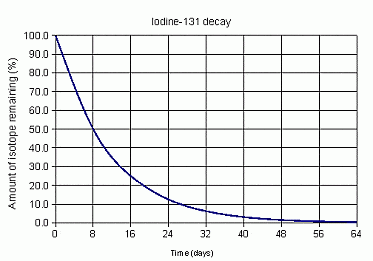
What is the half-life of iodine-131?
a)
32 days
b)
8 days
c)
16 days
d)
24 days
29.

If one-fourth of the carbon-14 is remaining then how many half-lives have passed?
a)
1
b)
2
c)
3
d)
4
30.
When an element loses protons, its __________changes.
a)
protonic number
b)
electronic number
c)
neutronic number
d)
atomic number
31.

What percent of carbon-14 would be left after 5730 years?
a)
100%
b)
75%
c)
50%
d)
25%
32.

What percent of carbon-14 would be left after 11,460 years?
a)
100%
b)
75%
c)
50%
d)
25%
33.

If a fossil is found to have one-eighth of Carbon-14 remaining then how old is the fossil?
a)
11,460 years
b)
5,730 years
c)
28,650 years
d)
17,190 years
34.
When an unstable radioactive atom decays, it usually turns into:
a)
a more stable atom
b)
a less stable atom
c)
the exact same atom but with less pure energy
d)
empty space
35.
The time it takes for 50% of the nuclei in a radioactive sample to decay to its stable isotope is called _____.
a)
the daughter product
b)
geologic time
c)
the half-life
d)
the half-time
36.
This happens naturally due to an unstable nucleus.
a)
fission
b)
fusion
c)
radioactive decay
d)
K-capture
37.
The half life of a radioactive substance:
a)
increases with time
b)
increases then decreases with time
c)
decreases with time
d)
stays the same with time
38.

a)
Radioactive Decay
b)
Nuclear Fission
c)
Nuclear Fusion
39.

a)
Radioactive Decay
b)
Nuclear Fission
c)
Nuclear Fusion
40.

What machine is used to detect radiation?
a)
Geiger counter
b)
Richter counter
41.
The half-life of an isotope is the time needed for half its mass to change to energy.
a)
true
b)
false
42.
_________ happens naturally due to an unstable nucleus.
a)
fission
b)
fusion
c)
radioactive decay
d)
K-capture
43.
Which of these statements correctly describes how the chain reaction occurs in nuclear fission.
a)
Uranium releases electrons to create electricity
b)
When a nuclear fission reaction occurs, the electrons emitted can strike other nuclei in the sample, and cause them to split
c)
When a nuclear fission reaction occurs, the neutrons emitted can strike other nuclei in the sample, and cause them to split
d)
Protons and neutrons change to electrons because the nuclei are so big
44.
What is a benefit of nuclear fission?
a)
The ability to absorb energy
b)
The ability to release tremendous amounts of energy
c)
The ability to produce more energy than nuclear fusion
d)
There are no beneficial aspects of nuclear fission
45.
Very high temperature and pressure is required for:
a)
Fission
b)
Fusion
c)
Radioactive Decay
46.
U-235 is the primary fuel
a)
Fission
b)
Fusion
c)
Radioactive Decay
47.
One disadvantage of nuclear energy is ___.
a)
it is a fossil fuel
b)
it leaves behind radioactive waste
c)
it emits large amounts of pollution into the atmosphere
d)
there are no disadvantages
48.
An example of an uncontrolled fission reaction is _______________
a)
Nuclear power plants
b)
Radio active decay
c)
Atomic Bomb
d)
On the surface of the sun
49.
What is the detonator for the hydrogen bomb?
a)
the atomic bomb
b)
Uranium 235
c)
A neutron
d)
A proton
50.
What do fission and fusion both provide?
a)
Heat
b)
Cold air
c)
Ice
d)
Fire
51.
How is nuclear fusion different from nuclear fission?
a)
In fusion, the product is a larger atomic nucleus.
b)
Fission produces energy but fusion does not.
c)
Fusion produces energy but fission does not.
d)
In fission, the product is a larger atomic nucleus.
52.
What are some of the outcomes of nuclear fusion?
a)
Produce larger materials from the collision of smaller materials.
b)
Release energy.
c)
Produce smaller materials from the collision of larger materials.
d)
Produce larger materials from the collision of smaller materials & Release energy
100 %

