
 Worksheets
Motion
Total questions: 55
Worksheet time: 33mins
An object is _____ if its position changes relative to another object.
in motion
a frame of reference
at reset
magical
A place or object used for comparison to determine if another object is in motion is called a
comparison point
point of view
frame of reference
motion detector
A distance vs. time graph shows an object's
frame of reference
speed
acceleration
favorite food
Speed =
distance / time
time/distance
distance x time
You walk 10 meters to math class in 20 seconds. Your average speed is
2 m/s
200 m/s
5 m/s
.5 m/s
On a distance-versus-time graph, a straight line ALWAYS indicates that an object’s speed is _____.
constant
increasing
zero
decreasing
Change in speed over a given period of time is
velocity
speed
motion
acceleration
On a distance vs. time graph, the steeper the slope _____
the slower the speed
less acceleration
the faster the speed
greater acceleration
The rate at which velocity changes is called
acceleration
motion
instantaneous speed
average speed
What is the SI unit for acceleration
m/s
m/s2
m
s
What is the SI unit for speed?
Km
s
m/s
m/s2
When something has speed in a certain direction it is called ___________.
velocity
motion
position
speed
Acceleration of an object happens when things ________
slow down
change direction
get faster
All of the above

The formula:
? = D/T with direction
is used to find
Acceleration
Speed
Force
Velocity
The process of changing distance or position from another object
reference point
motion
location
acceleration
Grayson walks 5 meters in 5 seconds. What is his average speed?
25 m/s
5 m/s
1 m/s
.25 m/s

The graph shows Ashley riding her bike to Maria's house.
What is occurring from point A to point B?
she is traveling at a constant speed
she i stopped to take a break
she is decreasing her speed

The graph shows Ashley riding her bike to Maria's house.
What was occurring from point B to point C?
She was increasing her speed
She was decreasing her speed
She stopped for 4 minutes

The graph represents
no motion
acceleration
constant velocity
negative acceleration

What is the speed of the motion from D to E?
20 m/s
0 m/s
40 m/s
200 m/s

What type of acceleration is shown here?
Positive
None
Negative
Varies


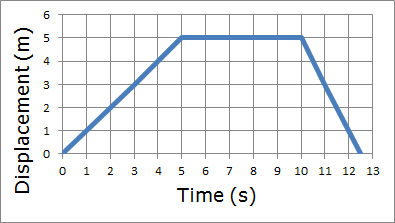
According to the graph how far does the person travel in the first 5 seconds?
2 m
10 m
0 m
5 m



Acceleration is defined as the CHANGE in
time it takes for one place to move to another place.
velocity of an object.
distance divided by the time interval
velocity divided by the time
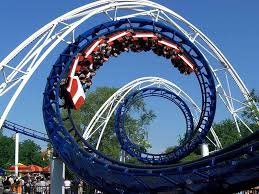
Why does a car accelerate as it rounds a corner at a constant speed?
Its direction changes
It doesn't
It slows down
Its speeds up

What segment of the graph shows no motion, or standing still?
A - B
B - C
C - D
None

True or False: this graph shows several segments ALL with constant velocity.
True
False

Describe motion of C - D.
Constant velocity away from the origin
Slowing down away from the origin
Slowing down away from the origin and then slowing down towards the origin
Slowing down away from the origin and then speeding up towards from the origin

Describe the motion from B - C.
Standing still
Constant velocity of 60 m/min
Constant velocity of 0 m/min
Accelerating


At what time does the object switch directions?
15 minutes
40 minutes
10 minutes
30 minutes

Use the picture to choose the most accurate description of the object's motion
object is moving at constant speed in the positive direction
object is speeding up in the negative direction
object is speeding up in the positive direction
object is slowing down in the negative direction

Use the picture above to choose the most accurate description of the object's motion
object is moving with a constant velocity in the negative direction
object is speeding up in the negative direction
object is slowing down in the positive direction
object is moving with a constant velocity in the positive direction

Use the picture above to choose the most accurate description of the object's motion
object is speeding up in the negative direction
object is slowing down in the negative direction
object is moving at constant speed in the negative direction
object slowing down in the positive direction
The slope of the velocity-time graph tells us the
acceleration
displacement
velocity
direction of travel
The velocity-time graphs represent the motion of four different objects. Identify any object that is stationary or not moving. Check all that apply.


Which section of this velocity-time graph shows the man moving back to a reference point?
Section A
Section B
Section C
None of the sections

Which line shows the fastest velocity? (choose all that apply)
Line A
Line B
Line C
Line D
None of them

