
NEW
Font size
S
M
L
XL
 Worksheets
Bio Semester II Final Review
Total questions: 40
Worksheet time: 37mins
Name
Class
Date
1.

what did Charles Darwin observe in finch populations of the Galapagos Islands off the coast of South America?
a)
different species on different islands
b)
all species on one of the islands
c)
identical species on all the islands
d)
the same species as North America
2.

All rabbits living in a particular area would be an example of a(n)
a)
population
b)
species
c)
fossil
d)
individual organism
3.

a bird that can easily outcompete other birds for food and that can produce many eggs has a high
a)
life expectancy
b)
mutation rate
c)
fitness
d)
adaptability
4.

What kid of isolation occurs when two populations of birds have different courtship dances?
a)
geographic
b)
sexual
c)
temporal
d)
behavioral
5.

the hind leg bones in a whale are examples of
a)
homologous structures
b)
analogous structures
c)
fossils
d)
vestigals
6.

What is the process of biological change in organisms over time?
a)
Fossils
b)
Evolution
c)
Adaptation
d)
Species
7.
what gave Charles Darwin the idea of evolution?
a)
google
b)
wikipedia
c)
mans attempt to destroy mankind
d)
finches in the Galapagos island
8.
Jean-Baptiste Lamarck proposed that organisms
a)
have an innate tendency toward complexity and perfection.
b)
have an innate tendency to become simpler as time passes.
c)
inherit all of the adaptations they display.
d)
belong to species that never change.
9.
The economist Thomas Malthus suggested that
a)
in the human population, people die faster than babies are born.
b)
without certain checks on population size, there would soon be insufficient food for the growing human population.
c)
in the 1700s, England needed more housing.
d)
the majority of a species’ offspring die.
10.
Charles Darwin called the ability of an organism to survive and reproduce in its specific environment
a)
diversity.
b)
evolution
c)
adaptation.
d)
fitness.
11.
Whose theory included "acquired traits" such as a giraffe needing a long neck so they stretch it over time?
a)
Darwin
b)
Lamarck
12.

AB blood type is an example of what type of inheritance?
a)
complete dominance
b)
incomplete dominance
c)
codominance
d)
polygenic inheritance
13.
How many PAIRS of sex chromosomes do humans have?
a)
23
b)
46
c)
1
d)
2
14.
What are the blood types of the possible children that a woman (type O) and man (type AB) can have? Use a Punnett square if you need to.
a)
O and AB
b)
O and A
c)
O and B
d)
A and B
15.
If a woman has type A blood and her child has type O blood, the father must have which of the following blood types?
a)
A, B, or O
b)
A or O
c)
AB or B
d)
O only
16.
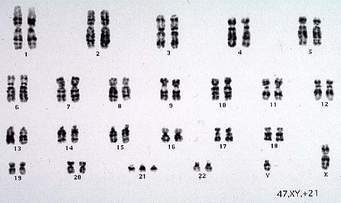
Based on the Karyotype shown, at which chromosome pair can we identify a genetic disorder?
a)
Chromosome pair 5
b)
sex chromosomes
c)
Chromosome pair 21
d)
There are no chromosomal disorders
17.
Which sex chromosomes would indicate a typical human male?
a)
XX
b)
X
c)
XY
d)
XXY
18.

What is the sex of this baby?
a)
Male
b)
Female
19.
Chromosomes exchange genetic material during
a)
crossing over
b)
replication
c)
synthesis
d)
translation
20.
The complementary DNA strand for the following sequence is: T T A C G
a)
G C A T T
b)
T T A C G
c)
A A U G C
d)
A A T G C
21.
What type of mutation occurs, when a base is subtracted from the sequence?
a)
Deletion
b)
Insertion
c)
Substitution
22.
What is the purpose of transcription?
a)
to make protein
b)
to make ribosomes
c)
to make nucleus
d)
to make mRNA
23.
Making mRNA using DNA strand is known as -
a)
Transcription
b)
Translation
c)
Replication
24.
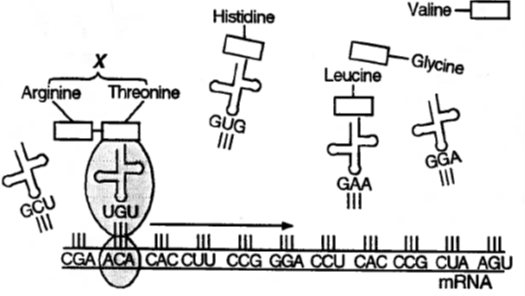
What process is going on in this photo?
a)
Transcription
b)
Translation
c)
Replication
d)
All the above
25.
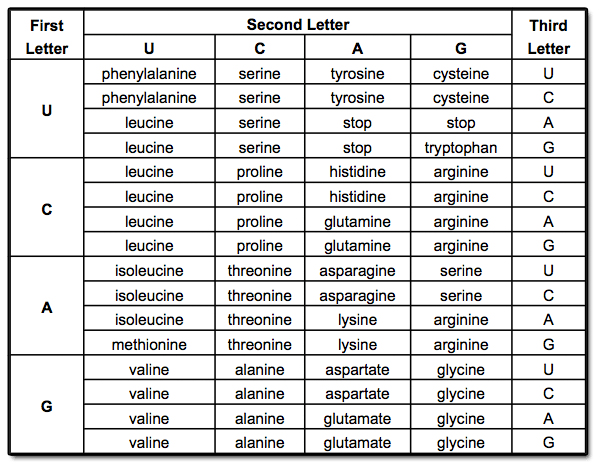
What amino acid is represented by the codon UUA?
a)
Phenylalanine
b)
Tyrosine
c)
Leucine
d)
Stop codon
26.
What is the location in the cell for transcription?
a)
nucleus
b)
cytoplasm
c)
ribosome
d)
mitochondria
27.
What is the location in the cell for translation?
a)
nucleus
b)
mitochondria
c)
ribosome
d)
chloroplast
28.
The function of ______ is to combine with proteins to form ribosomes.
a)
rRNA
b)
tRNA
c)
mRNA
d)
DNA
29.
What is the three base sequence of mRNA that codes for a single amino acid?
a)
Anticodon
b)
Codon
c)
Protein
30.
This nucleic acid is single stranded
a)
DNA
b)
RNA
c)
Both
31.
Contains the bases adenine, thymine, guanine and cytosine
a)
DNA
b)
RNA
c)
Both
32.
Contains the bases adenine, uracil, cytosine and guanine
a)
DNA
b)
RNA
c)
Both
33.
Carries the genetic code to the ribosome
a)
mRNA
b)
tRNA
c)
rRNA
d)
DNA
34.

What is the correct amino acid sequence for the mRNA code AUGCCAGUAUGA
a)
Met-Pro-Ala-Val
b)
Met-Pro-Val
c)
Tyr-Gly-His
d)
Tyr-Gly-Arg-His
35.
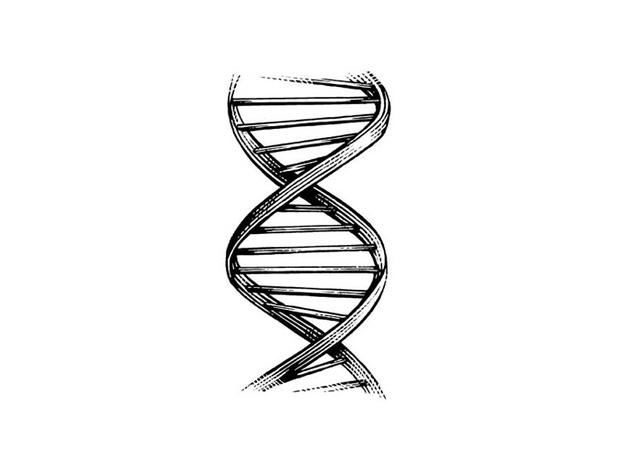
DNA has a _____________ structure.
a)
double helix
b)
single strand
c)
ring
d)
chain
36.
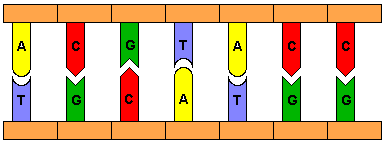
In DNA, Adenine pairs with ___________.
a)
Guanine
b)
Cytosine
c)
Thymine
d)
Uracil
37.
How many codons are needed to specify for five amino acids?
a)
3
b)
5
c)
15
d)
30
38.
What is the base found in RNA but not DNA?
a)
U (uracil)
b)
T (thymine)
c)
C (cytosine)
d)
A (adenine)
39.

How did Rosalind Franklin's photo 51 affect th work of Watson and Crick? (picture is shown)
a)
It was used to determine the physical structure of DNA
b)
It was used to identify the four bases that make up DNA
c)
It was used to determine the theory of independent assortment
d)
It was used to show DNA was the molecule of inheritance
40.
Which pair of scientists are given credit for the discovery of DNA's structure?
a)
Watson and Franklin
b)
Watson and Crick
c)
Franklin and Wilkins
d)
Wilkins and Crick
Reset

