
 Worksheets
Biology SOL review - 1st 9 weeks
Total questions: 30
Worksheet time: 19mins
Name
Class
Date
1.
True or False: A hypothesis must be stated in a way that is testable.
a)
True
b)
False
2.
In a "controlled" experiment, how many variables should you change at a time?
a)
4
b)
3
c)
6
d)
1
3.
Procedure
a)
Educated guess that can be tested
b)
Step by step plan of the experiment
c)
The purpose of the experiment; what is to be answered
d)
Variable that is to change on purpose
4.
Data
a)
Conclusion or reason proposed to explain an observation
b)
Act of recognizing a fact
c)
Information organized for analysis
5.
Observation
a)
Act of recognizing a fact using your senses
b)
Information organized for analysis
c)
Conclusion or reason proposed to explain an observation
6.
The variable that you change in the experiment. Also called the manipulated variable.
a)
Controlled
b)
Dependent
c)
Independent
d)
Responding
7.
Dependent Variable
a)
Variable that is to change on purpose
b)
Variable that is the result of what happened and is considered the data
c)
Variable that nothing was done to
8.
An organism that produces its own food supply from inorganic compounds is called a(an)
a)
heterotroph
b)
consumer
c)
detritivore
d)
autotroph
9.
What is the original source of almost all energy in most ecosystems?
a)
carbohydrates
b)
sunlight
c)
water
d)
carbon
10.
What is the term for each step in the transfer of energy and matter within a biological community?
a)
energy path
b)
food web
c)
trophic level
d)
food pyramid
11.

which symbiosis is this
a)
parasitism
b)
mutualism
c)
commensalism
d)
nonalism
12.

symbiotic relationship in which both organisms benefit
a)
competition
b)
Mutualism
c)
nitrogen fixation
d)
energy pyramid
13.

What does a food web represent?
a)
All connections of energy flow throughout all organisms in a habitat.
b)
The specific ways that mutualism is carried out.
c)
A single pathway or energy flow between organisms.
d)
How carnivores get their food.
14.
The amount of energy that usually transfers from one trophic level to the next...
a)
10%
b)
20%
c)
80%
d)
50%
15.
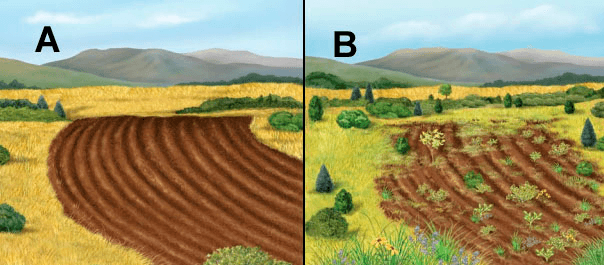
What type of succession is shown going from figure A to figure B?
a)
primary succession
b)
ecological succession
c)
secondary succession
d)
intermediate
16.

What is the order of succession shown in this figure?
a)
A, B, C, D
b)
B, A, D, C
c)
C, D, A, B
d)
D, A, B, C
17.
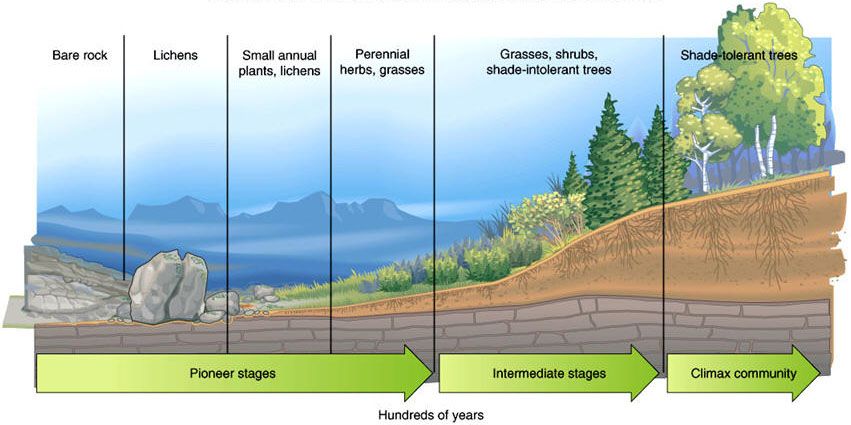
The picture shows what type of succession?
a)
primary
b)
secondary
c)
tertiary
d)
quadanary
18.
What property of water makes it the 'universal solvent'?
a)
it is a polar molecule
b)
it is an ionic compound
c)
it contains hydrogen bonds
d)
it steals electrons from other atoms
19.
Carbohydrates are made of...
a)
C H O
b)
C H O N
c)
C H O N P
d)
C H O N S
20.
Which group of organic molecules serve as long-term energy storage and waterproof coverings?
a)
proteins
b)
carbohydrates
c)
lipids
d)
nucleic acids
21.
Proteins are composed of what smaller subunits?
a)
amino acids
b)
nucleic acids
c)
fatty acids
d)
nucleotides
22.
Also known as simple sugars, these are the carbohydrate monomers.
a)
lipids
b)
nucleotide
c)
monosaccharide
d)
monomer
23.
What happens to an enzyme when it is exposed to high temperature and pH?
a)
the enzyme stays the same
b)
the enzyme is denatured
c)
the enzyme creates sulfur-sulfur bonds
d)
creates amino acids
24.
Enzymes belong to which group of organic compounds
a)
carbohydrates
b)
lipids
c)
proteins
d)
nucleic acids
25.
What does an enzyme act on directly?
a)
amino acids
b)
catalysts
c)
substrates
d)
proteins
26.

Attractions between water molecules are called
a)
Covalent bonds
b)
Ionic bonds
c)
Polar bonds
d)
Hydrogen bonds
27.

A Compound that is being dissolved is called a
a)
Solution
b)
Solute
c)
Solvent
d)
Suspension
28.
Which is the monomer (building block) for nucleic acids?
a)
amino acid
b)
fatty acid & glycerol
c)
nucleotide
d)
monosaccharide
29.
Which is not a use or function of protein?
a)
forms enzymes and hormones
b)
forms transport channel in cell membrane
c)
forms structural proteins in the body
d)
quick energy
30.
A(n) ______ ____ is the part of the enzyme the molecule fits into.
a)
product
b)
active site
c)
enzyme
d)
substrate
100 %

